Tuesday, 5 July 2016

Tennis Games on Atari consoles - Wimbledon Special: Part Two

In the second part of our Wimbledon special, we look at more digital versions of tennis. Today we go through the games that appeared on Atari's consoles, from the Atari VCS all the way up to the Atari Lynx. We tee off by revisiting the Atari VCS.

Tennis Games on the Atari VCS/2600

Atari's wooden box played host to hundreds of games, most of which bore little resemblance to, um, anything. Still, it attempted to replicate tennis and the sport featured in three games. It probably featured in more, but I don't know what they are. Here are the three games that I do know.

Video Olympics - Atari (1977)
Video Olympics was one of the launch games for the Atari VCS. It was basically Pong on a cartridge, with 50 variations on the theme which apparently mimicked such sports as football, basketball, ice hockey and, of course, in its simplest original two-bats-and-one-square-ball mode, tennis. Tennis without a net but with bouncy walls. At the time, there were countless consoles that played clones of Pong, with switches and dials and stuff to change the parameters of the game. Video Olympics was probably a way of Atari ensuring that its new VCS console was at least able to offer whatever was already on the market in one tidy package, providing pretty much every variation of Pong conceivable. The problem was, even in 1977, Pong and its many mutations were already old and dated. This game will provide some nostalgia value for, oooh, two minutes. Then you'll wonder how the video game industry ever got off the ground. Still, it's not too bad with two players.

Beep. Beep. Beep. Deep sounding beep. Who needs sound effects when you can have subtitles?


Tennis - Activision (1981)
This is the first game on the Atari VCS to look like a real tennis game, getting released two years before the next one. It's fun at first but gets tedious very quickly. You can't swing your racket, meaning that it's a simple case of getting your player to be in the same place as the ball in order to return it. Unless you are able to catch the ball at the end of your racket, it ends up going straight back to your opponent which results in endless games. A good first attempt to bring tennis to the masses, but it hasn't stood the rest time. You can play it for yourself in your browser through The Internet Archive's online console service. 

Pink is beating blue. Gosh.

Realsports Tennis - Atari (1983)
 
Atari attempted to recreate tennis using a viewpoint which is still favoured today. They also even attempted to give you the ability to influence the kind of shot that you were trying to pull off, not that it really worked that well. This is actually a fairly fun game but like a lot of VCS games today, it gets boring pretty quickly. The graphics are quite good, although the music sounds a bit like somebody has been pressing random keys on their Casio keyboard. It is quite surprising that it took Atari until 1983 to release a tennis game for their console, five years into its life. Realsports Tennis is easily the best tennis game for the Atari VCS, but that's not saying much seeing as there are only three, and one of those is Pong.

Those rackets look like the player's arms have come out of their sockets

Tennis Games on the Atari 5200
 
So, fans of tennis weren't too well served on the Atari VCS. What about the console's successor, the Atari 5200 Super System? Well, things got worse. There was just the one tennis game released for it. And that was.....

Realsports Tennis - Atari (1983)

This game is called Atari. No, Tennis. Realsports Tennis
In addidtion to its release on the Atari VCS/2600, Realsports Tennis also appeared on the Atari 5200, a game designed to make use of the console's "fantastic" controller. You controlled your little man using the joystick, but aimed your shots using its number pad. Needless to say, the game is pretty much unplayable. You could ignore the keypad and just use the joystick. This just results in you having a playful knockabout with your opponent with never ending relays. Not quite as exciting but far less frustrating, although it's unlikely you'll ever win a point.

This looks like an exciting game

Tennis Games on the Atari Lynx

Oh well, seeing as nobody actually owned an Atari 5200, the fact that Realsports Tennis was so bad wasn't that significant. The Atari 7800 did even worse. It didn't even have a tennis game. Nor did the Jaguar. The Lynx did though. In 1993, Jimmy Connors popped up on Atari's rather splendid little battery guzzler.

Jimmy Connors Tennis - UBI Soft (1993)

Hey Jimmy. I still don't know who you are
Jimmy Connors's Tennis on the Lynx wasn't a bad little game. It lacked a lot of the realism of the SNES equivalent, opting for simplicity and accessibility instead. There are some frustrating elements to the game. Missing your serve results in a fault and you never get to serve from the far end. Not great, but not major criticisms. The graphics are good and the game also features some nice sampled speech. Of all of Atari's consoles, this is easily the best tennis game for them. That's not saying much though.

Not too sure what that yellow square is but it looks out of place on a tennis court.
 

Monday, 4 July 2016

Tennis Games on the Super Nintendo - Wimbledon Special: Part One

It's that time of year when the world's greatest tennis players gather at the All England Club in London to take part in the most famous bat and ball tournament of them all - The Wimbledon Championships. I quite like tennis, but unfortunately I'm not very good at it. It's highly unlikely that I'll ever find myself on Centre Court at SW19 in my PE kit with my racket and balls. But, I don't want to feel left out, so my plan is to partake in a few games of tennis from the comfort of my settee. Oh yes, I'm going to play a few tennis video games. All on one machine to compare and contrast. And the machine on which its tennis games are going to be rigorously compared and contrasted is the good old Super Nintendo. And first to the bat is Andre Agassi.

Call me Andre
Andre Agassi Tennis - Tekmagik (1992)
Agassi was one of tennis' biggest stars in the 1990s so it was inevitable that he would pop in a video game based on the sport. Andre Agassi Tennis was released on the SNES in 1992 and is quite a simple version of the game. It all looks a bit plain and feels a bit rough around the edges. Gameplay comes to a sudden stop after each point is won and the controls could have done with a bit of refining. It's a functional version of tennis, but a bit dull.

New balls please

Nice motion blur effects there. Just lovely
David Crane's Amazing Tennis - Absolute (1992)
How do you convince the public that your game is worth playing? Why, call it amazing of course. That'll trick them. Just like Sega and their "Great" sports game series for the Master System, most of which were turds. Despite what the titles says, David Crane's Amazing Tennis isn't amazing.. It looks and sounds fantastic, and initially it seems to control ok. But, it has one major problem. The court is viewed from a low perspective. Although this does immerse you more in the game, it makes it difficult to judge the depth of the court and to know where the ball actually is, especially when you're on the far end. You also don't have full visibility of the width of the court, which makes it hard to make use of all of it. Sometimes, your player isn't even on the screen as the camera follows the ball, not the player. It's nice to see developers attempting something different, but there's a reason why most tennis games use a more traditional angle.

FootLocker!


Starring a little person on his lonesome
International Tennis Tour - Taito (1993)
Another game which uses a low perspective, although not quite as low as David Crane above. The court is also viewed from a distance, which gives better visibility of the gameplay, even if it makes the court look tiny. This is actually quite a fun game, and is much more forgiving than other tennis games, perhaps a little too forgiving. You somehow manage to pull off shots even though it clearly looks like you've missed the ball. The ball also seems to float over the net which makes things a bit easier. Worth having a look at if you're after an arcade-style tennis game.

A close game between Carter and Iston


Is it bad that I've never heard of Jimmy Connors?
Jimmy Connors Pro Tennis Tour - Ubi Soft (1992)
If it's realism you're after, Jimmy Connors Tennis is the game for you. You can perform all kinds of shots with the many buttons available on the SNES controller, although I'm not too convinced that you're fully controlling what's going on. It isn't the most attractive of games to look at, but it plays a good game of tennis and has a surprising amount of depth. To get the most out of this game though, you do need to invest time and effort into it. It's not immediately accessible and getting to grips with the controls isn't easy.

Whoosh! 113 MPH!! You can really sense the speed in this screenshot

Super. Just Super
Super Tennis - Nintendo (1991)
The earliest tennis game on the Super Nintendo, and easily the best. Super Tennis shows off some of the then-new console's 3D abilities, but these don't interfere with the game. The controls are responsive and the multitude of shots that you can pull off with the variety of the buttons feels natural. The game doesn't bog you down with statistics and options and suchlike. Instead, it just plays a great fun game of tennis. Super Tennis probably remained untouched as the best console tennis game until Virtua Tennis hit the Dreamcast ten years later.

Quick! Run away from that ball!

Wednesday, 27 April 2016

Super Mario Land - Nintendo Gameboy review


It'sa me!!!
Game: Super Mario Land
Format: Nintendo Gameboy
Developer: Nintendo
Publisher: Nintendo
Year Released: 1989
Also Released on: Nintendo 3DS (via Virtual Console service)
Now Available on: Nintendo 3DS (via Virtual Console service)


If there's one thing you can be certain of in life, it's that within milliseconds of Nintendo releasing a new console, Mario has somehow got his mug onto some game for it. The Nintendo Gameboy was no exception, with our drainpipe dwelling friend making his miniature presence known in the 1989 game, Super Mario Land, before you had chance to say "Itsa me!" As with Super Mario Bros. on the Gameboy's bigger brother, the NES, Super Mario Land was a platforming affair, with Mario whizzing around levels, bouncing off enemies, headbutting boxes, collecting mushrooms, throwing balls of something or other, defeating enemies and rescuing princesses. But, although the formula remains the same, Super Mario Land does represent a slight departure from the norm.


Does Daisy have a moustache?
As per usual, Mario is on a mission to rescue a Princess. But, this time around it's not the perpetually kidnapped Princess Peach that needs rescuing. Instead, Princess Daisy is the royal one who has got herself into a predicament of the being-held-hostage variety. Holding her prisoner is some evil being from space called Tatanga. Presumably Bowser, who is absent from this game, only has eyes for Peach so is happy for somebody else to kidnap other princesses. Unlike most Mario games, which take place in the Mushroom Kingdom, the action in Super Mario Land takes place in neighbouring Sarasaland, which is apparently a Kingdom made up of four countries. So it's similar to the United Kingdom in a way, only with better weather, fewer pubs and no Tescos. In fact, the whole universe of the Mario games could be some sort of commentary on contemporary geographical politics. The Mushroom Kingdom could be continental Europe. Sarasaland could be the UK. And, um, I don't really know where I'm going here so I'll go no further with my theory.

I really can't think of anything to add here

Princess Daisy is the ruler of Sarasaland (surely she should be Queen Daisy), but as she's got herself kidnapped, it means that Tatanga is able to take control of the kingdom and do whatever the evil things are that evil space beings do. Urgh! That's a horribly written sentence. Maybe I'll rewrite it one day. Threatening to put a stop to Tatanga's evil deeds is good old Mario, on hand to defeat him and rescue Princess Daisy. When does he ever get chance to do any plumbing? He's either got a very understanding boss, or he works for himself. It's no wonder he has to keep appearing in video games. He's got to pay the bills somehow.


That's an impressive nose you have there
The game takes place over four levels, each with three sub levels with a boss at the end of the third. Each level represents one of the four countries of Sarasaland which, according to legend (AKA the internet), are named Birabuto, Muda, Easton and Chai. Birabuto is modelled on ancient Egypt, Muda is inspired by some place called Mu, Easton is based on Easter Island and Chai is influenced by China. Now, you may have heard of Egypt, Easter Island and China, but where in the world is Mu? Let's find out. Ooooh, who'd have thought that a review of Super Mario Land would turn into a geography/history lesson? Not me, that's for sure.


So, Mu. According to the 19th Century explorer Augustus Le Plongeon, whose name translates as Gus the Plunger (perhaps not), Mu is a lost continent. Le Plongeon claimed that, once upon a time, Mu was located in the Atlantic Ocean. Refugees from Mu went to places like Egypt and central and southern America, resulting in the development of the Egyptian and Mayan civilisations in their respective locales, explaining their similarities despite their physical distances. Other "experts" believe that Mu was located in the Pacific Ocean, and was the common origin of civilisations that sprouted up all over the world. Wherever it was located, and whatever influence it had on the rest of the world, for some reason or another, it sank into the sea and has never been seen again. Poor Mu.


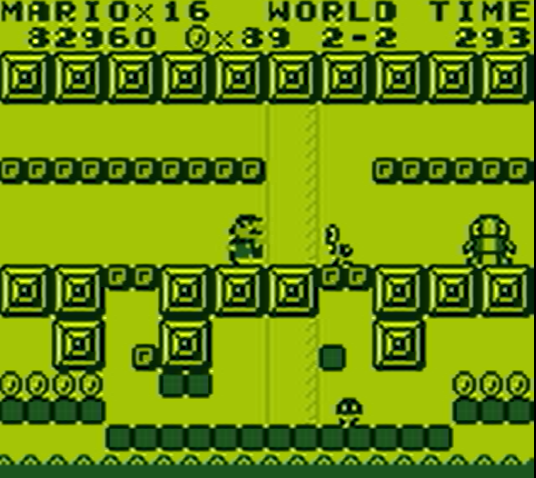
My head! I really need to find a better way of opening up these secret boxes!

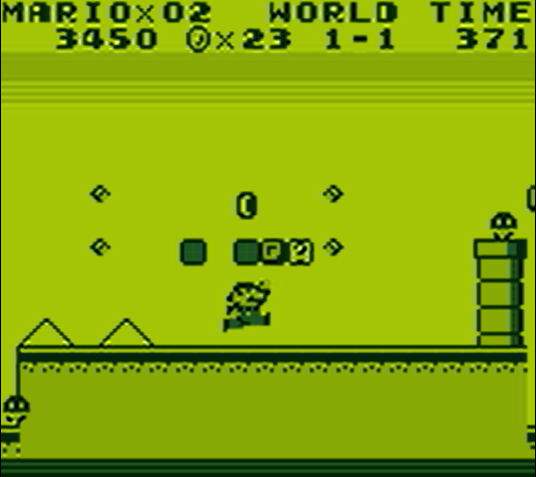
100 points for pounding an enemy into the ground. Great!
Right, back to Super Mario Land where Princess Daisy is still being held captive and Mario hasn't even begun his adventure yet because I've been going on about made up places. Gameplay in Super Mario Land is mostly very similar to that of Super Mario Bros. for the Gameboy's bigger brother, the NES. Mario must go from left to right to reach the end of each level. He can travel at two speeds, going faster by holding down one of the two controller buttons. The other button makes him jump, with his jumps being higher and longer if the "run" button is being held down too. Mario can bang his head into blocks scattered all around the levels. Blocks marked with question marks contain coins, power ups, extra lives or invincibility stars. The first power up is a mushroom which causes Mario to grow, enabling him to smash up blocks that are made out of bricks, sometimes revealing extra goodies but usually just to satisfy his destructive tendencies. Or to clear a path. Being bigger also gives Mario an extra layer of defence, allowing him to come into contact with an enemy without dying. Instead, he just shrinks down to his tiny self.


As per usual, Mario has two modes of attack. He can jump on enemies or throw things at them. When Mario is at his tiniest, he is only able to defeat enemies by jumping on them. He gains the ability to chuck stuff after gaining the mushroom power-up to make him bigger, and then collecting a flower power-up. Mario can also use his throwing power-up to collect hard to reach coins. This is particularly handy in some bonus areas.


Coins coins coins!


Best bonus level ever!
Oh yes, Super Mario Land includes a number of bonus areas. These are usually found by going down some of the pipes that are a feature of all Mario games. It makes you wonder what the pipes are actually for. Did somebody over order them when they were setting up Mushroom Kingdom and Sarasaland’s drainage network? “’Ere, gaffer. We’ve got a shitload of pipes left over. What do you want me to do with ‘em?” “Oh, just stick them in random places in the ground. Nobody will notice them. And that dickhead plumber who never seems to get any work done will probably fall into them. He’s absolutely useless. I’m still waiting for him to fix the flusher on my shitter, but he’s either chasing after a bit of skirt from the palace who’s got herself kidnapped, go-karting somewhere, playing tennis, or just generally not doing what he should be doing. His brother’s no better. And they call themselves Super. Somebody needs to report them to Rogue Traders. They’re nothing but a pair of fraudsters.”


Ahem. So, yes, there are plenty of pipes all over the place, and Mario can go down some of them to enter bonus areas. They mostly contain coins, sometimes a power up or two, and little else. The only problem is that, to find them, you usually have to try each pipe, until you come to the one that you need. Obviously, multiple plays will result in you memorising which ones contain the bonus areas. Some pipes also contain enemies popping out of them.


Extra Lives! Get yer extra lives here!
There are also various parts of levels containing secret areas, usually at the very top of the screen, above the display itself. These will often contain more coins and power-ups, and sometimes serve as an easier route through the level as they’ll avoid you having to take on enemies. Getting to them isn’t always easy or obvious, but it gives you a bit of something to do if you fancy it. Finally, if you haven’t managed to accrue enough bonus items throughout the levels themselves, you can also enter a bonus room at the end of each level where you have to stop a rapidly flashing Mario (dirty pervert) on one of four platforms. At the end of each platform is a bonus – usually lives, sometimes a flower. Mario will collect whatever lies at the end of each platform, although his route may get altered by the presence of a ladder. It’s a bit like Russian Roulette, only not quite as exciting. Or deadly. As you can probably gather, it’s fairly easy to build up a load of lives, either by collecting enough coins (100 will do it), or 1-ups themselves.


Who need R-Type when you have this?
In fact, the whole game itself is easy. It’s perhaps the easiest Mario game there is, and can be completed in about half an hour. End of level bosses don’t really pose much of a challenge at all. But, although it’s easy, it is fun. Lots of fun. Mario is a delight to control, and whizzes around the levels like a little flea. Breaking up the platforming elements are a couple of levels where Mario takes to the skies in a little plane to shoot down enemies. Again, these aren’t difficult levels, but they are fun. And this is one of the things that keeps bringing you back to the game. It isn’t one of those games that you play, complete, and never return to. You’ll find yourself returning to it time and time again, either to perfect your route, find all of the secrets, get a higher score, achieve a speed record. The game lends itself perfectly for all of these challenges but is also great if all you want is to enjoy a quick half an hour of quality platform gaming in its purest form.


Die Tagana!!! You're no Bowser!
Of course, the game was originally designed for a handheld console. But, it really does feel like a portable fully-fledged console game. The graphics are fairly minimal, but perfectly reflect the land on which each level is based, and the music is great with some fantastic and memorable little tunes. One of the tunes was even turned into a dance track and made it onto the hit parade. I remember watching it on Top of the Pops. Or was that Tetris? Perhaps both. Sound effects are also well-suited to the game. On the original Gameboy, due to the speed that the levels scroll, there was a bit of ghosting and motion blur, but this never really affected gameplay at all, and isn’t a problem when played on modern machines.


If you have a Gameboy, there’s a good chance that you already have this game as it is one of the must-own titles for the console. If you don’t have it, or you own anything that can play Gameboy games, you need to get this game. You need it. Show it your kids and grandkids. Show them this is what we did when games were in black and white. Or black and yellow.


RATINGS
Presentation – 80%
Typical Nintendo polish throughout. Nothing too exciting.
Graphics – 81%
The sprites are quite small and the levels are quite sparce, but they feel just right for the game, even though they feel a little non-Mario-ish.
Sound – 85%
Some fantastic tunes, unique to this game, and accompanied by familiar and suitable sound effects.
Playability – 86%
Playable from the moment you get going, simple and easy to pick up with plenty of variety.
Overall – 85%
The game became a classic from the moment it was released. It isn't the hardest of games, but was the perfect title for Nintendo's then-new handheld.

PLAYTHROUGH VIDEO
See the game from start to finish here


Saturday, 2 January 2016

Back to the Future Part III - Sega Master System review

Hehe. Probe.
Game: Back to the Future Part III
Format: Sega Master System
Developer/Publisher: Probe Software/Image Works
Year Released: 1991
Also released on: Commodore Amiga, Commodore 64, ZX Spectrum, Amstrad CPC, Atari ST, PC, Sega Mega Drive/Genesis

Now available on: Nothing


On 29th October 2015, we officially entered the future. That was the date that Marty McFly time travelled to in the 1989 movie, Back to the Future Part II. To celebrate the fact that the present is now the future, or the future is now the present, I’m going to treat myself to a hoverboard. I believe Amazon are trying to shift a few. Conveniently, this event also brings me onto this review. It’s not of Back to the Future Part II though, as I played that game as a youngster and it wasn’t a pleasant experience. Instead, it’s of Back to the Future Part III.

Hmmmm, I think I got away with using that slightly tenuous link to introduce this review.


Nooooooo!!!!
Back to the Future Part III is a game that typifies everything that was wrong with games based on movies, games that were released just to cash-in on a lucrative film license. It was released on a variety of computers and consoles in 1991, including the Sega Master System. And rather coincidentally, it’s that version that I’m reviewing here.
I’ve never actually watched the movie in full, which is quite an achievement seeing as it seems to be broadcast every other weekend on ITV2, in between Jurassic Park and Scooby Doo. I have caught bits of it though - some of the end, some of the beginning, some of the middle. I get the general idea that it involves Marty going back to wild wild west times to rescue Doc Brown in the past, and there’s a bit involving them needing to get their car fixed to get back to the future. Or was that the first film? Could be both. After playing this game, I don’t think it matters at all whether or not you have seen the film. It appears to be loosely based on three scenes from it.

Yes, three scenes. That’s all. And each scene depicted isn’t spread across multiple levels. You just get one level for each scene. If you’re any good at mathematics, you’ll have probably worked out that this means that the game contains only three levels. Three levels for £25, or whatever it cost for games back then. A bargain. In modern money with inflation, tax rises and suchlike, that’s probably about £180 now.

But, it might just be that those three levels are three of the best levels in any game ever made. In which case, it doesn’t matter that there are only three of them. They are so great that you can play them over and over again and indulge in their quality for all of eternity. Unfortunately the reality is that they’re all a bit shit.

Bang bang. That reminds me. Has Chitty Chitty Bang Bang been on this Christmas?


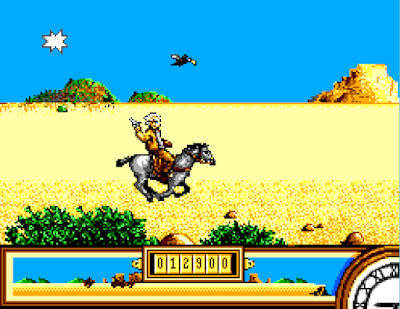
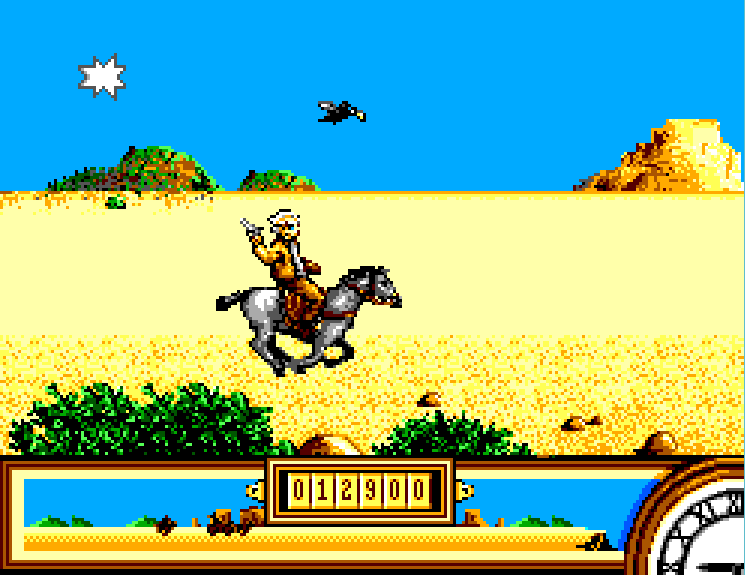
Level one sees you controlling Doc Brown on horseback as he chases after some woman called Clara who appears to be getting dragged away in a horse and cart. It’s called a buckboard according to the game. To prevent her from being dragged over the edge of a cliff, Doc must catch up with her by leaping over hazards or shooting anything dangerous-looking, like cowboys and birds. He can also collect items, although I haven’t got a clue what any of them actually are or what they do. This level is extremely tough as you don’t have time to react to the appearance of an enemy. Instead you have to remember what’s coming up by playing the level over and over again. Additionally, the controls require you to jump at exactly the right moment over chasms and hazards to avoid your horse coming to a sudden stop and flinging you over his head. Eventually you’ll get it, but it makes the level more a test of memory than of skill.
That's for stealing my steak bake. And don't think you're getting away so easily either, other birdy.


A little box at the bottom of the screen displays your progress in your rescue attempt of Clara, but you only appear to need to get half way across the display to complete the level. Either the programmers got bored and decided to end things at that point, or they forgot to come back to add the second half of the level to it. Whatever happened, it’s probably not a bad thing that such a horrible level appears to be over prematurely.


Plate tossing fun ahoy
Level two puts you in the time-travelling shoes of Marty McFly. It features a wild west shootout where you have to take on gun-toting cowboys by throwing plates at them. They might be custard pies, but whatever they are, controlling Mr McFly is a chore. His movement is very clunky, with the isometric layout of the level not making it easy to figure out which way to direct him. You seem to be able to apply some sort of swerve to your plates, but this only ever appears to result in them flying in every direction but the one that you want. The trick is to work out the correct place to stand and then throw your plate straight at your target. There are six enemies to take out with your crockery, with each requiring two well-aimed shots to do so. After you’ve done that, some bloke comes out of the saloon doors, firing badly at you. A few more plates in his face and he’s defeated too.

Duck! Not you. The ducks. You stay standing, I've got to throw a plate at you!


Yawn
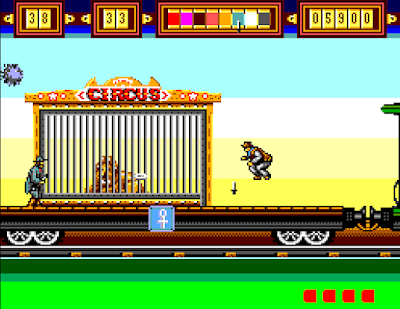
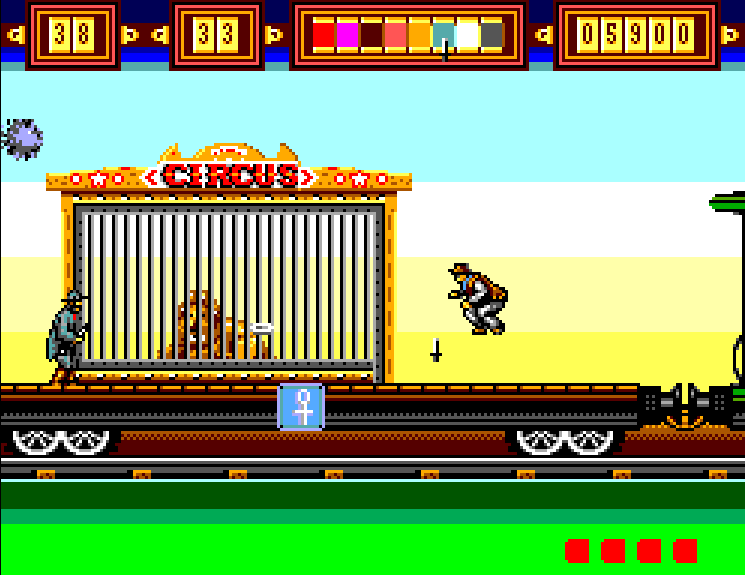
Onto level three, in which you, as Marty again, must make your way along a speeding train, picking up what I assume are parts for your car to get it up and running again. They look like little bars, so they’re probably something for your car’s flux capacitor, or whatever it’s called. They all add 11 points to a counter at the top of your screen, so when you get eight of them, you have 88 points, which I guess represents the 88 miles per hour that the Delorean needs to reach to be able to travel through time. Making things harder for you are a choice selection of baddies. You can take them out by throwing more plates at them. Where Marty is keeping these plates, and why he seems to think they make good weapons, is a mystery to me. Maybe it’s explained in the film. Perhaps I should watch it so I can make sense of such things. If you’re not into throwing plates at people, if you time the collection of the car parts correctly, a whiff of smoke comes from the train and takes your enemies out for you. Time is very tight on this level, so it’s important to get the job done as quickly as possible. Again, the controls aren’t the most responsive, with it being all too easy to jump at the wrong time, misfire, or just completely fall off the train.

What are you doing lion around there? Get it? Lion? Lying around! Never mind.


Ooh, the number 131. I'll mark it off my trains in games spotting list
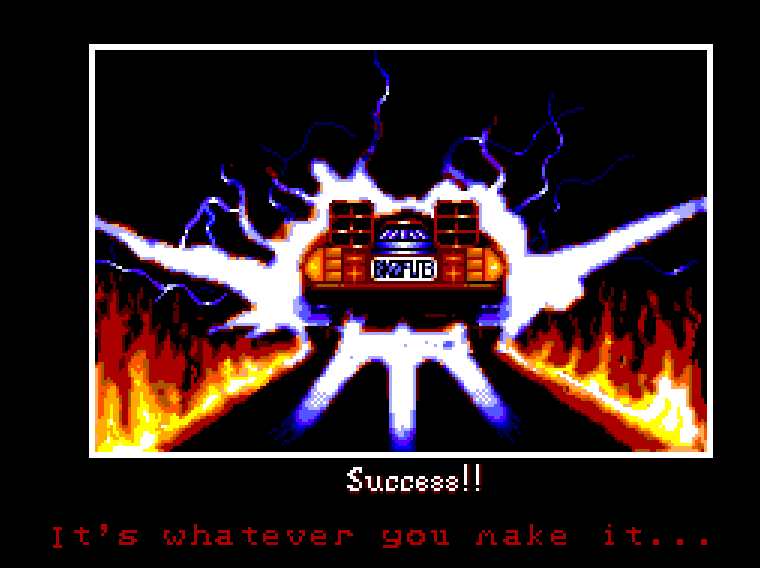
Once you’ve got all of the bars and made it to the front of the train, that’s it. No end of level boss, no big climax. You’re done. The game is over. You’ve made it. Fini. The ending contains some sort of semi-inspirational message about nobody’s future being mapped out for them and to make of life what you will, the likes of which you see in badly-compressed images that people share on Facebook. Sometimes with Minions. There’s a picture of the Delorean flying off into the future too, and a bit of music. It’s not much of a reward, but I suppose seeing as it only takes you five minutes to get to it, you probably don’t deserve any more.


Drama! Action!
Graphics aren’t actually too bad for this game, comparing quite well to some of the 16-Bit versions of the same game. They portray the film’s wild west setting quite well, although that only really entails using a lot of the colours yellow, orange and brown. A modified version of the Back to the Future theme and the rest of the music is bearable but forgettable, and sound effects do their job. But the main problem is that the game is just too short, and isn’t enjoyable to play anyway. Level one is a memory test, level two hardly requires any skill, and level three is a case of leaping from one carriage to another, shooting enemies and collecting bars, being similar to what you’d expect the first level of a game like Shinobi to be, only more frustrating. The levels just feel like a series of mini-games, which was an all-to-common way of adapting movies to video games. The sluggish controls detract further from any fun that can be had with this game.
Don't mind if I do Mrs Patmore


Bizarrely, from memory this game appeared to be quite well-received on its original release. I’m know that the video game versions of Back to the Future Part II were panned by critics, and rightly so because it’s garbage, but this one seemed to be more highly regarded. I don’t know why though. It’s awful. If you’ve got five minutes to spare, do anything but play this game. Phone your mum, make a cuppa, read another article on this website, sit and meditate, find pleasure in your own company. Anything but this.
Like and share if you agree.
 

RATINGS
PRESENTATION: 65%
A lengthy introduction of still images and text explains what’s going on, with similar intermissions between levels. The scenes are quite well-depicted in these bits with characters looking quite similar to their movie counterparts.

GRAPHICS: 76%
Large sprites and detailed screen layouts which reflect the game’s themes quite well, although it’s not always clear what some things actually are.

SOUND: 56%
Forgettable but inoffensive music. Sound effects are nothing special too.

PLAYABILITY: 33%
Frustrating from the start, a pain to control and, when you’ve mastered it, you can play through it in five minutes, less if you skip through the cut scenes.

OVERALL: 36%
The definition of the phrase “lazy tie-in”. Just three short unenjoyable levels which are an insult to gamers and fans of the film. The only thing I gained from it is learning what a buckboard is, and I’m not even sure if the word was made up for the film or is a real word.


Can't be bothered the five days until ITV2 are due to show another repeat of the film? Watch me play through the game. It's almost the same thing, but only five minutes long!
 

Saturday, 28 March 2015

Snapper - Acorn Electron Review

It's Pac-Man but not as we know it
Game: Snapper
Format: Acorn Electron
Developer/Publisher: Acornsoft
Year Released: 1983
Also released on: BBC Micro
Now available on: Nothing

The eighties was the golden age of arcade games. It was also the golden age of clones of those arcade games. These clones usually appeared on home micro computers when developers and publishers weren’t able/couldn’t be bothered to obtain the rights to do an official version. Snapper was the first cloned game that I ever played. A “conversion” of Pac-Man for the BBC Micro and Acorn Electron, Snapper was as spot on as you get. As I was the lucky owner of an Acorn Electron, it was the version for that that I played. Over and over and over again. I’ve still got it somewhere. I also think it was the first game I played on that computer, after ploughing through what seemed liked thousands of programs on the Introductory Cassette. I was blown away by the little introduction on that, by how the letters spelling out Acorn Electron flew onto the screen and then an acorn appeared. Still impresses me now.

Before I played Snapper, I don’t think I’d ever played Pac-Man. Of course I knew of Pac-Man. I received my Electron for Christmas 1985, so Pac-Man was already out of nappies and just starting school. He was the first big video game personality, so kids like me would have had an awareness of him. So in a roundabout way (I know that’s a proper phase – it appeared in my recently uploaded YouTube video of Wheel of Fortune), Snapper served as my introduction to Pac-Man. Apologies for the shameless plugging of my YouTube channel there. But it’s well worth a visit.

Loading screen! Get yer loading screens here!
While waiting for Snapper to load, you aren’t treated to anything extra special. Just the typical Acornsoft loading screen. The game was rereleased by Superior Software at some point, so that version might have a different loading screen. It’s also won’t be anything special though. Sometimes this is a good thing. I owned a number of games where it seemed like the first half an hour of waiting for it to load was for it to display a loading screen. Yes, Commando, you were one. And Superior Soccer. Wow, that was a shit football game. Loved it at the time though.

Once Snapper has loaded, you are presented with a basic but functional intro screen, giving you a guide to the keys to press to make your little Pac-Man clone explore the clone of the famous Pac-Man maze. Also displayed are the keys to pause and reset the game, as well as turning the sound on and off. And the key to start the game. Unless you like staring and static screens, I’d advise you to press the key to start the game. This is either the space bar or, if you’re lucky enough to own a joystick, the fire button on it. I had an Acorn Electron joystick. It was probably the worst joystick ever invented.


That reminds me. I need to get another house key cut.


Fun-filled dot-collecting frolics
After the screen has loaded and has been populated with dots, power pills, ghosts and Snapper himself, a short intro melody plays. Not the Pac-Man melody, but you can figure out where they got the inspiration from for it. And then it’s on with the game. According to fokelore, in a very early release of this game, Snapper looked identical to Pac-Man, and the ghosts looked identical to the Pinky, Perky, Inky, Blinky, Bonnie, Clyde and Bluey, or whatever their names were in Pac-Man. It appears that this infringement of their IP wasn’t appreciated by Namco, so the characters’ likenesses had to be changed. Wonder why they didn’t seem to mind that the rest of the game was so obviously ripped off from their arcade original? Hmmm, anyway, so the Snapper that everyone with an Acorn computer came to know and love featured a Pac-Man lookalikey with legs and a hat. The ghosts grew legs and arms. If folklore is true, an original copyright infringing Snapper is probably worth a fortune now. Probably.


Snapper on the BBC before Namco noticed one or two likenesses with one of their games. 
As a copy of Pac-Man, the idea of Snapper is simple and is known by millions around the planet. Just in case you’re not one of those millions, in this game you have to guide your character around a maze, collect dots and avoid ghost people. If you come into contact with one, you lose a life. But you can collect power pills (bigger dots) and chase after the ghost people who will now have all turned dark blue, highlighting their vulnerability. Catch one, and their eyes float black to the base in the centre of the game to be stripped of whatever voodoo it is that makes them blue and vulnerable. They return to their original colour and become fatal to the touch again. Collecting one ghost gives you 200 points, a second gives you 400, a third gives you 800 and a fourth gives you a whopping 1600 points. Of course, while the ghosts are running scared, you can use this time to collect as many dots as you can instead of chasing ghosts. The choice, as they say, is yours. That’s about it. Every now and again, a fruit appears towards the centre of the screen. Collect it for bonus points, or ignore if you don’t feel hungry.

Snapper has a choice of ghosts or cherries to gobble. Looks like he's going to go for the cherries. I don't blame him.
The beauty of Pac-Man, and this very faithful clone, is that everybody has their favourite way of playing it. Do you clear each quarter one at a time, collecting the power pill as you reach the end of the quarter and go to the next one? Or do you clear as much of the screen as you can and leave the power pills for last? Or do you just go gung-ho and go for whatever dots you can see? Or keep away from the ghosts as much as you can and take your time around the level? Or lure the ghosts towards you, grab a power pill and then scarper? It may be that you tactics change each time you play, or the further you get into the game.

Woo-hoo!
Yes, it’s a simple game, basically a virtual version of tig, or tag, or kiss chase – although without the kissing. It gets tougher as you go on. The ghosts, who leave you alone for much of the earlier levels, become more aggressive and home in on you, and the length of time they are vulnerable after collecting a power pill gets shorter and shorter.

Of all the home conversions and clones of Pac-Man that I’ve played, Snapper is perhaps the closest to the original. It gets the feel of the arcade game just right, even with the change in character design. Snapper moves responsively around the levels, which are splendidly reproduced with their blue walls and not-so-secret tunnel all present and correct. The ghosts may have different pre-defined routes in Snapper than their Pac-Man equivalents, but the way they all have individual characteristics remains the same.


We're at the top! 

There isn’t a lot to say about the sound. Apart from the short pre-game melody, the only noises you get are from collecting dots, fruit and power pills, and a siren when you’ve collected the latter while the ghosts are vulnerable. The siren rises in pitch as the power pill gets closer to losing its magical and mythical powers.

Whether you will like Snapper will be down to whether you like Pac-Man. It’s a fantastic clone of the game, adding nothing new to it. Some changes had to be made just to keep Namco off Acornsoft’s backs, limited just to character design and sound. The only things missing from the Pac-Man arcade game are the intermissions between levels. But other than that, this is just Pac-Man in a different outfit. And mighty fine it is too.

RATINGS
Presentation – 50%
Acornsoft’s earlier games were known for the lack of anything resembling a bell or a whistle. The loading screen features Acornsoft’s logo and the title of the game, and the title screen is white text on a black background with a list of keys. It’s hard to fault it though as it does the job.
Graphics – 78%
The graphics really do bring the arcade game to your portable TV. The maze is blue, the ghosts are all different colours, Pac-Man, sorry, Snapper is yellow. And it’s fairly clear to work out what the fruits are too. Most of the time.
Sound – 75%
Like Pac-Man in the arcade, there is no music in this game apart from a short pre-game melody, but there are suitable sound effects that play throughout the game.
Playability – 76%
Instantly playable, with tight responsive controls. The game runs at a good speed and really does feel like an arcade game.
Overall – 76%
As close as you’re going to get to Pac-Man at home on a retro machine without having your own arcade cabinet in your bedroom. A really good clone of a classic arcade game. Of course, if you don’t like Pac-Man, you won’t like this. 

YOUTUBE VIDEO
Here's Acorn Electron Snapper in action