Wednesday, 18 February 2015

The Legendary Axe II - PC Engine/TurboGrafx-16 Review


That's a weird looking axe. It's as if it can't decide what
it is. Am I an axe or a sword? I'll be both.
Game: The Legendary Axe II
Format: PC Engine/TurboGrafx-16
Developer/Publisher: Victor Interactive Software/NEC
Year Released: 1990
Also released on: Nothing
Now available on: Nothing

In a land dominated by home microcomputers back in the 1980s, it took a while for the console gaming market to really take off in the UK, and indeed over in the rest of Europe. Although Atari, Mattel and Coleco had all had a European presence since the dawn of the console industry, their machines were never really a threat to the mega-popular computers from Sinclair, Commodore, Amstrad and Acorn. It was only towards the end of the decade that things began to change. The Sega Master System and Nintendo Entertainment System both began to take some slices out of the home gaming pie as console sales started to pick up. Not wanting to share the market that they still dominated, Amstrad and Commodore attempted to release console-ised versions of their computers, the doomed Amstrad GX4000 and the equally ill-fated Commodore 64GS. For a variety of reasons, nobody was interested in them. Instead, they were looking to the future, to new more powerful consoles that were making their way from foreign lands in the East: the Sega Mega Drive, the Super Famicom, and the PC Engine.

Except, it seemed, that the manufacturers of these new machines of wonder weren't in any rush to get them over to Europe. After Europe had all but shunned consoles for much of the eighties, it seemed that Europe would remain at the back of the queue to get the shiny new machines. Sega and Nintendo held off launching their new machines for quite a while. The Sega Mega Drive finally made it to Europe in Autumn 1990, two years after its initial Japanese release, and the Super Nintendo didn't make it here until Spring 1992, almost two years after its release in Japan as the Super Famicom. But what about the PC Engine? Well, it appears that NEC, the company behind the tiny little console, weren't really that interested in the the European market at all, and didn't even release it over here. There was apparently a PAL version manufactured and distributed in very small quantities, but it hardly counts as an official release. Nope, if you wanted to play the PC Engine in Europe, you had to import one. So, why was this continent overlooked by NEC? And what did we miss?

The PC Engine was NEC's first console, and it was in their home market that they initially partook in battle. The console was released in 1987, and their first opponent was Nintendo. The 8-bit Famicom (NES for westerners) had dominated in Japan for a few years by then, but was beginning to look old. Well, it had always looked old. The PC Engine, despite also technically being an 8-bit console, played more like a 16-bit machine and got off to a great start, eating into some of Nintendo's share of the market. In its home market, the PC Engine even outsold the Mega Drive, released the following year. Nintendo would claw back some of its portion of the market with the release of the Super Famicom in 1990, while Sega were never able to overcome either, remaining in third place in Japan. 

Just as Nintendo had done with the Famicom a few years earlier, NEC wanted to take their new console over to America. Having had a successful stab a denting Nintendo's profits in Japan, NEC presumably thought they could do the same thing in the USA and decided to release their console there. However, Sega had similar plans, and they weren't going to let NEC get a head start this time. Both NEC and Sega released their renamed consoles, the TurboGrafx-16 and the Genesis, in America at about the same time. Sega already had a presence in America with their Master System console, but seeing as it only had a piddly percentage of the market, it hardly gave them any real advantage at all over NEC. What did give Sega the advantage though was a great marketing campaign. Sega's strategy seemed to be about demonstrating what the Genesis could do that its competitors couldn't, specifically Nintendo but they took shots at NEC too. As far as technology goes, the Genesis was clearly superior, and their marketing showed this. They were also keen to tap into a more mature market. The kids that had grown up with Nintendo consoles were now teenagers, and wanted something more edgy, more cool, not something for children. The Genesis was that console, not the Nintendo Entertainment System and not the TurboGrafx-16. Genesis had the sports licenses, the best arcade game conversions, and some unique original games were on their way too: Moonwalker, Castle of Illusion, Dick Tracy and of course a certain blue hedgehog. It was Sega, not NEC, that robbed Nintendo of a large chunk of their user base, and the market was split pretty much equally between Sega and Nintendo once the SNES arrived on the scene for the next few years.

Having had little success in the USA, it's probably likely that NEC took a look a Europe and decided not to bother. The PC Engine's release in Europe was rumoured to be around the time of the launch of the Mega Drive, and NEC probably expected to face the same issues when battling Sega in Europe. Probably even worse, seeing as Sega already had a success on their hands with the Master System in Europe. Sega had a more powerful console on its way, plus an already-established fan base.

Now, had NEC decided to release the PC Engine in Europe in 1989, at a price of around £99, things may just have been very different. The PC Engine did get coverage in the European gaming media, just as the Mega Drive did, as an import device, and probably in anticipation of an official launch in the not-too-distant future. So video gaming fans had an awareness of its existence. It was seen as part of the new generation of consoles, more powerful than anything currently available. A head start over the Mega Drive would have made it the only console available of the new generation. And even when the Mega Drive launched, it's possible that gamers would have stuck by it. Europeans are known for their loyalty to comparatively underpowered machines. The ZX Spectrum, Commodore 64, Sega Master System all managed to maintain support well into the 1990s, years after the technology in them was ancient. The PC Engine may just have been another console that Europeans took to their hearts, and loved and supported. But we never had the chance to love and support it. Instead we had the now-legendary battle between the Mega Drive and Super Nintendo. But how different could that have been if the PC Engine was involved in it too? Sadly, we'll never know. Europeans never really got the opportunity at the time to experience PC Engine games for themselves. This has changed in recent years. Many PC Engine/TurboGrafx-16 games finally made their official European debuts on the Wii's Virtual Console service, and can still be purchased for however long the service continues. And of course, there is always emulation. Dodgy as it may be, it really is the only way to play PC Engine/TurboGrafx-16 games, games not available on the Wii and that would otherwise be lost to history. And as a console that failed to make it into Europe, it has a library of games that remain undiscovered by many people, including myself. So, to right these wrongs, I've decided to explore some of the console's games, in the hope of finding some hidden gems.

He's got a good pair of gnashers. Could do with some
whitening toothpaste though.
First up, and representing a pretty good discovery straight away, is The Legendary Axe II. The Legendary Axe II is, as you've probably guessed, the sequel to The Legendary Axe. It's a sequel in name only though, as the two games are very different to each other. Some say that Legendary Axe II wasn't even developed as a sequel, it was a completely unique game that later became Legendary Axe II, probably as a way of making the most of the success of the first game. Regardless of whether or not it was developed as a true sequel, it is very different. I haven't played the first game, but from what I've seen and read about it, its tone is nowhere near as dark and depressing as that of its sequel. And it plays differently too. And the first game actually has a legendary axe in it. The Legendary Axe II does include an axe, but it's one of three main weapons, and probably the worst of those three.


Prince Sirius shows blue-haired bloke and red-haired chick his new sex toy.


Ow! My head! And why have I got a sword through my hand?
The story behind the game, as played out on screen before your very eyes just before you begin your adventure, is that the evil Prince Zach has claimed the throne after the death of his father, King, er, um, Phil. You play the part of his better behaved brother, Prince Sirius, and must hack and slash your way through a series of side scrolling levels, to dethrone Zach. take charge of the Kingdom and run it in a goodly manner. I think that's the plot anyway.

After watching the story unfold, you get on your way. You start off with a sword, and can collect items that defeated nasties leave behind to enhance its power, or other weapons if you feel like a change. As well as the axe mentioned earlier, there is also a morning star, whatever one of those is. A ball and chain I think. The sword is a pretty good all rounder, and is probably the weapon you'll use the most. The morning star has a good range and can attack in multiple directions. but isn't very strong. And the not-so-legendary axe is quite powerful, but has a short range, so isn't particularly brilliant. Other collectibles include bombs which when detonated, destroy everything on screen. These are usually most handy for the end of level bosses, but you don't really need to use them until later on in the game, so it's best just to save them up. You can also collect stars, moons and suns, which either give your energy meter a boost, fill it up to full fullness, or give you an extra life.


The thing behind the wall wants to get out. Not sure how he got there, and why his head and leg seems to be mispositioned.


There's nothing more annoying than treading in gum. Is
it yours? I'll whack you over the head with my axe if so.
Prince Sirius moves well to your commands, jumps fairly high and carries out your attacking wishes satisfactorily. He's not one of those characters that goes slipping and sliding off platforms and suchlike, and when he gets attacked, he doesn't get pushed around like whatshisface from Castlevania. He'll not be frustrating you at all, which is a good thing in a game like this. Enemies are also not frustrating either. They are plentiful, but the fight against them is always fair. The game moves along at a nippy pace too - it's not a plodding affair.

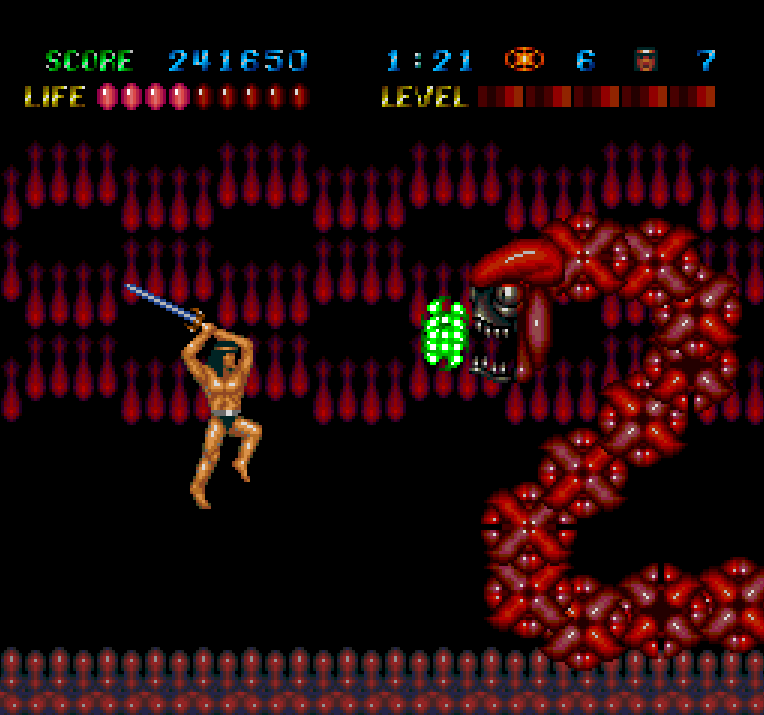
The Legendary Axe II is a dark dark game. Not just in graphics, but in tone. It just feels sombre, threatening, depressing, oppressive and menacing. It's not the sort of game you'd play if you need cheering up. You'll play through some very dark, and often quite bizarre, levels. One level has a skeleton trapped behind the wall in the background, trying to escape through gaps in it, another sees you jumping from a platform of skulls to another platform of skulls. There is a level where you descend deeper and deeper through caverns of slime-covered walls. End of level bosses are equally as odd. One is a midget swinging a massive ball at you, another is a what appears to be a doll or young girl who splits into other young girls and then transforms into standard enemies from the game. In contrast to everything that has gone before, you end the game in some sort of futuristic maze. Rather than being attacked by the undead, your foes are robots. Finding your way through the maze is quite a challenge, and once you've managed it, you're faced with a rather tough end of game boss. Even the ending will baffle you. When you've completed the game and just as you take your seat on the throne, a woman appears to fly at you out of the blue with some malicious intent. Before you know what's going on, the end credits begin. If you play the Japanese version, she appears to have forgotten to put her clothes on too.  


Balls


I offered to babysit, and then the kids went all weird on me.
Never again.
Graphics in this game aren't particularly amazing, but they do get better as you progress through the game. Characters and other sprites are well animated and some of the end of level baddies are stunning. They definitely do the job though and portray the game's tone fantastically. Music is good too, definitely suiting the style of game, with melancholy organ-style melodies playing throughout.

The game does throw a good challenge at you but is beatable. It is similar in style to games like Castlevania, but isn't as ridiculously tough and unfair as that. However, it seems to lack Castlevania's charm and probably isn't something you'll want to come back to soon after completing it. The feeling of dread that characterises it isn't always going to appeal to somebody looking for a quick game to play. But it's fun nevertheless and is a good example of a game that us Europeans were deprived of. Shame on you NEC. Why did you spare us from such joys? Humph!

Ever wondered what Big Bird would look like without his feathers? Well wonder no more.


Prince Sirius has a rather odd looking toilet in his house.
The eye is actually the flusher, and a finger on the left hand
holds the toilet roll.
RATINGS
Presentation: 70%
A simple main screen, no options to speak of, but the game begins with a short intro giving a bit of background to why you are doing what you do.
Graphics: 78%
Dark, dull, depressing, but in a good way. Great if you like the colours grey and brown. Animation is good, and end of level baddies are great.  
Sound: 75%
Atmospheric tunes and suitable sound effects. 
Playability: 80%
Instantly enjoyable and stays entertaining throughout, although you probably need to be in the right mood to want to play it. Throws a good challenge at you but never feels unfair.
Overall: 78%
A surreal, creepy little game, well worth seeking out if you have a PC Engine or TurboGrafx-16. 


BONUS SCREENSHOTS
Seeing as I spent most of this review going on about the PC Engine/TurboGrafx-16 and why it didn't make its way to Europe and not the game itself, I've got a few left over screenshots of the game. It's a shame to waste them, so here they are:


It might look like Prince Sirius has just knocked out that nasty, but he actually fell over the rock on the floor. Sirius is
actually levitating for no apparent reason.

Stop it! That tickles!

Parp!

I really don't know what to say here. Except, why doesn't Prince Sirius wear many clothes. I'm sure
most royal types don't wander around semi-naked. At least I hope not. Urgh! Prince Charles in his undies.

Achoo! Yes, that's snake snot there.

Parp! 

Roboman gives Sirius the finger. Bad Roboman.

Sirius camply scarpers with one of Pat Butcher's earrings.

Still scarpering, still with Pat's earring. But in a disco where only one light works.

Sirius meets Zach, his evil brother, sitting atop a, um, don't know what.

When toilets attack

After defeating Zach, Sirius takes his place on top of whatever it is. All of a sudden, a lady launches
herself at him. What happens next? Who knows?

The Legendary Axe II - The Video
Oh yes, as a special reward for getting your way through this review, you can watch the game in action from start to finish. Enjoy!


Monday, 22 September 2014

Tomorrow Never Dies - Sony PlayStation review

It's Tomorrow Never Dies! Lots of black here.
Game: Tomorrow Never Dies
Format: Sony PlayStation
Developer/Publisher: Black Ops Entertainment/Electronic Arts
Year Released: 1999
Also released on: Nothing
Now available on: Nothing

Games based on movies have never had it easy. They're a bit like politicians and journalists. Even before you know anything about them, you are suspicious of them, distrusting of their real purpose, wary of their intentions. What is their agenda? What do they really want? Do politicians just exist to make the country a greater place and to demonstrate the power of democracy? Of course not! Do journalists just want to report the news with impartiality and objectivity, and not push forward their own beliefs and motives? Don't be daft! Do video games based on films just happen to be developed because the movie's plotline makes a great idea for a highly enjoyable game, a game that will be treated with love and care to be the very best it can be? Nope, not at all! Movie tie-ins are just there either to cash in on the movie they're based on or promote it. Regardless of whether the game is good or bad, it'll sell anyway. And this explains why most are average at best. The most infamous movie-licensed game is E.T. for the Atari VCS/2600, and is a good example of why they get such a bad reputation. Atari invested heavily on rights and (over)-production of cartridges but neglected to ensure that the game on them was any good. They ignored the ideas that the film's director, Steven Spielberg had for a game, gave its developer less than six weeks to put something together and skipped the playtesting. What they ended up with is what is often declared the worst game ever made. Although it truly is terrible, it definitely isn't the worst, but it's one of the most high profile bad games that exist. Even though the game didn't sell anywhere near as many copies as Atari expected, possibly the trigger that ignited the Great Videogame Crash of 1982TM, the game still sold really well overall, shifting 1.5 million copies and being the fifth best-selling game for the console. These sales can only be attributed to fact that the game was based on a hit movie. It certainly wasn't because the game itself made people want to go out and buy it. And this fact alone is the reason why gamers have certain reservations about video games based on movies. "Lazy tie-in" was a phrase often used in reviews of movie-based video games. It's as if publishers and developers didn't feel they needed to put the effort in to making a great game. It would sell anyway.

E.T. on the Atari VCS. A terrible game, but probably
more well-known than most movie-based games.
Sometimes the fault isn't just down to complacency on the part of the people making the game. Sometimes the source material was to blame. Some films just don't translate well as video games. Again with E.T., how the hell were you meant to turn the film into a videogame? Time and time again, films with inappropriate plots or themes were turned into games. Examples include A Nightmare on Elm Street, Texas Chainsaw Massacre, Jaws, Home Alone, Home Alone 2, Last Action Hero, Cliffhanger, The Mask, the Back to the Future trilogy, Beethoven's 2nd, Days of Thunder, Bram Stoker's Dracula, Wayne's World, and countless others. A way of trying to adapt the film into a game was to loosely base the game on the film. Sometimes they were so loose that it seemed like the developers hadn't even watched the film. Maybe they'd stared at a promotional poster for five minutes and then began beavering away at a game based on what they saw. But, having the freedom not to have to stick so strictly to the film would mean that there's a good chance that the game might actually be playable. Wouldn't it? Sometimes, yes. But mostly, no. There was still a feeling that the developers weren't giving it their all and they just put out half-arsed attempts at games. Even so, there were some games that did turn out to be fairly good despite barely resembling the films on which they were based. Jurassic Park on the Mega Drive was one. The only thing it had in common with the movie was that it featured dinosaurs, but it was still quite playable nevertheless. Even better was the arcade version. Alien 3 for the Mega Drive, SNES and Amiga was not bad too, as were certain versions of Ghostbusters. And what about The Addams Family? All good fun.

Goldeneye on the N64. Great stuff.
But, of course, there were the rare occasions that a movie tie-in completely worked. Not only did the game stay faithful to the plot, but it also captured the tone, themes and style of the film too. Graphically it resembled what you could see on the big screen, and its soundtrack was either directly lifted from or heavily inspired by the film's score. It really was like playing an interactive version of the movie. Disney's Aladdin on a variety of consoles and computers is a good example. Spiderman 2 on the PlayStation 2, Xbox and Gamecube is another. But there is one movie to game, um, game that stands out as the pinnacle of movie to game games. It's so well-known, that it is somewhat a cliché to name it as the ultimate movie tie-in. But name it I will. It's none other than Goldeneye for the N64. Not only is it a great movie conversion, it's also one of the console's greatest games. Based on Pierce Brosnan's first outing as 007, the game allowed you to control the suave secret agent in a first person shooter that revolutionised first person shooters. Brilliant on its own, it was in multiplayer mode that the game really shined. Up to four players could play hide and seek and shoot the crap out of each other for hour after hour after hour. Even though time hasn't been kind to it and it looks quite dated now, once you get past the slightly awkward controls it's still a fantastic blast today.

You can almost hear the James Bond theme just by
looking at this image. Oh, actually, I've left the game
running in the background and it keeps playing.
The problem I had at the time was that I didn't own a N64. In fact, I only knew one person who did have one. Well, it wasn't his. It was his brother's, and we'd have to hope he wasn't in to get a go of it. This meant that I didn't get as much Goldeneye game time as I would have liked. So imagine my joy when I found out that the next James Bond movie, Tomorrow Never Dies, would appear on the PlayStation. If it was at least as good as Goldeneye, I'd be in for a treat. I assumed that the developers would simply take Goldeneye's winning formula, make enhancements where needed, and they'd have another hit on their hands. Nothing could go wrong.

But it did. For some reason, somebody somewhere must have thought that a good way to repeat the success of Goldeneye was to ignore what made it great and try something else. My initial reaction to playing Tomorrow Never Dies back in 1999 was one of disappointment. I can picture myself sitting there now, playing through the first level, and shouting "Why???!! Pierce Brosnan! How could you do this?" Still, I stuck with the game, and did actually begin to enjoy it. Or tolerate it maybe. Although it wasn't Mr Brosnan's fault, I still blamed him for being a bad James Bond in this game. "You were so good in Goldeneye. Why not in this? I'm disappointed in you. I never liked you in Mrs Doubtfire either."

Lovely shades of lilac here. 
Mr Bond's mission in Tomorrow Never Dies is to investigate and eventually take on media mogul, Elliot Carver, the owner of newspapers and television networks. Somehow, he is able to print the news of events before they happen. And it just so happens that these events appear to be causing tensions between China and the United Kingdom. Is Carver somehow involved in making these events happen, and if so, why? Perhaps he runs the Daily Express. They always appear to be trying to predict the news. Well, weather-based news, and how we're either going to have the hottest summer or the coldest winter since records began. They never get it right though. And I doubt that non-existent heatwaves or big freezes are going to cause us to get into some kind of war with China. Anyhow, Tomorrow Never Dies is one of my favourite James Bond films, but it's a while since I saw it last, so how the film actually goes is somewhat hazy. The game, released only on the PlayStation, is split into ten missions, each representing scenes from the film. It sticks fairly closely to the plot, I think, using a combination of full motion video footage from the movie and in-game computer animated scenes to tell the story. Before each mission, M gives a quick overview of Bond's task to come. Overall, the general presentation is quite good. It begins with the MGM lion roaring over its logo and then the franchise's famous gunbarrel opening sequence over the James Bond theme. This is all followed by a cinematic intro video featuring excerpts from the game and the film. It really does feel like you're about to be part of the movie. I'll look at how the game actually plays in a bit, but one of the highlights is the inclusion of the movie's opening credits after the completion of the second mission, featuring the obligatory nearly-naked women dancing all over the place over Sheryl Crow's fantastic Tomorrow Never Dies record. It comes to something when one of the best bits of a game is pre-filmed opening credits and a song. Pre-game and in-game menus are also well-presented, looking crisp and polished and well-suited to the game.

What's on the menu? I'll have the New Game for starters, and maybe save room for Options.

We appear to have a very isolated snow flurry here. Good
job it's not on the Sky dish. Completely mucks up the picture
does snow.
While presentation is good when you're not playing the game, things aren't quite as great when you are playing it. Graphics are very rough around the edges, blocky, dull and barely resemble the locations that they are meant to represent. The first level is probably the exception, which doesn't look too bad, but that's probably because it's mostly a snowy landscape and I don't suppose snow is too difficult to draw. But as you progress through the game, you really have to use your imagination to fill in the gaps in the locations as it looks like the graphics designers decided to give up half way and went home. One level, set in a hotel, sees our hero paying a visit to the bar to have a chat with a bartender. A bar that seems to be made up of one very long bar counter, a couple of chairs and not a lot else. Behind the bar is a large kitchen which is just a series of counters alongside a wall. The graphics just don't capture their settings, instead causing them to feel a bit empty. To me, they seem to create a strange atmosphere. In a way, they remind me of Atari VCS/2600 games. You know what the graphics are meant to be of, but you have to draw them in your mind to "see" them. Additionally, there is a lot of pop-up, choppy and jerky animation and framerate, wobbly backgrounds and, urgh, it's just not good.

James staggers to the bar after having had a few too many shaken but not stirred beverages.


Paris gives Mr Bond a slap. The wallpaper is covered by
pictures of Elliot Carver and the old Internet Explorer logo.
Soundwise though, things are much better. In addition to the original James Bond theme and Miss Crow singing her song, the game makes use of atmospheric remixes of the Bond theme and other secret agenty-sounding music. It all works rather well and is one definite positive of the game. Sound effects are good too, although the voice acting is rather average. In the game, James Bond is voiced by a Pierce Brosnan soundalike rather than the actor himself.  


James is pretending that he's on the phone to somebody. I do that sometimes. Great way of avoiding conversations.

Not sure why I picked this screenshot.
Tomorrow Never Dies uses a third-person viewpoint rather than the first-person view of its predecessor. This change seems to take something away from the feeling that you are James Bond. You're watching him rather than being him. The game does sometimes kind of switch to first person, but only when you're in a tight corner and the camera has to do it out of necessity so you can see where you are and where you're going. Once you're in a more open area, it's back to the standard third person view. Bond himself isn't the easiest person to control. His movement is rather rigid and awkward. Collecting weapons and ammo, usually dropped by enemies, requires you to walk over them. But quite often you'll find yourself walking to the left of them, or to the right, or around them in a circle. Basically anywhere but where you want to go. Sometimes you have to back up enough so you can line up your target collectible and walk in a straight line to it. It reminds me a little of a drunk person taking a walk up to their front door with their key pointing at it.

James Bond's sneezes are quite explosive.


I see you baby, shakin' that ass. Yes, you! In the trees!
If you're able to get James Bond to go where you want him to go, he is able to pick up a variety of weapons during his missions. Firing these is a simple case of pressing the fire button. If you want, you can bring up a gigantic target thing to assist you with aiming. The problem with this is that you can only really target an enemy when you're close enough to them. And by the time you've got your enemy targeted, they've noticed you and begun shooting at you. You do get the opportunity to use a sniper rifle, but this still has the same problem. You can zoom in a bit and target an enemy from a distance, but shooting at them quite often does nothing. So, you creep a bit closer. Aim again and fire. Still nothing. By the time you're close enough to them for your bullets to have an effect, the tip of your rifle is probably touching your enemy's nose and you're standing right in front of them in clear view. It makes the sniper weapon almost pointless, and removes the element of stealth from the game. And for a game that's meant to be about a spy who goes about his business secretly, this isn't good. It's best to leave the game to auto-aim on your behalf, but even this is flawed. Although the auto-aim will lock on the closest enemy, as soon as another one appears, it'll flick to that enemy. Changing weapons, although it isn't difficult, pauses the action. And switching to your special weapons, things like cameras, gadgets, med kits and remote detonators, requires you to go to another menu within the weapon selection menu. Again, it's not difficult, but is needlessly fiddly. Surely there were other ways to make weapon and gadget selection more fluid and natural.

After accidentally causing a computer to explode in PC World, James needs to get out of the store quickly.


Why are there filing cabinets outside?
The enemies in the game do pretty much the same thing throughout. They aren't the brightest of baddies, although they can be quite annoying. From a distance, they are harmless. But, when you get closer to them and they spot you, they usually being walking towards you. Obviously, whoever is controlling them seems to have the same controller issues that you have, as they seem to walk in zig zags. While doing so, they'll be firing at you. As mentioned above, using the manual aiming system is useless here as the little bastards don't keep still. So, just auto aim at them and stop them in their tracks. You can strafe and roll about using the L2 and R2 buttons, but this can just make things more difficult for yourself as you'll probably find that your auto-aim has locked onto somebody else and the person you were originally aiming at is firing at you from elsewhere. Yes, this is another of the game's annoyances. It sometimes happens that an enemy that you can't see will begin firing at you from a random location. If you're on the move, turning around just isn't that easy. The only way to do it properly is to stop and then turn and spin around until you can spot whoever it is who's shooting at you. Sometimes, by the time you have, he's shot you that many times that you die. There are times as you're progressing through levels and clearing enemies from your path, that more just turn up behind you and begin firing. If the controls were better, this wouldn't feel as unfair as it does. And if the game was a stealth game, like it's meant to be, you wouldn't be wandering about it the open as much as you end up doing to leave yourself vulnerable to sneaky attacks from behind.

It's Ski Sunday, with a bit of arty lens flare.
Although the game is mostly a third-person shooter, it does attempt to include some Bond-ish malarky. Place a bomb here, take photographs there, locate something in a filing cabinet here, find somebody and get information from them there, and so on. The problem is, there isn't enough of it. It just doesn't feel secret agenty enough. Just walk around, shoot people, walk a bit more, shoot more people, watch a snippet from the film, and repeat. Even a couple of levels included for variety, a skiing level and a driving level, do little to shake and stir things up enough. The skiing level is nice enough, but just requires you to ski down a mountain. You can attempt to knock some baddies off their skis, but attempting to do so usually leaves you worse off, so it's best just to focus on the skiing which isn't really that exciting or difficult. Similarly, the driving level is just as uninspiring. You just drive around, swerving all over the road like a drunk, firing at cars in order to kill them. Yep, that's how it's described. You get told how many cars you have left to kill. It just isn't fun. These two levels could have been so much more.

Get killing those cars! Throw a missile at them or something.

The British are notoriously bad tippers. This displeases
bar staff.
Playing through this game just gives you more and more reasons to be annoyed. You'll set off alarms, sometimes by destroying certain objects, killing certain enemies or entering certain locations. But, the alarms don't seem to do anything apart from make an annoying noise. And, bizarrely, they stop after a short period of not alerting anybody to anything. The two modes of play, Agent mode and 007 mode are identical, except that enemies in 007 mode are harder to kill. Why not change things up a bit for the harder mode? You'll find that, just when you need a med kit to replenish your energy, your secondary item is something else, and by the time you've figured out which button you're meant to press to get into the menu for the item selections, you've died anyway. But worst of all, where the hell is the multiplayer mode?! I mean, multiplayer is what made GoldenEye the N64 must-have game. It was a no-brainer not to include it in Tomorrow Never Dies. It's a bit like releasing a new Call of Duty game today but deciding to leave out the multiplayer element. It just wouldn't happen. Okay, so you could only realistically use two controllers on the PlayStation, but even this would be acceptable. Two is better than just one.

She doesn't look happy. You're not getting any tonight James.
Despite the criticism above, Tomorrow Never Dies isn't completely awful. It isn't that great either, It's just totally average. It is fairly playable for a while once you get used to the controls, and the way that it tells the story makes you want to progress through it. The main problem with Tomorrow Never Dies is actually Goldeneye. On its own, Tomorrow Never Dies is just your typical lazy movie tie-in. The developers put a lot of effort into using the movie license, making good use of footage from the movie and the soundtrack. But, like countless other games based on films, the game itself is lacking and uninspiring. Now, had Goldeneye not existed, this wouldn't have been too much of a problem. Tomorrow Never Dies would have been just what was expected. Nobody would have got their hopes up too much for the game and nobody would have been surprised with what they ended up with. However, Goldeneye set a benchmark. It proved that, with the right source material and given the right treatment, some films can be turned into great games. And it looked like James Bond movies might just contain some of the right ingredients - a suitable plot line, characters, enemies, settings and scenarios. It's just a shame that the care and attention that went into developing Goldeneye didn't get put into Tomorrow Never Dies too. Was this down to the fact that the two games were released by different publishers and produced by different developers? Rare developed Goldeneye for Nintendo, whereas Black Ops Entertainment developed Tomorrow Never Dies for Electronic Arts. We all know the reputation that Electronic Arts had for relying on big-name franchises and licenses to sell games, rather than the games themselves. After the success of Goldeneye, Electronic Arts won the video game rights to the James Bond franchise, and it looked they were all too eager to abuse, sorry, use it to its full potential. Tomorrow Never Dies just feels like it was an attempt to cash-in on the movie. Perhaps it was even an attempt to cash-in on the success of the Goldeneye video game. I'm sure I wasn't the only one who owned the game expecting it to be similar to Goldeneye. And I'm sure I wasn't the only person to be disappointed with Tomorrow Never Dies, and shocked to find that it didn't even contain anything resembling a multiplayer mode. Maybe it would reappear for the next Bond game, The World is Not Enough. Hmmmm.... nope, apparently it doesn't. Oh well.

Phwoar! Boobies! 
RATINGS
Presentation: 85%
Overall presentation is quite good, with intros and opening credits from the film itself and well-designed menu screens and intermissions.
Graphics: 60%
Ugly but functional. 
Sound: 80%
A good use of the film's theme tune, with remixes and other spy-style music used to good effect. Pretty good sound effects but average voice acting.
Playability: 65%
Takes a bit of getting used to, and isn't the most fun you'll ever have with your PlayStation, but it might keep you good for a short while. 
Overall: 63%
A bog-standard third-person shooter. Lacks the element of stealth, no multiplayer. Unfortunately will always exist under the shadow of Goldeneye and forever be compared with its superior N64-based predecessor.


Oh crap...

Monday, 14 July 2014

Robocop (Arcade Version) - Review

It's RoboCop. The game of a movie also called RoboCop.
Game: RoboCop
Format: Arcade
Developer/Publisher: Data East
Year Released: 1988
Also released on: Amstrad CPC, Atari ST, Commodore 64, Commodore Amiga, Apple II, DOS, MSX, Nintendo Entertainment System, Nintendo Gameboy, TRS-80/Tandy Color Computer, ZX Spectrum 


RoboCop fires fried chickens at some bloke in a window.
I've never watched any of the RoboCop films. I'm not sure why. I'm sure they're great films, but they're not something I've ever felt like making the effort to view. Maybe if I was flicking through the channels looking for something to watch and one of them happened to be on, I'd give it a go. But it's not something that has happened yet - perhaps it will one day. I get the general idea that the films feature a robot who also happens to be a cop, or a cop that is actually a robot. And I guess the robot copper goes around doing his policeman duties to uphold the law and protect civilians, such things like arresting criminals, catching roadhogs, giving directions to folk who happen to be lost, taking statements and doing paperwork.

The video shop here has a rather extreme way of getting back unreturned VHS rentals


Oooof! Right in the conkers!
When RoboCop was first released, I would have been nine or ten. Too young to legally watch the film, although as it was the first film to be scrambled on Sky Movies, and as we had Sky but didn't initially subscribe to Sky Movies, I was fascinated to see how the film would appear scrambled. So I watched the first few minutes of a scrambled RoboCop, until I realised that I was being a bit weird. Back then, RoboCop was cool. Kids at school had RoboCop flasks and sandwich boxes. I had a Mr T flask and a Garfield sandwich box. They wore T-shirts featuring RoboCop and spoke his famous sayings, saying things like "You're move, creep," and, um, that's it. They also said things like "Hasta la vista, baby!" but that wasn't from RoboCop so it's kind of irrelevant. I suppose what I'm trying to get across is that, once upon a time, RoboCop was a hugely influential franchise, and even those who couldn't or didn't see the film, were aware of its presence. So when I came upon the RoboCop arcade machine in some place, I had to have a go of it. Oh yes, even I knew that RoboCop was cool. And I'd be cool too if I pretended to be RoboCop for a moment or two, policing the streets of Detroit and doing whatever it is that a RoboCop does.

A damsel in distress calls for help. Meanwhile man in a window is keeping watch.

Not enough space in the van? Just ride on its roof.
One thing I remember about playing RoboCop as a kid was that it I didn't last very long. I enjoyed it, but my 10p go was over within a short space of time. I'd sometimes splash out and slip another 10p coin into the machine to get a little further, but I think I realised that I was never really going to get very far into the game without needing a lot more money. But, in these modern days of freeloading and playing what you want as much as you want, I decided to revisit RoboCop. Armed with a virtual pile of 10p coins, ready to be inserted whenever I died, I powered up RoboCop, the arcade game, and readied myself for some cyborg crime fighting fun.

Rather than using the crusher thing to crush cars, this junk yard gets people to jump on them. It's slower but much cheaper.

Throwing a balloon at the Hulk.
RoboCop is a side-scrolling run and gun game with beat em up elements. According to Wikipedia, the computer game rights to RoboCop were held by Ocean, so Data East had to license the game from Ocean to produce the arcade game. This meant that an arcade game publisher had to acquire rights from a computer game publisher to make the game. Usually it was the other way round. Oooooh!

The action in RoboCop takes place over seven levels, interspersed with a couple of bonus levels. The game remains pretty much the same throughout. RoboCop wanders through the levels shooting just about anybody who gets in his way, bar a few hostages who he can free by shooting their captors. He can fire in eight directions: up, down, left, right and diagonally. When up close with an enemy, he can give them a smack with his metal-clad arm. RoboCop's standard gun has unlimited ammo, but he can pick up collectables to enhance his weapon. These do things like fire laser-like bullets, multi-directional ammo and the usual kind of stuff. However, these usually come with limited ammunition. There's always a downside to your fun, isn't there? RoboCop can also pick up other guns with more explosive and devastating firepower. Enemies fire at you from all directions and different enemies have different attacks. You'll get used to the attacks quickly, but things also become relentless quite quickly with numerous enemies positioning themselves everywhere. They aren't difficult to defeat, but it's clearing them all off the screen that's the issue. Even so, with a bit of skilful firing, ducking and diving, you can put paid to their hostilities in quite a satisfying way. A boss battle awaits you at the end of each level. Again, once you've learned the patterns and their weak points, defeating most of them isn't difficult, although some of the later ones really do hammer your power bar. During the boss battles, you can also see your enemy's power bar, so you know how close your are to defeating it. This is the earliest game that I have seen this feature in. Or maybe Castlevania was earlier?

My, what a big ball you have.

A bonus level features twice in the game. This is a chance to earn some extra points, get some target practice and increase your power capacity. The bonus level takes the form of a shooting gallery with you simply having to fire a targets within a set time limit. It's nothing too challenging, or that exciting to be honest.

Target practice. Not a lot else to say really.

Man in the window has got his pals to help out.
Most of the early levels scroll left to right, with the last couple of levels going upwards as you make use of lifts to get higher in a building. These are probably the game's worst levels. After a fast-paced action-packed build up, the final two levels are a bit of a letdown. You clear a floor of enemies and what appear to be armed security cameras. Then you take a lift to the next floor up to repeat the process. And you do this over and over again. Ignoring the tedium of the last couple of levels and their never-ending lifts, the game is pure and simple arcade gaming with little to divert your attention from just getting on with firing in all directions and ridding the levels of enemies.

There appears to be some kind of weird orgy happening on floor 4F. Better stay where you are Robocop.


That's one big tin opener. 
Presentation and graphics are great. Each level captures its scene well, and quick intermissions tell the story. Characters are all well animated and are also quite big and bold. There is a bit of slowdown when the action gets too intense, but this is quite rare. Although dark and moody, the graphics also have a fair amount of colour in them to give vibrancy to each of the levels. The soundtrack is also fantastic, with music and sound effects that really suit the style of game. There is also a good amount of sampled speech in the game, with RoboCop saying his famous sayings and generally being quite a chatty robot cop thing. Oh yes, this is a game that showcased some of what the technology at the time could do. It was nothing extra spectacular, but was very good.

CCTV is a bit over the top here. But that little city model looks cute though.


Reminds me of a meeting room at work. Without the deadly
robot though. And less of a view.
RoboCop plays well. Controls are simple and responsive, with shooting, jumping and firing working as it needs to. Being made of metal, RoboCop isn't able to jump that high and isn't the quickest of movers, which can get a bit frustrating when you want him to get out of the way enemy fire. A slight frustration is that the direction he's aiming in sticks sometimes, so you have to re-aim to hit your required target. Another problem with the game is that, especially later on, you can lose your life within seconds of continuing. Although this was obviously so people getting towards the end of the game would spend more money and continue, it does sometimes feel a bit unfair. It's as if you're not given the chance to use skill to battle yourself out of a situation, instead you're paying your way out of it. Keep hitting continue and you'll slowly but surely get through. That said, the game isn't impossible and you can get quite far on one life if you try, something I just couldn't do when I was younger. RoboCop is definitely a quality arcade game, better at the beginning than towards the end. It's completely mindless and lacking in depth, but it offers a good fix of running and gunning action if that's your thing.

It's all over and the end. Boohoo!
RATINGS
Presentation: 81%
The opening parts feel suitably cinematic and set the scene well. There are screens that tell the story but blink and you'll miss them.
Graphics: 85%
Detailed, crisp and well animated graphics. The last few levels are a bit of a let down though.
Sound: 85%
Great. The game features a great soundtrack and high quality sound effects. 
Playability: 77%
Instantly playable but RoboCop does feature some frustrating elements which prevent it from being amazing. The last few levels are tedious and ruin a good build up. 
Overall: 78%
A solid arcade game, and a good movie tie-in. Not perfect, and it's not something that you'd regularly return to, but it's fun when you do.