Showing posts with label Amstrad CPC. Show all posts

Thursday, 8 August 2013

Right Royal Retro Baby Games

To celebrate the birth of Prince George, the first child of Duke and Duchess Cambridge and the boy who will one day be King, here are some right royal retro games featuring babies. But not royal ones.


Brat
Atari ST, Commodore Amiga (Image Works, 1991)
Released for the Atari ST and Commodore Amiga, Brat is a baby who needs direction, and probably some love and affection. If not, he'll probably get some sort of attention deficit disorder and in twenty years time will become some sort of vigilante computer hacker. In this game, Brat walks in a straight line on a suspended landscape. It is your job to ensure that he doesn't fall off the floating world that he inhabits or come a cropper by hitting any of the obstacles that get in his way. You do this simply by placing objects on his route, mostly direction arrows which tell Brat which direction to take, but there are some other items to place which can be used to combat some of the obstacles. The game is a bit like an isometric Lemmings, quite a simple idea and well-presented, but unfortunately hard and frustrating to play due to being very unforgiving if you make mistakes. Brat is also one of those annoying kids wearing sunglasses, a leather jacket and a sideways baseball cap, a style that has never ever been cool.


Jack the Nipper
ZX Spectrum, Commodore 64, Amstrad CPC, MSX (Gremlin Graphics, 1986)
Taking the role of a trouble-making toddler, you get to explore various comic-book style locations with the aim to cause as much madness and mayhem as possible. If Grand Theft Auto was a 8-bit computer game featuring babies, then this would have been it.


Chuck Rock II: Son of Chuck
Commodore Amiga, Amiga CD32, Sega Master System, Mega Drive/Genesis, Game Gear, Mega-CD (Core Design, 1993)
A side-scrolling platform game featuring Chuck Rock's son. He doesn't quite have his dad's belly yet so defeats enemies using a club. Pretty standard platform fare from a time when pretty standard platformers were abundant. The graphics and sound are great as you'd expect from a Core Design game, but the game itself was lost amongst its competition so is probably not so well-remembered.


Wonder Boy
Arcade (Sega, 1986), Sega SG-1000. Sega Master System,  Sega Game Gear (as Revenge of Drancon in USA), ZX Spectrum, Commodore 64, Amstrad CPC, Mobile Phone, Wii Virtual Console (rerelease of Master System version)
Also released as Adventure Island on Nintendo Entertainment System, MSX, Gameboy Advance, Gamate, Gamecube, PlayStation 2, Wii Virtual Console (release of NES version)
We're not sure if Wonder Boy is a baby or just a kid who hasn't yet been potty-trained. Whatever he is, he roams dangerous landscapes wearing a nappy while throwing axes at enemies and beheading end-of-level bosses like some sort of crazed loon in a quest to rescue his girlfriend Tanya. On his journey, Wonder Boy picks up fruit and milk for energy and dolls for bonus points. Sega's Wonder Boy was a fantastically playable arcade game which was converted to consoles and computers aplenty. It was renamed Adventure Island and slightly altered for the Nintendo and MSX. Both Wonder Boy and Adventure Island then continued as two separate gaming franchises with numerous sequels. Whereas Wonder Boy follow-ups became more adventure-based, Adventure Island sequels stuck to being arcade-style platformers.


The Sims
PC, Mac, PlayStation, Xbox, GameCube (Maxis, Electronic Arts, 2000, 2003)
EA and Maxiseseseses' life sim gave gamers the ability to direct virtual human beings through their day-to-day lives. From the mundane events like emptying the bin and going for a wee (or just leaving them to piss themselves) to major life events like getting a job or building an extension on your house to turn it into a games room. Another large part of the game was forming relationships, especially romantic relationships. You could get your Sims to fall in love by flirting, chatting, telling jokes, dancing or attempting a sneaky kiss. Once your Sims had taken that first step in the path of romance, it doesn't take them long to decide to have a baby. After making the decision, the conception, pregnancy and birth happens in seconds and a baby in its basket suddenly appears in your front room. The game then becomes all about looking after your virtual sprog, feeding, changing and cleaning them in the hope that the authorities don't come knocking to take it away. So, if you want to imagine what life is like for Will and Kate, create your own make-believe Royal couple and get them to have a baby.


Baby's Day Out
Sega Mega Drive/Genesis (Hi-Tech Entertainment, 1994)
According to movies in the 1990s, parents were shite. They always seemed to forget their kids. The McCallisters managed to lose Kevin twice in two Home Alone films, and in Baby's Day Out, some infant went for a jolly by itself. I guess anyway. I've never actually seen the film in full. A game based on the film Baby's Day Out was programmed for the Sega Mega Drive/Genesis but was never released. In fact, the game was never actually finished, but what does exist of it - you can find it online if you know where to look - is a heap of stinking crap that probably couldn't have been salvaged and turned into anything worth playing. It might explain why a completed version was never put onto a cartridge. The idea of the game is to guide Baby to the exit of each level. You do this by controlling what looks like an angel, who opens doors, moves objects, and basically makes the route safe. The controls are horrible, gameplay is completely unintuative, the graphics dull and depressing, and I don't think there's any sound to speak of. Or I'd forgotten to turn on my speakers when I played it.

Monday, 27 May 2013

Review: Diamond Mine II - Acorn Electron


Diamond Mine II's loading screen
Game: Diamond Mine II
Format reviewed: Acorn Electron
Developed by: Blue Ribbon
Year of original release: 1985
Also available on: BBC Micro, Amstrad CPC, Commodore 16, Commodore Plus/4, MSX
Available now on: Nothing

Mining and diamonds seem to be a common theme in computer games of old. Games like Boulder Dash for example and, er, um, Manic Miner. Not too sure we saw Miner Willy doing any actual mining in it though. I suppose you could count Jet Set Willy too as it featured the same character. Oh well, maybe mines and diamonds aren't that common a theme. Perhaps the black backgrounds that were a feature of many 1980s computer games made me think they were all set in mines, and I suppose diamonds were fairly easy to draw so they also seemed to pop up quite a bit in old games.

When this screen is moving, the box of colours changes and
moved inwards from the outer edge. Psychedelic!
Anyway, a game that was a fusion of the less-common-than-I-thought themes of mining and diamonds was Diamond Mine, a game released in 1984 for the Acorn Electron by MRM and again the following year by Blue Ribbon. Oh wait! There was also Mineshaft, also released on the Acorn Electron. Another mining game! We're not looking at that today though. We're also not looking at Diamond Mine either as it is pretty much impossible to play. Instead, we're heading straight for its far superior sequel, Diamond Mine II which Blue Ribbon also released on the Acorn Electron in 1985, as well as a few other machines which I may come onto later if I remember.

As its title suggests, the idea of Diamond Mine II is to mine diamonds. And like many games in the 1980s, the mines takes the form of maze-like levels. You simply have to clear the diamonds from the paths in the mazes. You do this by guiding a pipe through the level. If you touch your own pipe or attempt to go backwards on yourself, you lose a life. You can however retract your pipe, a necessity to get through the game. The pipe retracts for however long you hold down the relevant key, which is Return in the Electron version.

I was mining in a mine one day. In the very merry month of May
Making life tougher are nasties which take the form of mutant eyes. These eyes move horizontally through each level and are also able to travel through walls. You can suck them up your pipe but if they come into contact with any other part of it, it's another life lost. Sucking them up is only temporary as a few seconds later they're back! If this happens when you're clearing a completely different part of the level, you need to retract and suck them up again. Part of the beauty of the game is seeing how much you can clear before retracting, whether to be daring or over-cautious? As moving your pipe through the levels and retracting it uses energy, you need to be careful that you don't retract too often or waste too much time making a decision, so playing too safe isn't always a good idea. So you need to keep an eye on your energy levels as well as the wandering eyes. I once went out with somebody with a wandering eye. Had to end it though as I thought she was seeing somebody else.

Remaining energy becomes points at the end of each level.


There are diamonds on this level. They just happened to be
blue when I took the screenshot.
Controls for the game are simple. You just have up, down, left and right and the aforementioned retract key. At first, movement feels a bit sluggish but as you get into the game, the speed is just right. Clearing objects from mazes is a concept lifted straight from Pac-Man, but there are enough extra elements to make this a different kind of game. Levels quickly get tough and really do test your skills. It's sometimes frustrating to lose a life by accidentally going back into your own pipe, but this often happens when you're under pressure. Like a lot of 80s games, you need to combine skill with strategy and this game balances the two well.

Eye eye.
Graphics do a good job too. Levels are colourful and clear. Your pipe makes a chomping noise as it collects diamonds and there are suitable sound effects for deaths, bonus points and the like. The only music is a little tune which plays when you start a new game. Fortunately it doesn't play throughout as it would quickly get annoying. Like the graphics, the sounds suit the game. In fact, everything about this game just feels right. Although the game isn't up there with the all-time greats, and doesn't feel as frantic and as fluid as other arcade style games, Diamond Mine II is a good game if you're feeling like a quick challenge. It's also quite addictive too and leaves you knowing that you could easily do better if you just have one more go.

RATINGS
Presentation: 65%
Nothing too exciting but they do the job. The Blue Ribbon corporate loading screen is followed by the game's name, writer and copyright info on background of changing colours.
Graphics: 83%
The game is colourful and it's clear to see what's going on. The diamonds are just dots of changing colours, while the game's only sprites, somebody bouncing at the top of the screen and the mutant eyes, are well-drawn.
Sound: 70%
Suitable sound effects with a short melody when you start the game.
Playability: 82%
Easy to pick up, hard to put down. Fun to play without being overly frustrating.
Overall: 81%
A great little Acorn Electron arcade style game, something to return to again and again.

Mining for Diamonds elsewhere

Diamond Mine II wasn't an Electron exclusive. Oh no, not at all. It also made appearances on some other home computers too, although for some reason didn't make it to the Spectrum or C64.

Level one Amstrad CPC-style
The BBC Micro version is almost identical to the Electron version, save for better sound and a different loading screen. It plays a bit smoother too. The game is also fairly similar on the Amstrad CPC, although features a different opening theme tune. Movement on this version is fluid like the BBC version although the eyes seem to regenerate quicker meaning there is more retracting of your pipe needed, so doesn't feel as fun.


While over on the Commodore 16, we have this.
The game was also released for the Commodore 16 and Commodore Plus/4. The Commodore 16 version, although it features the same concept of gathering diamonds with a retractable pipe, uses a different level layout and isn't quite as enjoyable to play. There are a larger number of enemy eyes which, like on the CPC, cause you to have to retract more often. This just makes the game feel frustrating. On the Plus/4, the level structure of the Acorn machines and the Amstrad are the same. However, although the pipe flows smoothly, you need to be in exactly the right place above or below a vertical path to be able to move you pipe along it. This again breaks up the flow of the game. An MSX version was released too, but I haven't taken a look at that one.

Wishy washy colours on the Commodore Plus/4


The BBC Micro version is the best of the bunch with the trusty Electron version a close second.

Cloning Diamonds

Diamond Mine II wasn't an original game. Instead it was based on a little known arcade game called Anteater from Tago Electronics whose only other release appears to be a game called Calipso. I have to say I have never heard of either. Instead of piping your way through a maze to collect diamonds, Anteater features an aardvark with an extendable snout which sniffs its way around similar mazes, collecting ants and worms. It is quite infuriating to play and it's little wonder that it isn't a well known game now. An unreleased port was apparently created for the Atari 2600, while the only other versions for other devices are clones. Aardvark was a very close remake, released for some of the Atari and Commodore machines of the early 80s, while Oil's Well from Sierra On-line and Diamond Mine II were clearly influenced by the gameplay of the Anteater arcade game.


Diamond Mine II video

Want to see Diamond Mine II on the Acorn Electron in action? Of course you do. Head on over to our YouTube channel to see it! Or view it here in super-tiny vision.

Friday, 16 March 2012

Marble Madness - Conversion Comparisons: Number Two

3D games - they've always been the holy grail of games developers; something they've sought to perfect for decades. Nowadays, they've pretty much cracked it, but over the years, we've seen many attempts to take gamers into a third dimension. Amongst them, there were holographic games in the early 1990s from Sega, who also released 3D games for their Master System a little earlier along with 3D glasses, Nintendo with their migraine-inducing Virtual Boy, and with their eyesight-destroying 3DS of current times. But, one style of 3D games that has been around for years and is still around to this very day is the isometric game.

Oh yes, isometric games are games which are actually 2D but look three dimensional due to their dual perspective thingymagic. Or something. In the 1980s, there were such classics as Batman, Head over Heels, Knightlore and, er, Super Trolley. Into the 1990s, and we had Populous, Sonic 3D Blast, which was neither a blast, nor strictly 3D, a crappy sequel to Cool Spot in which the dot in the 7 Up logo went to Hollywood, and Mario RPG and Land Stalker. Around the turn of the millennium, it was becoming clear that isometric games went well with "God"-sims, with games like Theme Hospital, Sim City 3000 and The Sims all using isometric graphics. Today, all manner of lifestyle role-playing games, usually involving farms or cafes or shops or looking after pets populate Facebook and app stores, and in many cases, they're isometric. But one isometric game stands out amongst the rest as the most iconic isometric game there is. That game is Marble Madness, an Atari arcade game from 1984.

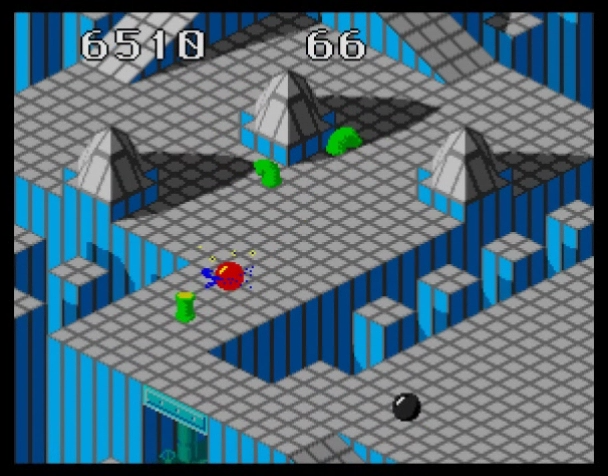
In Marble Madness, you take control of a marble, guiding it through a series of mazes to an exit. In your way are traps, enemies and falls. And that's pretty much it. Keep control of your balls, and you'll be fine, but if you let your balls drop too many times, you'll come a cropper. Marble Madness in the arcades featuring Escher-styled levels and a strangely eerie soundtrack which reflected the surrealness of the game, adding immensely to its atmosphere. It received conversions aplenty. But, how well did it convert to the various platforms out there? Let's find out as we compare the comparisons from worst to best.

1. Worst Version: ZX Spectrum
This version of the game is pure crap. On the Spectrum, the game was released twice - first as a Construction Kit and later as a deluxe edition. In either version, the game allows you to guide your marble through various 3D isometric levels, but they're completely different to the arcades. There's no scrolling, so once you each the bottom of a screen, you have to wait for the next one to appear, thus breaking up the flow of the play and sometimes leaving you in a position which results in endless deaths until your time runs out. The game doesn't capture any of the arcade game's atmosphere and just serves as a pile of steaming shit. And what the hell is going on with the music during gameplay? What gets me is the gushing reviews of it from the time. Your Sinclair seemed to think that Amiga owners would get almightily upset by this hunk of dross. Seriously?

2. Gameboy Advance
The conversion to the Gameboy Advance is actually the newest version, being released in 2004, 20 years after the arcade original. And although it accurately copies the arcade game's graphics, which you'd expect it to do, it gets everything else wrong. Sound-wise, the music is a little too funky and completely misses the importance of the finesse of the arcade original's score. Even so, it's all about the gameplay, innit? Unfortunately, Marble Madness on the Gameboy Advance plays like a dog. In the 20 years since its arcade debut, your marble has become quite arthritic, and guiding it around the levels is a chore. It judders and jerks as it slowly moves in the direction you want it to go in. Most of the time it doesn't even want to go in that direction and just shoots off at a random angle. Getting anywhere with this game is pure frustration. And you can't use the excuse that Marble Madness doesn't translate to the small screen, as well shall soon see. Avoid.

3. MS-DOS
I don't know anybody who would have had a computer running MS-DOS in the mid 1980s, but if they did, they would have been able to purchase Marble Madness for it. Not that they would have wanted to. The game features a rather interesting colour scheme, one channel music which sounds awful, and fiddly controls. They aren't too sluggish, but keeping your ball under control is quite a challenge. Bleurgh!


4. Amstrad CPC
This is a similar version to the Spectrum one. What stops it from being right down there at the bottom is the fact that the graphics feature a little bit of colour, the Spectrum's terrible "music" isn't included, and it doesn't feel quite as frustrating to play. It's still a hideous game, but there are worse versions.


5. Atari ST
This version isn't too bad graphics-wise, which you'd expect seeing as it's a 16-Bit version, but elsewhere it isn't great at all. Especially when you consider how well the game was converted to the Amiga. Controls and collision detection are rubbish, with your marble falling off platforms when it is clearly safely situated on top of one, and other places where it appears to be able to float in mid-air, when in fact it should be dropping to the ground. Despite this, the game is not too difficult to get through (although the video of me playing the game a little later doesn't suggest this!), but it just isn't that much fun.

6. Commodore 64
This is actually a similar version to the Atari ST version, obviously with 8-Bit graphics. However, in this version, the marble handles better, and the game seems to play a bit more fairly. The ball feels more like it is rolling rather than sluggishly dragging itself around the levels.


7. Commodore Amiga
This is one of the Amiga's earliest games, and is a great conversion of the arcade original, getting released only two years after the arcade game's debut. It is the best of the home computer ports, featuring accurate reproductions of the graphics, pretty good music and fairly good controls. Not bad at all.

8. Sega Master System
Deciding what should take position 8 was a close call between the Sega Master System and the Nintendo Entertainment System versions. In the end, I decided that the NES version just about pips the Master System version. The Master System version is fun to play, with good graphics and okay music. The controls are alright too, although there are occasions when the marble seems to go out of control.


9. Nintendo Entertainment System
The NES version was converted by Rare. Despite the technical differences between the NES and Master System, this version is more polished all-round and plays more like the arcade game than the Master System version. It also gives you a choice of control method which is quite handy.


10. Nintendo Gameboy
This is a fantastic version and it is truly remarkable how the arcade game was minaturised and squeezed into the little screen of the Gameboy. It looks and sounds great, and plays really fluidly. Whereas some of the games feel a bit of a chore to play, this is actually great fun.

11. Sega Mega Drive
Easily the best home version of Marble Madness is the version released for the Mega Drive. It is pretty much a straight conversion of the arcade game, looking, sounding and playing as close to the original as possible. This verson also features difficulty level settings to make the game easier or harder for you.
Rumour has it that there were actually two versions of Marble Madness released for the Mega Drive. The one everybody knows about is the version released by Electronic Arts for the US and European markets and as described above, it's a fantastic conversion. However, apparently Tengen released a Japanese version, which is even more arcade-perfect. Unfortunately, the game goes for a fortune on eBay, and isn't available as a ROM to be played through an emulator, so finding out whether it is different and/or better than the Electronic Arts version isn't easy.


In conclusion, there were numerous conversions of Marble Madness for a variety of systems, ranging from totally awful yo absolutely terrific. The downside of all versions is that the arcade game was too short, with only six levels, and none of the conversions add anything extra to the arcade game. It might be that the Mega Drive version comes out as best, but did the original price tag of £40 actually represent good value for money? Plus, the arcade game wasn't really that much fun, was it? More annoying than entertaining.

As an extra treat, seeing as I'm now getting a little better a capturing video and putting it on YouTube, here's a video comparing each of the versions above!


Wednesday, 29 June 2011

Conversion Comparisons - Number One: Pac-Land

The Arcade Version's title screen. Thrilling!
Once upon a time a range of computers and consoles happily co-existed. They were all completely different to each other, each with their unique strengths and weaknesses and numerous quirks. Developers had to write code specific to each system, to enable their programs to take advantage of the respective platform's features and capabilities. This meant that one game could look and play completely differently on one machine to the next. The differences could be slight, or they could be massive. This situation gave fuel to the playground arguments about which system was best. And, er, I'm boring myself now. Basically, this section, named "Conversion Comparisons" will pick a game and look at how it fared when converted from its original platform. We start with Pac-Land.

Pac-Man jumps over a car driven by a pink ghost. As you do.
Pac-Land was one of the first true side-scrolling platform games, and was released in 1984 by Namco. It was a sequel to Pac-Man and took much of its inspiration from the Pac-Man cartoon. The general idea was to get Pac-Man from one end of the Pac-Land to another, collect a pair of magic boots from a fairy, and then go back home. And then, a little later in the day, do the same thing again. I'm not sure if the objective was for Pac-Man to obtain as many magic boots as possible for the Pac Family to hoard, but it seems plausible enough. Making Pac-Man's journey slightly more difficult were the ghosts, intent on attacking him from all angles and in all kinds of vehicles and disguises.  Pac-Man can only attack them after popping a power pill - otherwise he can only avoid them. Other hazards include seemingly endless bodies of water, collapsing bridges and bottomless pits. The return journey was easier than the outward journey as the magic boots gave Pac-Man the ability to float. Kind of. Pac-Land featured colourful levels, cartoony visuals (impressive for the time) and the theme tune playing constantly with accompanying sound effects. They all complimented each other perfectly, and the game, although simple, was fun and addictive and rewarded skilful playing.

Pac-Land was converted to many of the major platforms during the late 1980s and early 1990s. Here is a summary of some of the conversions from worst to best.

Title on Sir Lord Alan Sugar's compy.
1. WORST VERSION: Amstrad CPC - The Amstrad version features full colour graphics (very pink though) and plays fairly closely to the Spectrum version, which will appear in this list in the not-too-distant future. It has a good rendition of the theme tune but suffers from a couple of major flaws: unresponsive controls and no side-scrolling graphics. The problem with the game not having side-scrolling graphics is that sometimes an enemy will enter the screen from the right just as you're about to exit it. The unresponsive controls mean that avoiding this enemy is impossible. In other instances, making a split-second change of mind is impossible. The game feels slugglish and is frustrating to play, and is in my opinion the worst version of the bunch.

Amstrad: Pac-Land on the Amstrad is rather pink.
The Phantom is pure genius and Tangerine Dream is Fab, apparently
2 - Sinclair Spectrum - This is a very close second-worst. Graphically, it does away with the colours of the Amstrad version, replacing them with drab dark blues and yellows, which makes it look like Pac-Man is wandering about the streets of Pac-Land at night. Its rendition of the arcade game's theme tune is identical to the Amstrad's version, and quite impressive it is too. Unfortunately, the game also replicates the Amstrad's flip screen technique, and therefore suffers from the same problems that not having side-scrolling levels causes. What prevents this from being the worst version though is that the controls feel ever-so-slightly smoother and a bit more responsive. Even so, Pac-Man will come to an unavoidable end much too often and it won't be long until you give up on helping him find magic shoes to hoard. Incidentally, both this and the Amstrad version feature a slightly modified version of the game's theme for the return journey, which is commendable.
Sinclair Spectrum: The street lamps in Pac-Land make everything look yellow
The rather beautiful title screen of the NES version.
3 - Nintendo Entertainment System - This version does away with the cartoony graphics from the original, and makes it look a bit like Pac-Man is travelling through a giant Lego version of Pac-Land. The sprites, both for Pac-Man and the enemies, are about half the size of those in the original, and are dwarfed in comparison to the backdrops. The music is OK, whereas the sound effects are quite close to the arcade's. What lets this game down though are the controls. For some reason, Namco thought it would be good to use the NES controller's two A and B buttons to control Pac-Man left and right, and any direction on the D-pad to jump. Why??? Doesn't the very design of the control pad make it obvious which buttons should do what? The D in D-pad stands for directional, which gives you a clear idea of its purpose! You kind of get used to the stupid controls after sticking with them for a while, but when you come across an obstacle that requires some sort of split second decision, you'll suddently forget that you're meant to be using the controller back-to-front and press the wrong button. There's probably some way of reconfiguring the controls, but there shouldn't really be any need to do so for a game which by default should have clear controls. In addition, the levels appear to have been messed around with a little bit, and the game doesn't really feel much like you're playing Pac-Land. It's not awful, but it could have been much better.

NES: I don't know why, but everytime I look at the graphics for the NES version, I feel thirsty.

These title screens get sexier and sexier, don't they?
4 - Commodore Amiga - Graphically, this is one of the best looking versions of the game, with sprites and backdrops that closely resemble those of the arcade game. The music is also pretty good too, and the fact that the game doesn't require a fire button means that you can use the controller's trigger button to jump, rather than having to push up (having to push up to jump in Amiga games was always a pet hate of mine). The level layouts are also fairly faithful to the arcade version's layouts, and unlike a lot of the other versions (Amstrad, Speccy, NES and C64), you are able to stand on top of vehicles, a feature of the arcade game. However, letting this game down is its scrolling. For some reason, Pac-Man's journey to retrieve magic shoes from the fairy at the other end of Pac-Land is literally not a smooth one. The scrolling is terribly jerky, and seems to get worse when there's more going on. At some points, it feels like you're playing the game in slow motion. This disrupts the arcadey flow of the game, and almost ruins what could have been a perfect conversion.

Commordore Amiga: Looks nice, but if you could see this moving, you'll be tearing the disk out of its drive and flushing it down your toilet in minutes.


Another gorgeous title screen.
5 - Commodore 64 - Of the 8-Bit home computer versions, this is by far the best. Although the graphics aren't as colourful as the Amstrad's, which is partly down to the Commodore 64's washed-out pallette, they are drawn much closer to the arcade's, and the screens scroll. And, unlike the Amiga version, they scroll smoothly, and this is what puts it just ahead of the Amiga version.Which begs the question, if it could be done on the C64, why couldn't the Amiga do it? The game does still suffer from some frustrating deaths, and you aren't able to stand on top of vehicles, which takes something away from the fun of the arcade game, and the level design is slightly different from the original. Even so, this is a very good conversion of the arcade game and is miles ahead of the versions on the computer's contemporaries.

Commodore 64: I love how these old Commodore 64 games have always looked old.

Woah! The Commodore 64 graphics may be washed out, but this certainly isn't!
6 - Atari Lynx - This is a very faithful conversion of the arcade game, probably the most faithful of the bunch, incorporating virtually all of the original's features, even the parallax scrolling, It plays well on the small screen, but is perhaps a little too tough and doesn't feel as whizzy as its arcade parent.
Atari Lynx: Pac-Man on the small screen.

Quite simply the most beautiful title screen in existence. Ever.
6 - BEST VERSION: PC Engine/Turbografx - Simply the best version of Pac-Land is the one released for the PC Engine. Although the colour scheme has been tampered with a little, and the music is a tiny bit different, everything else from the arcade game is pretty much intact. The game does give the option of playing it with the bizarre control system used on the NES version, but makes it easy to change to what they call "Lever control". This is the version that feels most like the arcade version, and pips the Lynx version to the post simply by being more fun to play.

PC Engine: Pac-Man has a power pill just above his head, and is ready to gobble up the ghosties. Unfortunately, he ended up getting squashed by the two cars as I was fannying about trying to get a screenshot.
Video
Here's a video demonstrating each of the above versions of the game in action!


An Extra Treat!!!
While waiting for the home computer versions to load, you were treated to a rather funky map of Pac-Land. And, here they are. Exciting!

The Amstrad Loading Screen


The Spectrum Loading screen. Looks like the artists gave up half way - look at the house towards the top right, 
The Commodore 64 loading screen in a wonderful watercolour style.

The Commodore Amiga loading screen - plush and full of colour and life. I'd like to move there right now.