 3D games - they've always been the holy grail of games developers; something they've sought to perfect for decades. Nowadays, they've pretty much cracked it, but over the years, we've seen many attempts to take gamers into a third dimension. Amongst them, there were holographic games in the early 1990s from Sega, who also released 3D games for their Master System a little earlier along with 3D glasses, Nintendo with their migraine-inducing Virtual Boy, and with their eyesight-destroying 3DS of current times. But, one style of 3D games that has been around for years and is still around to this very day is the isometric game.
  Oh yes, isometric games are games which are actually 2D but look three dimensional due to their dual perspective thingymagic. Or something. In the 1980s, there were such classics as Batman, Head over Heels, Knightlore and, er, Super Trolley. Into the 1990s, and we had Populous, Sonic 3D Blast, which was neither a blast, nor strictly 3D, a crappy sequel to Cool Spot in which the dot in the 7 Up logo went to Hollywood, and Mario RPG and Land Stalker. Around the turn of the millennium, it was becoming clear that isometric games went well with "God"-sims, with games like Theme Hospital, Sim City 3000 and The Sims all using isometric graphics. Today, all manner of lifestyle role-playing games, usually involving farms or cafes or shops or looking after pets populate Facebook and app stores, and in many cases, they're isometric. But one isometric game stands out amongst the rest as the most iconic isometric game there is. That game is Marble Madness, an Atari arcade game from 1984.
  In Marble Madness, you take control of a marble, guiding it through a series of mazes to an exit. In your way are traps, enemies and falls. And that's pretty much it. Keep control of your balls, and you'll be fine, but if you let your balls drop too many times, you'll come a cropper. Marble Madness in the arcades featuring Escher-styled levels and a strangely eerie soundtrack which reflected the surrealness of the game, adding immensely to its atmosphere. It received conversions aplenty. But, how well did it convert to the various platforms out there? Let's find out as we compare the comparisons from worst to best.
 1. Worst Version: ZX Spectrum
This version of the game is pure crap. On the Spectrum, the game was released twice - first as a Construction Kit and later as a deluxe edition. In either version, the game allows you to guide your marble through various 3D isometric levels, but they're completely different to the arcades. There's no scrolling, so once you each the bottom of a screen, you have to wait for the next one to appear, thus breaking up the flow of the play and sometimes leaving you in a position which results in endless deaths until your time runs out. The game doesn't capture any of the arcade game's atmosphere and just serves as a pile of steaming shit. And what the hell is going on with the music during gameplay? What gets me is the gushing reviews of it from the time. Your Sinclair seemed to think that Amiga owners would get almightily upset by this hunk of dross. Seriously?
 2. Gameboy Advance
The conversion to the Gameboy Advance is actually the newest version, being released in 2004, 20 years after the arcade original. And although it accurately copies the arcade game's graphics, which you'd expect it to do, it gets everything else wrong. Sound-wise, the music is a little too funky and completely misses the importance of the finesse of the arcade original's score. Even so, it's all about the gameplay, innit? Unfortunately, Marble Madness on the Gameboy Advance plays like a dog. In the 20 years since its arcade debut, your marble has become quite arthritic, and guiding it around the levels is a chore. It judders and jerks as it slowly moves in the direction you want it to go in. Most of the time it doesn't even want to go in that direction and just shoots off at a random angle. Getting anywhere with this game is pure frustration. And you can't use the excuse that Marble Madness doesn't translate to the small screen, as well shall soon see. Avoid.

 3. MS-DOS
I don't know anybody who would have had a computer running MS-DOS in the mid 1980s, but if they did, they would have been able to purchase Marble Madness for it. Not that they would have wanted to. The game features a rather interesting colour scheme, one channel music which sounds awful, and fiddly controls. They aren't too sluggish, but keeping your ball under control is quite a challenge. Bleurgh!

 4. Amstrad CPC
This is a similar version to the Spectrum one. What stops it from being right down there at the bottom is the fact that the graphics feature a little bit of colour, the Spectrum's terrible "music" isn't included, and it doesn't feel quite as frustrating to play. It's still a hideous game, but there are worse versions.
 5. Atari ST
This version isn't too bad graphics-wise, which you'd expect seeing as it's a 16-Bit version, but elsewhere it isn't great at all. Especially when you consider how well the game was converted to the Amiga. Controls and collision detection are rubbish, with your marble falling off platforms when it is clearly safely situated on top of one, and other places where it appears to be able to float in mid-air, when in fact it should be dropping to the ground. Despite this, the game is not too difficult to get through (although the video of me playing the game a little later doesn't suggest this!), but it just isn't that much fun.

 6. Commodore 64
This is actually a similar version to the Atari ST version, obviously with 8-Bit graphics. However, in this version, the marble handles better, and the game seems to play a bit more fairly. The ball feels more like it is rolling rather than sluggishly dragging itself around the levels.

 7. Commodore Amiga
This is one of the Amiga's earliest games, and is a great conversion of the arcade original, getting released only two years after the arcade game's debut. It is the best of the home computer ports, featuring accurate reproductions of the graphics, pretty good music and fairly good controls. Not bad at all.

 8. Sega Master System
Deciding what should take position 8 was a close call between the Sega Master System and the Nintendo Entertainment System versions. In the end, I decided that the NES version just about pips the Master System version. The Master System version is fun to play, with good graphics and okay music. The controls are alright too, although there are occasions when the marble seems to go out of control.

 9. Nintendo Entertainment System
The NES version was converted by Rare. Despite the technical differences between the NES and Master System, this version is more polished all-round and plays more like the arcade game than the Master System version. It also gives you a choice of control method which is quite handy.

 10. Nintendo Gameboy
This is a fantastic version and it is truly remarkable how the arcade game was minaturised and squeezed into the little screen of the Gameboy. It looks and sounds great, and plays really fluidly. Whereas some of the games feel a bit of a chore to play, this is actually great fun.

 11. Sega Mega Drive
Easily the best home version of Marble Madness is the version released for the Mega Drive. It is pretty much a straight conversion of the arcade game, looking, sounding and playing as close to the original as possible. This verson also features difficulty level settings to make the game easier or harder for you.
Rumour has it that there were actually two versions of Marble Madness released for the Mega Drive. The one everybody knows about is the version released by Electronic Arts for the US and European markets and as described above, it's a fantastic conversion. However, apparently Tengen released a Japanese version, which is even more arcade-perfect. Unfortunately, the game goes for a fortune on eBay, and isn't available as a ROM to be played through an emulator, so finding out whether it is different and/or better than the Electronic Arts version isn't easy.
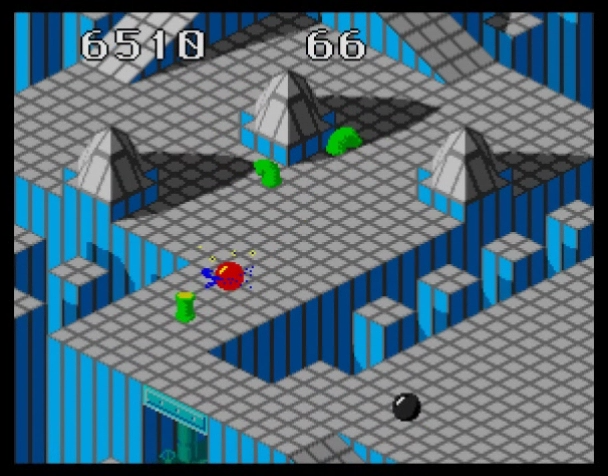
In conclusion, there were numerous conversions of Marble Madness for a variety of systems, ranging from totally awful yo absolutely terrific. The downside of all versions is that the arcade game was too short, with only six levels, and none of the conversions add anything extra to the arcade game. It might be that the Mega Drive version comes out as best, but did the original price tag of £40 actually represent good value for money? Plus, the arcade game wasn't really that much fun, was it? More annoying than entertaining.
As an extra treat, seeing as I'm now getting a little better a capturing video and putting it on YouTube, here's a video comparing each of the versions above!


