Game:R-Type Format:ZX Spectrum Developer/Publisher:Electric Dreams/Activision Year Released:1988 Also released on:Arcade, MSX, Amstrad CPC, Commodore Amiga, Commodore 64, Atari ST, PC Engine/TurboGrafx, Sega Master System, Nintendo Gameboy, Gameboy Advance, Sharp X68000, Sony PlayStation, XBox 360, mobile phones, iOS, Android
R-Type is one of the iconic arcade games of the 1980s. Tough as boots, hard as nails, solid as a rock, you only stood a chance of completing it if you had the eyesight of a hawk and the reflexes of a cat. Or if you happened to be a hawk or a cat with a penchant for playing arcade shooters. As was the tradition back then, successful games tended to find their way out of the arcades and into the homes of computer and console gamers the planet over. R-Type was no exception and was ported to a multitude of machines. Rather remarkably, each conversion was actually rather good. The PC Engine/TurboGrafx game is generally considered to be the best of the bunch, and one of the best games on the system itself, while a splendid version for the Sega Master System was also highly regarded. But it's the ZX Spectrum port which is probably most deserving of praise. As well as being a bloody good version of the game, its existence is something of a technical marvel, pushing Mr Sinclair's baby to its limits and getting it to do things that he probably never thought possible.
The objective of all versions of R-Type is outlined in two lines of text: "Blast off and strike the evil Bydo Empire." No detail is given about what the Bydo Empire is and what it does that makes it so evil. But, striking it involves pitting yourself against a plethora of angry and aggressive alien types over a series of levels. The fact that the Bydo Empire appears to have such an antagonistic arsenal seems to confirm that it is most definitely up to no good, so must be evil.
You take on your enemies in your piddly little spaceship. Well, it looks piddly when compared with the enemies you come up against, especially some of the end of level bosses. But, as with any video game spaceship, it's possible to collect upgrades on your travels to greatly enhance your firepower, turning it into some space-based super destructive light and laser show. You can also power up your beam by holding down the fire button. Letting go of it unleashes a mega blast. A unique feature in R-Type is a collectible pod-like thing. This can be attached to the front or back of your spaceship, offering a smidgen of protection from enemy fire. Or it can be detached and sent off to destroy some of the hostiles that you can't be bothered to destroy yourself. When detached, it is invincible but it leaves you vulnerable. It added a touch of strategy and tactical play to the game. One of the key strengths of R-Type was that, although it was a difficult game, it didn't feel impossible. Your progress through the game is slow, as you eke your way through a level. You play a bit, die, play it again, die again, play again, try a slightly different route, get a bit further, die again, use the same route again, get a little further, die again, and repeat over and over again until you've eventually got your route, the enemy patterns and your tactics memorised to get you through a level. And there's something very satisfying about seemingly being able to fly through the level like a pro, taking out wave after wave of enemies and maxing out your spaceship with power-ups aplenty.
Translating an arcade game to the Spectrum inevitably leads to compromises, but Bob Pape, the man given the task of converting R-Type, did a spectacular job in retaining as much as he could from the arcade version of the game. The graphics are detailed and colourful with no obvious colour clash. Even if there was, there's so much going on that you probably wouldn't notice it. Sprites are recognisable from their arcade counterparts and the effects when firing from your powered up spaceship are remarkable. Special credit must be given to the end of level bosses who are just as fearsome as they are in the arcade original.
The sound in the game is a bit pants. There are no background tunes, although if there were, they'd more than likely be terrible. There are a couple of bits of music which play just before the game begins and when you die, and sound a bit like the phone in 24. But in game sound effects are limited to a put-put-put when you fire, and squelchy noises when you hit an enemy. Other bloops and bleeps and noises make up the rest of the effects. They're inoffensive but not great, but I guess more prominent sounds would get on your nerves after a while.
Most important though is that the game feels like the real thing. The Spectrum version isn't a game loosely based on R-Type - it is R-Type. The original R-Type was all about finding a route and planning your strategy based on what you've learned when attempting it before. And the Spectrum version is the same. The hard bits are still hard, the easy bits (well, easier bits) are still easier. The same enemies appear in the same places, and you have to clear a path in the same way. R-Type is famed for its difficulty level. It was from the eighties when games were tougher and gamers were real men. Or butch women. Throw anything at them and they'd tackle it. None of this modern-day microtransactiony crap where you can buy your way through a game. Ok, we'll ignore the fact that most arcade games could be played to the end if you kept shoving more 10p coins into them and continuing each time you died, which I suppose is actually a microtransaction. Hmmmm, anyway, Like the arcade version, R-Type on the Spectrum is a tough nut, and some might find its difficulty level offputting. Sticking with it does reap rewards, but there's nothing more frustrating than getting your spaceship maxed out to the nines only for you to get shot in the ass by a rogue bullet and having to return to the game with your standard setup. Later on in the game, the going gets extremely tough unless you have a bit of extra help from your weaponary. This isn't really a fault of the conversion, and it's exactly how all other versions play, but it's one of the reasons why R-Type isn't everybody's cup of Yorkshire Tea. There is a bit of slowdown when too much is going on, and it sometimes feels like frames go missing as a way of the game trying to keep up with the action so it loses some of its fluidity. Responsive controls are a must for a game like this and in this version, the controls are fine, although you really need to play it with a joystick or control pad to prevent getting your fingers all a-tangle. One issue, again inherited from the arcade version, is that your spaceship moves a little too slow. Sometimes, an almost-certain death stares you in your face. All you need to do to avoid it is move a little to the right. But, your spaceship just doesn't seem to want to move quick enough. Of course, quicker movement would probably result in less control over it, so perhaps its speed is just right. Who knows?
So, R-Type on the Speccy is a great conversion, and a must-have game for any Spectrum collection. Looks great, sounds shite, plays great. But, there is a problem. And this affects many games converted from arcades to home machines in this modern world of emulation and rererereleases and suchlike. Why would anybody play it today? The whole point of porting the game to computers like the Spectrum was to bring the arcade game to home audiences. The truth is that, although it was a fantastic port of R-Type, the arcade game is much better. And when it's now possible to get hold of the arcade game itself either through official rereleases or through other methods usually involving MAME and a visit to your favourite ROM-hosting website, there is little need to play a conversion of it. You can just play the real thing. The Spectrum version is definitely worth taking a look at and is a great game in its own right, but unless you're the sort of person who wants to complete every version there ever was of R-Type, you'd only really have a go of Spectrum R-Type for curiosity's sake. In a similar way, both the PC Engine/TurboGrafx version and the Sega Master System version were released on the Wii's Virtual Console service. The PC Engine version was clearly the better one, so why would anybody who wanted to play R-Type on the Wii opt to download the Master System version? And, on that note, I shall end my review. I'm kind of depressed now. I've convinced myself that all home conversions are pointless if they don't improve on the arcade version. Wish I'd never have mentioned it now.....
RATINGS
Presentation: 80% The Spectrum makes a great attempt at emulating the arcade's iconic title screen, continue and high score screens, and things are consistently well presented throughout the game. Graphics: 95% Fantastic graphics which show the intrinsic details of the alien worlds and their inhabitants, with plenty of colour and some amazing effects. Some of the Speccy's best. Sound: 55% No music, but the sound effects are adequate. Playability: 82% Challenging initially, but the game lures you in and holds your attention as you know that on each attempt, you can get a little further by finding the optimum route through each level. Importantly though, it's great fun. Overall: 85% A Spectrum classic, and a fantastic conversion of a great arcade game, but slightly redundant today when you can just play the arcade game instead.
To celebrate the birth of Prince George, the first child of Duke and Duchess Cambridge and the boy who will one day be King, here are some right royal retro games featuring babies. But not royal ones.
Brat Atari ST, Commodore Amiga (Image Works, 1991)
Released for the Atari ST and Commodore Amiga, Brat is a baby who needs direction, and probably some love and affection. If not, he'll probably get some sort of attention deficit disorder and in twenty years time will become some sort of vigilante computer hacker. In this game, Brat walks in a straight line on a suspended landscape. It is your job to ensure that he doesn't fall off the floating world that he inhabits or come a cropper by hitting any of the obstacles that get in his way. You do this simply by placing objects on his route, mostly direction arrows which tell Brat which direction to take, but there are some other items to place which can be used to combat some of the obstacles. The game is a bit like an isometric Lemmings, quite a simple idea and well-presented, but unfortunately hard and frustrating to play due to being very unforgiving if you make mistakes. Brat is also one of those annoying kids wearing sunglasses, a leather jacket and a sideways baseball cap, a style that has never ever been cool.
Jack the Nipper ZX Spectrum, Commodore 64, Amstrad CPC, MSX (Gremlin Graphics, 1986)
Taking the role of a trouble-making toddler, you get to explore various comic-book style locations with the aim to cause as much madness and mayhem as possible. If Grand Theft Auto was a 8-bit computer game featuring babies, then this would have been it.
Chuck Rock II: Son of Chuck Commodore Amiga, Amiga CD32, Sega Master System, Mega Drive/Genesis, Game Gear, Mega-CD (Core Design, 1993)
A side-scrolling platform game featuring Chuck Rock's son. He doesn't quite have his dad's belly yet so defeats enemies using a club. Pretty standard platform fare from a time when pretty standard platformers were abundant. The graphics and sound are great as you'd expect from a Core Design game, but the game itself was lost amongst its competition so is probably not so well-remembered.
Wonder Boy Arcade (Sega, 1986), Sega SG-1000. Sega Master System, Sega Game Gear (as Revenge of Drancon in USA), ZX Spectrum, Commodore 64, Amstrad CPC, Mobile Phone, Wii Virtual Console (rerelease of Master System version) Also released as Adventure Island on Nintendo Entertainment System, MSX, Gameboy Advance, Gamate, Gamecube, PlayStation 2, Wii Virtual Console (release of NES version)
We're not sure if Wonder Boy is a baby or just a kid who hasn't yet been potty-trained. Whatever he is, he roams dangerous landscapes wearing a nappy while throwing axes at enemies and beheading end-of-level bosses like some sort of crazed loon in a quest to rescue his girlfriend Tanya. On his journey, Wonder Boy picks up fruit and milk for energy and dolls for bonus points. Sega's Wonder Boy was a fantastically playable arcade game which was converted to consoles and computers aplenty. It was renamed Adventure Island and slightly altered for the Nintendo and MSX. Both Wonder Boy and Adventure Island then continued as two separate gaming franchises with numerous sequels. Whereas Wonder Boy follow-ups became more adventure-based, Adventure Island sequels stuck to being arcade-style platformers.
The Sims PC, Mac, PlayStation, Xbox, GameCube (Maxis, Electronic Arts, 2000, 2003)
EA and Maxiseseseses' life sim gave gamers the ability to direct virtual human beings through their day-to-day lives. From the mundane events like emptying the bin and going for a wee (or just leaving them to piss themselves) to major life events like getting a job or building an extension on your house to turn it into a games room. Another large part of the game was forming relationships, especially romantic relationships. You could get your Sims to fall in love by flirting, chatting, telling jokes, dancing or attempting a sneaky kiss. Once your Sims had taken that first step in the path of romance, it doesn't take them long to decide to have a baby. After making the decision, the conception, pregnancy and birth happens in seconds and a baby in its basket suddenly appears in your front room. The game then becomes all about looking after your virtual sprog, feeding, changing and cleaning them in the hope that the authorities don't come knocking to take it away. So, if you want to imagine what life is like for Will and Kate, create your own make-believe Royal couple and get them to have a baby.
Baby's Day Out Sega Mega Drive/Genesis (Hi-Tech Entertainment, 1994)
According to movies in the 1990s, parents were shite. They always seemed to forget their kids. The McCallisters managed to lose Kevin twice in two Home Alone films, and in Baby's Day Out, some infant went for a jolly by itself. I guess anyway. I've never actually seen the film in full. A game based on the film Baby's Day Out was programmed for the Sega Mega Drive/Genesis but was never released. In fact, the game was never actually finished, but what does exist of it - you can find it online if you know where to look - is a heap of stinking crap that probably couldn't have been salvaged and turned into anything worth playing. It might explain why a completed version was never put onto a cartridge. The idea of the game is to guide Baby to the exit of each level. You do this by controlling what looks like an angel, who opens doors, moves objects, and basically makes the route safe. The controls are horrible, gameplay is completely unintuative, the graphics dull and depressing, and I don't think there's any sound to speak of. Or I'd forgotten to turn on my speakers when I played it.
Don't come the raw prawn with me, ya flamin' gallah!
Game:Neighbours Format:Commodore 64 Developer:Impulze Year Released:1991 Also released on:ZX Spectrum, Atari ST, Commodore Amiga Now available on:Nothing
Neighbours, everybody needs good Neighbours. With a little understanding, you can find the perfect blend. And so on. Back in the late 1980s and early 1990s, everybody watched Neighbours. They might not admit it but, every evening at 5.35pm, after Children's BBC had finished, millions of people tuned their television sets to BBC One to find out what the residents of Ramsey Street had been up to. This was the era of Madge and Harold, Mrs Mangle and Bouncer, Jim, Paul and Lucy Robinson, Helen Daniels, Jane and Mike (played by Guy Pearce) and of course, Scott and Charlene, played by a young Jason Donovan and Kylie Minogue. The show was so popular that in one year the entire cast were invited to star in the Royal Variety Performance, and a range of merchandise was produced to cash in on its success. There were annuals, board games, jigsaws and computer games. As this website is dedicated to old video games, we'll focus on the computer game version of Neighbours, specifically the Commodore 64 version. Maybe I should start Classic Annuals UK where I could look at old annuals. Before we continue, let's remember the Neighbours theme tune and opening credits.
Ah! Memories! So, how do you transfer a soap opera into a computer game? Easy! Turn it into a racing game! And to ensure it accurately reflects the fact that it's based on a soap from the land down under, include kangaroos and emus as some of the obstacles. Strewth, there's no stereotyping in this game!
Scott appears to be getting over-friendly with a kangaroo.
G'day! Welcome to my garage.
The game opens with a SID rendition of the show's theme tune and a rather plain intro screen. I guarantee you that you'll sit and listen to the full theme tune while trying to remember the words to it. Or maybe that's just me. Afterwards, you pay a visit to Scott Robinson's garage. This is where you can pick from up to four other Ramsey Street residents to be your competitors and either a slow, medium or fast skateboard. There is also a small car and a kangaroo on the floor of the garage, partially covered by a sheet. As we know, every Australian keeps a kangaroo in their garage. Usually next to their barbecue, a crate of Fosters, a boomerang, and a hat with corks dangling from it. You can choose to cover the car or kangaroo with the sheet if you wish. Concealing them will prevent them from appearing in the game.
The characters you can pick as competitors are Lenny (who?), Henry, Matt (not sure who he is either) and Mike. Apparently Lenny could be Charlene. I don't ever recall her being called that but according to a Neighbours website, it was her nickname. You learn something new everyday, don't you? As the game was released in 1991, I don't think Mike, Henry, Scott or Charlene were still in the programme then. I even think their pop careers had taken a nose-dive too by then.
Rack off you dag. Bouncer appears to be in this screenshot. The filthy mongrel!
Scott meets an emu in Ramsey Street. Crikey!
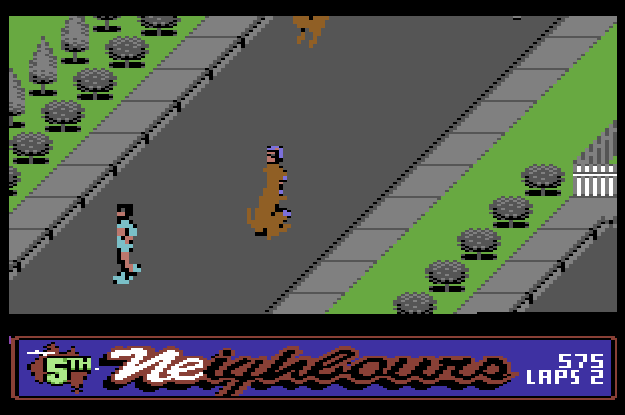
After you've chosen your opposition, a skateboard and decided what to do about your kangaroo, it's time to hit the road. It seems that in a long-forgotten episode, the Ramsey Street youngsters have been out and turned said street into a race track. They also appear to have rearranged the street, making it appear more like a maze than the cul-de-sac familiar to viewers of the TV show. Yourself as Scott Robinson and your competitors line up and begin racing. Rather bizarrely, each competitor has a different mode of transport. You use the skateboard that you picked earlier, and another of the racers also uses a skateboard, but the other competitors use a go-kart, bicycle and what looks like a lawnmower. Not that it really makes any difference to the race itself. Movement around the course is quite fluid although a bit fiddly at first, especially when taking corners. The idea of the game is simply to come first in the race, but making life more difficult are obstacles and the fact that you have to ride through pairs of markers. If you miss the markers, you need to go back on yourself to go through them. Depending on what you did in Scott's garage with your sheet, the obstacles include Mrs Mangle's dog Bouncer, Mrs Mangle herself, open manholes and manhole covers, and kangaroos. Oh yes, not only does every Australian keep a kangaroo in their garage, they also roam suburban streets. Here's a quick fact. In Neighbours, Bouncer, the dog, was paid more than the human actors! He was actually called Bouncer in real life too. That's two things I've learned today.
The best way to describe the gameplay is that it's a cross between Micro Machines, Paperboy and Horace Goes Skiing (or any skiing sim for that matter). Colliding too often results in you losing energy, with your energy bar represented by the Neighbours logo which loses colour as it depletes. If you win the race, you go onto another race where you face more obstacles and hazards, a redesigned street, and pairs of markers that are harder to get through.
I believe this was Lassiter's and Daphne's coffee shop. And that's Australia either side of it in case you need reminded where Neighbours was set.
The race itself is quite fun, but also frustrating. Collisions happen regularly, forcing you back a bit, and break up the flow of the game. If I was any good at the game, this probably wouldn't be a problem. The main problem though is that the street race feels more like a mini game than a full game. Although the game uses Ramsey Street as its setting, and includes the soap's characters, it feels that the game's link to Neighbours is tenuous to the extreme. Translating a soap opera to a computer game is never going to be easy, which is why there are very few other (if any) soap tie-ins, but more could have been made of the licence than just making a racing game with it. I'm not sure how, but a series of mini-games may have worked better. Maybe some sort of pool game in Madge's swimming pool, or trying to smash the windows of the houses by playing cricket in the street as featured in the opening titles (should I really admit that I remember that part from the show's opening?). Or trying to find out how many times you can play truant from Erinsborough High before Fisher expels you? Mr Fisher was Home & Away, wasn't he? Oh well. Anyway, yes, the game just feels like it's missing something and doesn't really capture the feel of the TV show that well. No matter how many kangaroos they insert into it.
The graphics do their job but aren't really that attractive and appear quite blocky even for a Commodore 64 game. Apart from a rendition of the theme tune, there's no other sound to speak of. Maybe the SID chip was exhausted after producing such a musical masterpiece. All in all, Neighbours isn't a terrible game but it's by no means a great game. It plays alright for a short period of time, but doesn't really maintain your interest and can feel a bit of a chore to play. It's quite simply a lazy tie-in, which doesn't represent the show it's based on at all well.
RATINGS Presentation: 60% A rather plain title screen, and not really anything going on in between action. Graphics: 65%
Dull and blocky and don't really represent Ramsey Street that well. Sound: 55%
The rendition of the Neighbours theme tune isn't too bad, but there isn't any other sound to speak of. Playability: 65% Quite fun at first and gets a bit better when you've got used to the controls, but it doesn't maintain your interest and doesn't draw you in for repeat plays. Overall: 65% A lazy attempt to cash in on the popularity of the television show.
Neighbours in other neighbourhoods
Aussies on the Speccy! Strewth!
As you'd expect, Neighbours wasn't a Commodore 64 exclusive. Instead, the residents of Ramsey Street found their way onto other computers too. Namely, the ZX Spectrum, Commodore Amiga and Atari ST. The Spectrum version was absolutely awful. With even more fiddly controls than the Commodore 64 version, a horrible version of the theme tune and barely recognisable sprites, you'd be throwing the overpriced cassette onto the barbie within minutes. On the Atari ST and Commodore Amiga, things were a little better. The graphics are much improved, which probably goes without saying due to them being on technically superior machines, and there is a greater variety of enemies and obstacles which make better use of their source material, but the controls are still too fiddly and it just isn't easy, or that fun, to play at all.
The opening screen on the Amiga version. Looks just like the TV show.
Traffic cones, cars in the middle of the road, some kid playing with his remote control car. Give me Summer Bay any day.
Game:Edd the Duck! Format:Commodore Amiga Developer:Impulze Year Released:1990 Also released on:ZX Spectrum, Amstrad CPC, Commodore 64 Now available on:Nothing
Andy Crane, Edd the Duck and Wilson the Butler in the Children's BBC Broom Cupboard
If you were a child of the mid-to-late 1980s or early 1990s and you grew up watching Children's BBC, you may remember The Broom Cupboard. In broadcasting-speak, The Broom Cupboard was an in-vision continuity studio situated somewhere in BBC Television Centre. It was basically a little room where presenters provided information about other BBC shows for kids, interviewed celebrities, announced competitions and provided introductions and links into other shows. Arguably, The Broom Cupboard became more famous than the programmes themselves, and gave several presenters their first big breaks into broadcasting. The Silver Fox himself, Phillip Schofield, found fame from the Broom Cupboard, as did Andy Crane and Andi Peters. Amongst the clutter of the Broom Cupboard (pictures, props, toys, monitors, illuminated signs), Phil, Andy and Andi shared their little studio with puppets, who became personalities in their own right. A young Phillip Schofield was accompanied by Gordon the Gopher, perhaps the most well-remembered of the Broom Cupboard puppets. Even today, he still makes appearances on TV, and recently appeared as Phillip's co-presenter on Dancing on Ice, a vast improvement on Christine Bleakley.
It's Edd the Duck!!!
Gordon and Phillip went on to present Going Live on Saturday mornings, leaving a couple of empty places in The Broom Cupboard. Andy Crane filled the presenter's seat, with the puppet's chair first occupied by a banana, called Ben (or Bobby), and later a duck with punk green hair. That duck was Edd the Duck. A huge fan of Kylie Minogue, Edd the Duck spent several years in The Broom Cupboard, assisting Andi Peters with presenting duties after Andy Crane departed. For the BBC, he was fantastic, as his image could be licensed to appear on all kinds of merchandise to fill their coffers even more. Inevitably, and rather handily for this blog, one of the licensed products was a computer game. Edd the Duck's game, called Edd the Duck! appeared on several home computer formats. And today, we shall look at the Amiga version.
The fish in this picture reminds me of Ben from EastEnders.
In Edd the Duck! you control Edd through various TV-studio related levels. Levels are based on the weather department, although there is no Michael Fish in it to deny any forthcoming hurricanes, special effects department and children's TV department (quick fact: The Broom Cupboard was used as an emergency news studio during the "great storm" of 1987, as it was the only studio at TV Centre with power!). On each level are a number of stars. Edd must collect all of these stars to complete each level. Quite conveniently, a counter at the bottom of the screen tells you how many stars are left on each level. Levels on Edd the Duck! scroll vertically, with Edd starting at the bottom of each level, working his way upwards a la Rainbow Islands. Oh yes, the influence for this game is quite obvious, with the only thing missing from this being the rainbows themselves.
This is where Microsoft got the idea for the design of the Windows logo. It's true.
Bees and the EastEnders Ben fish give Edd a headache.
Each level features a number of enemies. These cannot be killed, but they can be frozen, literally, by throwing snowballs at them. This stops them from moving and makes them harmless, although this is only temporary. When the snow melts, they begin moving again and become fatal to the touch. Put simply, the idea of the game is to collect stars and avoid enemies.
Edd the Duck! is presented really well, with some nice pre-game screens, intermissions, a good game over sequence and leader board. Graphically, it's all very nice and colourful, with well-defined cartoon-style sprites, detailed platforms, and a general feel of overall quality. Sound-wise, the music is terrific. There's only one tune that plays throughout the game, although this is actually quite a good, catchy tune, sounding very Children's BBC in style, and there is nice intro music, game over and leader board music too. There are no sound effects to speak of, but all in all, the game's presentation is all quite nice and jolly and captures the TV studio context well.
The sun is rather happy in this colourful picture
An image from the "Special Effects Department" level. This is where the BBC made Doctor Who.
Onto the gameplay, and again, it's not too bad. Edd moves at a good pace around the levels, and responds quickly to your instructions. One of the problems comes when jumping as it isn't possible to make Edd move when in mid-jump. The makes precision-landing quite difficult and causes the game to become frustrating in parts. This results in you taking your time and freezing all enemies in your path when it comes to attempting to reach stars in their vicinity, rather than relying on well-honed arcade skills to leap and jump wherever you want. This flaw is what gives the game its main challenge, as I suppose it would actually be quite an easy game if the controls were better. This is because, other than enemies scattered around the level, there is nothing else to cause you any problems. Edd can survive any fall, there's no rising water level to put pressure on you to hurry up, there are no dangerous inanimate objects, such as spikes, and there are no end-of-level bosses. Yep, the iffy jumping method adds challenge to the game, but takes some of the fun out of it. With better controls, the developers could have added various other features to the game to make it more of a test of gaming ability.
Moons, stars, mouldy green platforms and a smiley space shuttle populate this screenshot.
Another problem is that the game is quite short. There are only the three levels (weather, special effects, kids TV), each split into three stages. And the first level and the third level look fairly similar to each other. It is possible to get through the game quite easily, just by taking it one bit at a time, freezing enemies, collecting a star, and then moving to the next bit. But, doing it that way isn't much fun and you'll end up trying to whizz through the levels, but failing to get very far because the jump control isn't that great and it's all too east to accidentally jump into an enemy. Given that the game is obviously aimed at kids, I can't imagine that kids would get much pleasure out of it as they aren't exactly known for possessing much patience!
Edd the Duck! feels like a game that could have been so much more. A little extra work on the controls, and a few extra features, and it could have been a minor classic, maybe even giving Rainbows Islands, the game on which is it obviously attempting to cash-in, a run for its money. Instead, it remains a nicely-presented, moderately fun little game which will keep you amused for a short while.
It's the end of Edd's TV career after colliding with too many enemies. Oh dear.
RATINGS Presentation: 90% Nice loading screen and intro screen, with polished intermissions and leaderboard. Graphics: 83%
Clear and colourful, with attractive cartoon visuals, good animation and, on level two, a nice background. Sound: 85% The Amiga's sound chip provides some great tunes, although it would have been nice to have different music for each level. Playability: 76%
Easy to pick up and play, but suffers just because Edd can't change direction when jumping, and can get frustrating. Overall: 78%
An enjoyable platform game, but missing a few elements that could have made it amazing.
Edd on the Speccy! A game that can't be completed!
Edd the Duck! elsewhere
Being the worldwide superstar that he was, Edd the Duck made appearances on a few other computers at the time. In addition to the Amiga version above, he also graced the Amstrad CPC, ZX Spectrum and Commodore 64 with his presence. I gave the Spectrum version a go, and found that Edd is actually able to move while in mid-air in it, which makes controlling him a little easier. However, apparently this version of the game isn't possible to complete due there not being enough stars in one of the levels (the counter wants you to get 20, but there are only 19 on the level). A poke fixes this, but it does make you wonder what kind of playtesting went on before releasing games back then!
3D games - they've always been the holy grail of games developers; something they've sought to perfect for decades. Nowadays, they've pretty much cracked it, but over the years, we've seen many attempts to take gamers into a third dimension. Amongst them, there were holographic games in the early 1990s from Sega, who also released 3D games for their Master System a little earlier along with 3D glasses, Nintendo with their migraine-inducing Virtual Boy, and with their eyesight-destroying 3DS of current times. But, one style of 3D games that has been around for years and is still around to this very day is the isometric game.
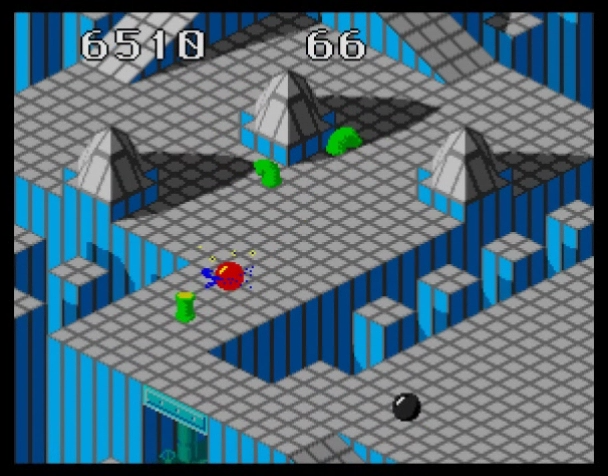
Oh yes, isometric games are games which are actually 2D but look three dimensional due to their dual perspective thingymagic. Or something. In the 1980s, there were such classics as Batman, Head over Heels, Knightlore and, er, Super Trolley. Into the 1990s, and we had Populous, Sonic 3D Blast, which was neither a blast, nor strictly 3D, a crappy sequel to Cool Spot in which the dot in the 7 Up logo went to Hollywood, and Mario RPG and Land Stalker. Around the turn of the millennium, it was becoming clear that isometric games went well with "God"-sims, with games like Theme Hospital, Sim City 3000 and The Sims all using isometric graphics. Today, all manner of lifestyle role-playing games, usually involving farms or cafes or shops or looking after pets populate Facebook and app stores, and in many cases, they're isometric. But one isometric game stands out amongst the rest as the most iconic isometric game there is. That game is Marble Madness, an Atari arcade game from 1984.
In Marble Madness, you take control of a marble, guiding it through a series of mazes to an exit. In your way are traps, enemies and falls. And that's pretty much it. Keep control of your balls, and you'll be fine, but if you let your balls drop too many times, you'll come a cropper. Marble Madness in the arcades featuring Escher-styled levels and a strangely eerie soundtrack which reflected the surrealness of the game, adding immensely to its atmosphere. It received conversions aplenty. But, how well did it convert to the various platforms out there? Let's find out as we compare the comparisons from worst to best.
1. Worst Version: ZX Spectrum
This version of the game is pure crap. On the Spectrum, the game was released twice - first as a Construction Kit and later as a deluxe edition. In either version, the game allows you to guide your marble through various 3D isometric levels, but they're completely different to the arcades. There's no scrolling, so once you each the bottom of a screen, you have to wait for the next one to appear, thus breaking up the flow of the play and sometimes leaving you in a position which results in endless deaths until your time runs out. The game doesn't capture any of the arcade game's atmosphere and just serves as a pile of steaming shit. And what the hell is going on with the music during gameplay? What gets me is the gushing reviews of it from the time. Your Sinclair seemed to think that Amiga owners would get almightily upset by this hunk of dross. Seriously?
2. Gameboy Advance
The conversion to the Gameboy Advance is actually the newest version, being released in 2004, 20 years after the arcade original. And although it accurately copies the arcade game's graphics, which you'd expect it to do, it gets everything else wrong. Sound-wise, the music is a little too funky and completely misses the importance of the finesse of the arcade original's score. Even so, it's all about the gameplay, innit? Unfortunately, Marble Madness on the Gameboy Advance plays like a dog. In the 20 years since its arcade debut, your marble has become quite arthritic, and guiding it around the levels is a chore. It judders and jerks as it slowly moves in the direction you want it to go in. Most of the time it doesn't even want to go in that direction and just shoots off at a random angle. Getting anywhere with this game is pure frustration. And you can't use the excuse that Marble Madness doesn't translate to the small screen, as well shall soon see. Avoid.
3. MS-DOS
I don't know anybody who would have had a computer running MS-DOS in the mid 1980s, but if they did, they would have been able to purchase Marble Madness for it. Not that they would have wanted to. The game features a rather interesting colour scheme, one channel music which sounds awful, and fiddly controls. They aren't too sluggish, but keeping your ball under control is quite a challenge. Bleurgh!
4. Amstrad CPC
This is a similar version to the Spectrum one. What stops it from being right down there at the bottom is the fact that the graphics feature a little bit of colour, the Spectrum's terrible "music" isn't included, and it doesn't feel quite as frustrating to play. It's still a hideous game, but there are worse versions.
5. Atari ST
This version isn't too bad graphics-wise, which you'd expect seeing as it's a 16-Bit version, but elsewhere it isn't great at all. Especially when you consider how well the game was converted to the Amiga. Controls and collision detection are rubbish, with your marble falling off platforms when it is clearly safely situated on top of one, and other places where it appears to be able to float in mid-air, when in fact it should be dropping to the ground. Despite this, the game is not too difficult to get through (although the video of me playing the game a little later doesn't suggest this!), but it just isn't that much fun.
6. Commodore 64
This is actually a similar version to the Atari ST version, obviously with 8-Bit graphics. However, in this version, the marble handles better, and the game seems to play a bit more fairly. The ball feels more like it is rolling rather than sluggishly dragging itself around the levels.
7. Commodore Amiga
This is one of the Amiga's earliest games, and is a great conversion of the arcade original, getting released only two years after the arcade game's debut. It is the best of the home computer ports, featuring accurate reproductions of the graphics, pretty good music and fairly good controls. Not bad at all.
8. Sega Master System
Deciding what should take position 8 was a close call between the Sega Master System and the Nintendo Entertainment System versions. In the end, I decided that the NES version just about pips the Master System version. The Master System version is fun to play, with good graphics and okay music. The controls are alright too, although there are occasions when the marble seems to go out of control.
9. Nintendo Entertainment System
The NES version was converted by Rare. Despite the technical differences between the NES and Master System, this version is more polished all-round and plays more like the arcade game than the Master System version. It also gives you a choice of control method which is quite handy.
10. Nintendo Gameboy
This is a fantastic version and it is truly remarkable how the arcade game was minaturised and squeezed into the little screen of the Gameboy. It looks and sounds great, and plays really fluidly. Whereas some of the games feel a bit of a chore to play, this is actually great fun.
11. Sega Mega Drive
Easily the best home version of Marble Madness is the version released for the Mega Drive. It is pretty much a straight conversion of the arcade game, looking, sounding and playing as close to the original as possible. This verson also features difficulty level settings to make the game easier or harder for you.
Rumour has it that there were actually two versions of Marble Madness released for the Mega Drive. The one everybody knows about is the version released by Electronic Arts for the US and European markets and as described above, it's a fantastic conversion. However, apparently Tengen released a Japanese version, which is even more arcade-perfect. Unfortunately, the game goes for a fortune on eBay, and isn't available as a ROM to be played through an emulator, so finding out whether it is different and/or better than the Electronic Arts version isn't easy.
In conclusion, there were numerous conversions of Marble Madness for a variety of systems, ranging from totally awful yo absolutely terrific. The downside of all versions is that the arcade game was too short, with only six levels, and none of the conversions add anything extra to the arcade game. It might be that the Mega Drive version comes out as best, but did the original price tag of £40 actually represent good value for money? Plus, the arcade game wasn't really that much fun, was it? More annoying than entertaining.
As an extra treat, seeing as I'm now getting a little better a capturing video and putting it on YouTube, here's a video comparing each of the versions above!