 |
| That's a weird looking axe. It's as if it can't decide what it is. Am I an axe or a sword? I'll be both. |
Game: The Legendary Axe II
Format: PC Engine/TurboGrafx-16
Developer/Publisher: Victor Interactive Software/NEC
Year Released: 1990
Also released on: Nothing
Format: PC Engine/TurboGrafx-16
Developer/Publisher: Victor Interactive Software/NEC
Year Released: 1990
Also released on: Nothing
Now available on: Nothing
In a land dominated by home microcomputers back in the 1980s, it took a while for the console gaming market to really take off in the UK, and indeed over in the rest of Europe. Although Atari, Mattel and Coleco had all had a European presence since the dawn of the console industry, their machines were never really a threat to the mega-popular computers from Sinclair, Commodore, Amstrad and Acorn. It was only towards the end of the decade that things began to change. The Sega Master System and Nintendo Entertainment System both began to take some slices out of the home gaming pie as console sales started to pick up. Not wanting to share the market that they still dominated, Amstrad and Commodore attempted to release console-ised versions of their computers, the doomed Amstrad GX4000 and the equally ill-fated Commodore 64GS. For a variety of reasons, nobody was interested in them. Instead, they were looking to the future, to new more powerful consoles that were making their way from foreign lands in the East: the Sega Mega Drive, the Super Famicom, and the PC Engine.
Except, it seemed, that the manufacturers of these new machines of wonder weren't in any rush to get them over to Europe. After Europe had all but shunned consoles for much of the eighties, it seemed that Europe would remain at the back of the queue to get the shiny new machines. Sega and Nintendo held off launching their new machines for quite a while. The Sega Mega Drive finally made it to Europe in Autumn 1990, two years after its initial Japanese release, and the Super Nintendo didn't make it here until Spring 1992, almost two years after its release in Japan as the Super Famicom. But what about the PC Engine? Well, it appears that NEC, the company behind the tiny little console, weren't really that interested in the the European market at all, and didn't even release it over here. There was apparently a PAL version manufactured and distributed in very small quantities, but it hardly counts as an official release. Nope, if you wanted to play the PC Engine in Europe, you had to import one. So, why was this continent overlooked by NEC? And what did we miss?
The PC Engine was NEC's first console, and it was in their home market that they initially partook in battle. The console was released in 1987, and their first opponent was Nintendo. The 8-bit Famicom (NES for westerners) had dominated in Japan for a few years by then, but was beginning to look old. Well, it had always looked old. The PC Engine, despite also technically being an 8-bit console, played more like a 16-bit machine and got off to a great start, eating into some of Nintendo's share of the market. In its home market, the PC Engine even outsold the Mega Drive, released the following year. Nintendo would claw back some of its portion of the market with the release of the Super Famicom in 1990, while Sega were never able to overcome either, remaining in third place in Japan.
Just as Nintendo had done with the Famicom a few years earlier, NEC wanted to take their new console over to America. Having had a successful stab a denting Nintendo's profits in Japan, NEC presumably thought they could do the same thing in the USA and decided to release their console there. However, Sega had similar plans, and they weren't going to let NEC get a head start this time. Both NEC and Sega released their renamed consoles, the TurboGrafx-16 and the Genesis, in America at about the same time. Sega already had a presence in America with their Master System console, but seeing as it only had a piddly percentage of the market, it hardly gave them any real advantage at all over NEC. What did give Sega the advantage though was a great marketing campaign. Sega's strategy seemed to be about demonstrating what the Genesis could do that its competitors couldn't, specifically Nintendo but they took shots at NEC too. As far as technology goes, the Genesis was clearly superior, and their marketing showed this. They were also keen to tap into a more mature market. The kids that had grown up with Nintendo consoles were now teenagers, and wanted something more edgy, more cool, not something for children. The Genesis was that console, not the Nintendo Entertainment System and not the TurboGrafx-16. Genesis had the sports licenses, the best arcade game conversions, and some unique original games were on their way too: Moonwalker, Castle of Illusion, Dick Tracy and of course a certain blue hedgehog. It was Sega, not NEC, that robbed Nintendo of a large chunk of their user base, and the market was split pretty much equally between Sega and Nintendo once the SNES arrived on the scene for the next few years.
Having had little success in the USA, it's probably likely that NEC took a look a Europe and decided not to bother. The PC Engine's release in Europe was rumoured to be around the time of the launch of the Mega Drive, and NEC probably expected to face the same issues when battling Sega in Europe. Probably even worse, seeing as Sega already had a success on their hands with the Master System in Europe. Sega had a more powerful console on its way, plus an already-established fan base.
Now, had NEC decided to release the PC Engine in Europe in 1989, at a price of around £99, things may just have been very different. The PC Engine did get coverage in the European gaming media, just as the Mega Drive did, as an import device, and probably in anticipation of an official launch in the not-too-distant future. So video gaming fans had an awareness of its existence. It was seen as part of the new generation of consoles, more powerful than anything currently available. A head start over the Mega Drive would have made it the only console available of the new generation. And even when the Mega Drive launched, it's possible that gamers would have stuck by it. Europeans are known for their loyalty to comparatively underpowered machines. The ZX Spectrum, Commodore 64, Sega Master System all managed to maintain support well into the 1990s, years after the technology in them was ancient. The PC Engine may just have been another console that Europeans took to their hearts, and loved and supported. But we never had the chance to love and support it. Instead we had the now-legendary battle between the Mega Drive and Super Nintendo. But how different could that have been if the PC Engine was involved in it too? Sadly, we'll never know. Europeans never really got the opportunity at the time to experience PC Engine games for themselves. This has changed in recent years. Many PC Engine/TurboGrafx-16 games finally made their official European debuts on the Wii's Virtual Console service, and can still be purchased for however long the service continues. And of course, there is always emulation. Dodgy as it may be, it really is the only way to play PC Engine/TurboGrafx-16 games, games not available on the Wii and that would otherwise be lost to history. And as a console that failed to make it into Europe, it has a library of games that remain undiscovered by many people, including myself. So, to right these wrongs, I've decided to explore some of the console's games, in the hope of finding some hidden gems.
 |
| He's got a good pair of gnashers. Could do with some whitening toothpaste though. |
 |
| Prince Sirius shows blue-haired bloke and red-haired chick his new sex toy. |
 |
| Ow! My head! And why have I got a sword through my hand? |
After watching the story unfold, you get on your way. You start off with a sword, and can collect items that defeated nasties leave behind to enhance its power, or other weapons if you feel like a change. As well as the axe mentioned earlier, there is also a morning star, whatever one of those is. A ball and chain I think. The sword is a pretty good all rounder, and is probably the weapon you'll use the most. The morning star has a good range and can attack in multiple directions. but isn't very strong. And the not-so-legendary axe is quite powerful, but has a short range, so isn't particularly brilliant. Other collectibles include bombs which when detonated, destroy everything on screen. These are usually most handy for the end of level bosses, but you don't really need to use them until later on in the game, so it's best just to save them up. You can also collect stars, moons and suns, which either give your energy meter a boost, fill it up to full fullness, or give you an extra life.
 |
| The thing behind the wall wants to get out. Not sure how he got there, and why his head and leg seems to be mispositioned. |
 |
| There's nothing more annoying than treading in gum. Is it yours? I'll whack you over the head with my axe if so. |
The Legendary Axe II is a dark dark game. Not just in graphics, but in tone. It just feels sombre, threatening, depressing, oppressive and menacing. It's not the sort of game you'd play if you need cheering up. You'll play through some very dark, and often quite bizarre, levels. One level has a skeleton trapped behind the wall in the background, trying to escape through gaps in it, another sees you jumping from a platform of skulls to another platform of skulls. There is a level where you descend deeper and deeper through caverns of slime-covered walls. End of level bosses are equally as odd. One is a midget swinging a massive ball at you, another is a what appears to be a doll or young girl who splits into other young girls and then transforms into standard enemies from the game. In contrast to everything that has gone before, you end the game in some sort of futuristic maze. Rather than being attacked by the undead, your foes are robots. Finding your way through the maze is quite a challenge, and once you've managed it, you're faced with a rather tough end of game boss. Even the ending will baffle you. When you've completed the game and just as you take your seat on the throne, a woman appears to fly at you out of the blue with some malicious intent. Before you know what's going on, the end credits begin. If you play the Japanese version, she appears to have forgotten to put her clothes on too.
 |
| Balls |
 |
| I offered to babysit, and then the kids went all weird on me. Never again. |
The game does throw a good challenge at you but is beatable. It is similar in style to games like Castlevania, but isn't as ridiculously tough and unfair as that. However, it seems to lack Castlevania's charm and probably isn't something you'll want to come back to soon after completing it. The feeling of dread that characterises it isn't always going to appeal to somebody looking for a quick game to play. But it's fun nevertheless and is a good example of a game that us Europeans were deprived of. Shame on you NEC. Why did you spare us from such joys? Humph!
 |
| Ever wondered what Big Bird would look like without his feathers? Well wonder no more. |
 |
| Prince Sirius has a rather odd looking toilet in his house. The eye is actually the flusher, and a finger on the left hand holds the toilet roll. |
RATINGS
Presentation: 70%
A simple main screen, no options to speak of, but the game begins with a short intro giving a bit of background to why you are doing what you do.
Graphics: 78%
Dark, dull, depressing, but in a good way. Great if you like the colours grey and brown. Animation is good, and end of level baddies are great.
Sound: 75%
Atmospheric tunes and suitable sound effects.
Playability: 80%
Instantly enjoyable and stays entertaining throughout, although you probably need to be in the right mood to want to play it. Throws a good challenge at you but never feels unfair.
Overall: 78%
A surreal, creepy little game, well worth seeking out if you have a PC Engine or TurboGrafx-16.
Playability: 80%
Instantly enjoyable and stays entertaining throughout, although you probably need to be in the right mood to want to play it. Throws a good challenge at you but never feels unfair.
Overall: 78%
A surreal, creepy little game, well worth seeking out if you have a PC Engine or TurboGrafx-16.
BONUS SCREENSHOTS
Seeing as I spent most of this review going on about the PC Engine/TurboGrafx-16 and why it didn't make its way to Europe and not the game itself, I've got a few left over screenshots of the game. It's a shame to waste them, so here they are:
Seeing as I spent most of this review going on about the PC Engine/TurboGrafx-16 and why it didn't make its way to Europe and not the game itself, I've got a few left over screenshots of the game. It's a shame to waste them, so here they are:
 |
| It might look like Prince Sirius has just knocked out that nasty, but he actually fell over the rock on the floor. Sirius is actually levitating for no apparent reason. |
 |
| Stop it! That tickles! |
 |
| Parp! |
 |
| I really don't know what to say here. Except, why doesn't Prince Sirius wear many clothes. I'm sure most royal types don't wander around semi-naked. At least I hope not. Urgh! Prince Charles in his undies. |
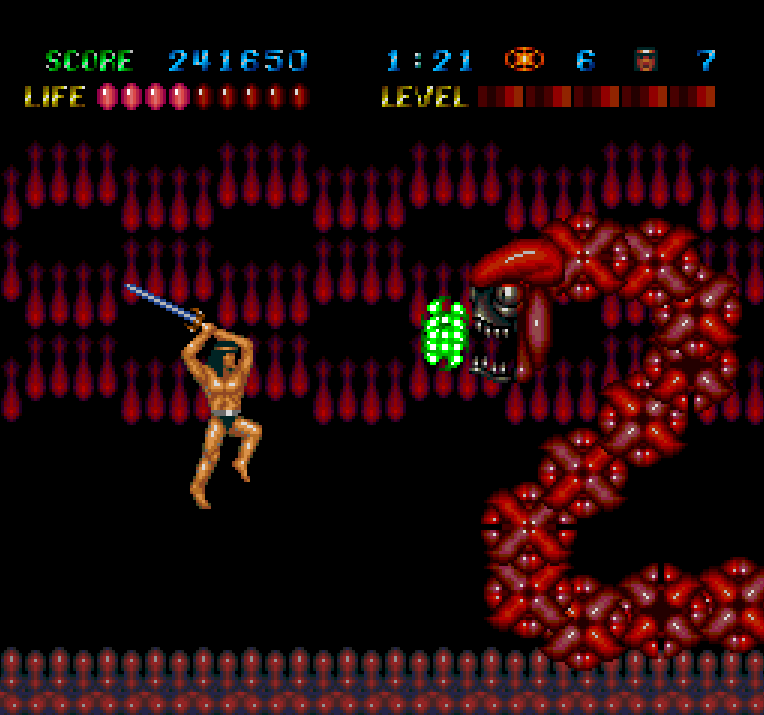 |
| Achoo! Yes, that's snake snot there. |
 |
| Parp! |
 |
| Roboman gives Sirius the finger. Bad Roboman. |
 |
| Sirius camply scarpers with one of Pat Butcher's earrings. |
 |
| Still scarpering, still with Pat's earring. But in a disco where only one light works. |
 |
| Sirius meets Zach, his evil brother, sitting atop a, um, don't know what. |
 |
| When toilets attack |
 |
| After defeating Zach, Sirius takes his place on top of whatever it is. All of a sudden, a lady launches herself at him. What happens next? Who knows?
The Legendary Axe II - The Video
Oh yes, as a special reward for getting your way through this review, you can watch the game in action from start to finish. Enjoy!
|


