A massive sign blocks the only way in to Adventure Island
Game:Super Adventure Island Format:Super Nintendo Developer:Hudson Soft Year Released:1992 Also released on:Nothing Now available on:Wii Virtual Console (800 points)
It's 2014 and the new generation of console gaming is finally with us. Once again, the three main contenders - Sony, Microsoft and Nintendo - have put forward their offerings for this latest bout. It's still very early days, way too early to predict a victor. The PlayStation 4 and Xbox One both appear to have got off to great starts and seem to be pretty much neck and neck, while the Wii U, even with the advantage of a year's head start, seems to be wandering around aimlessly like somebody's drunk uncle, not sure of its place or purpose, hoping that somebody will figure out that it is a brand new console and not just a variation of the original Wii.
New technology brings new capabilities, and this will undoubtedly mean that games become more realistic. This isn't just in terms of graphics, gameplay environments, physics and suchlike. Oh no. Developers are adding more depth to the characters in their games, giving them multi-faceted personalities and a greater variety of traits. They want gamers to become more emotionally involved in games, immersing themselves in the world of the characters that they are controlling - characters with human-like flaws, complexities, prejudices, their own set of morals - good or bad. The characters may not always be likeable, but as they possess more real personalities, gamers are likely to be able to empathise with them and understand how and why they behave in the way that they do.
Master Higgins is toast if he doesn't make these jumps
Of course, I've been empathising with video game characters for years. Master Higgins, of Adventure Island fame, is one such character I find myself relating to quite easily. You see, Master Higgins appears to frequent Adventure Island with a bizarre amount of regularity. It reminds me of my childhood when, no matter whether it was the summer holiday, Easter, half term or just a random weekend, I seemed to find myself at a caravan site in North Wales. My mum and dad having a holiday home there was probably something to do with it. I'm sure my adventures in North Wales weren't anywhere near as exciting or treacherous as Master Higgins' are in Adventure Island, but they probably come close. We once nearly got stuck in a flood near Cricceith, and I remember getting lost in the sand dunes on the beach once. I even very nearly had my very first kiss while there. And, this story of youthful romance even has a retro gaming element to it. It was the summer of 1992, and I'd spent three weeks on holiday there. I was at a special age, 13, nearly 14. And I became aware that I'd noticed a young lady with long dark hair while wandering around the arcade of an evening. I also noticed that she appeared to have spotted me too, and it became quite apparent that we spent much of the three weeks there giving each other knowing glances. On the final night, I was standing at a 5p-a-go fruit machine with a friend, watching him pump his pocket money into it in the hope he'd win the £2.50 jackpot. Behind me was the Out Run machine, and standing at it was the girl with long dark hair and her friend. All of a sudden, the friend walked over to me and asked me if I'd "go with" long dark haired girl. I froze on the spot. Back then, I didn't really understand what to "go with" somebody meant. I muttered something about having to go home the next day, which got the response "So?". After what felt like hours of standing there, wanting to say yes but not sure exactly what I'd be letting myself in for, the girl walked back to her friend at Out Run and they went away. And that was it. For years I kicked myself about the missed opportunity. Oh well. Yes, even in the romantic misadventures of my youth, retro games seem to feature. In fact, this wasn't the only time. A few years later, a Nintendo Entertainment System and Duck Hunt hampered another opportunity.
Worst date ever....
Back to Adventure Island where it appears Master Higgins had more luck with the ladies than I did, seeing as one of the reasons for him going there time and time again was to rescue his kidnapped girlfriend. Unlike my visits to North Wales, which have never (yet) been depicted in a video game, Master Higgins' visits to Adventure Island were immortalised in a series of games for a range of consoles, namely the NES, SNES, Gameboy, PC Engine, Wii and even the Gamate. Today we'll be looking at his first appearance on the SNES which went under the title Super Adventure Island because it was the fashion at the time to slap Super to the beginning of titles for games on the SNES. But before we do, let's take a quick look at Adventure Island's convoluted, complex but not-really-that-interesting origins.
Wonder Boy - Adventure Island's spiritual ancestor
Adventure Island began life as the arcade platform game Wonder Boy, which featured Tom-Tom's quest to rescue his girlfriend. Being named after a sat nav, Wonder Boy easily found his way to home computers and consoles with ports appearing on the Spectrum, Amstrad, Commodore 64, SG1000, Master System and Game Gear. Hudson Soft acquired the rights to produce the game for the Famicom/Nintendo Entertainment System but legend has it that they decided to change the main character. Instead of featuring a nappy-wearing toddler named after a not-yet-invented satellite navigation system, it instead featured a caricature of Hudson Soft's PR man, Takahashi Meijin. They also decided to change the game's name to Adventure Island (for Westerners anyhow - in Japan the game's title translated as Master Takahashi's Adventure Island). However, seeing as the legend in this case is Wikipedia, there's a good chance that it's wrong. Other sources suggest that, although Hudson Soft acquired the rights to the game from Wonder Boy's developers, Escape (now Westone Bit), they didn't acquire the rights to the name and its main character, which were owned by Wonder Boy's publisher, Sega. Whatever happened, Adventure Island on the NES was basically Wonder Boy with a different name and without Wonder Boy himself and with a small number of creative changes. It's not quite as good a conversion as the one for the Master System, but it's not bad.
Throwing an axe at an innocent looking snail in Wonder Boy (arcade version)
Despite their shared beginnings, Wonder Boy and Adventure Island went on to become two independent franchises - kind of. Whereas subsequent Wonder Boy games contained more role-playing elements, Adventure Island's sequels mostly kept to the arcade platform style of the original. Wonder Boy was first followed by Wonder Boy: Monster Land in the arcade in 1987, which like its prequel received conversions for home computer and consoles aplenty, mostly under the name Wonder Boy in Monster Land, sometimes with a Super at the beginning of it. In Japan, the Master System conversion was named Wonder Boy: Monster World and was the beginning of the Monster World franchise. As with the NES conversion of Wonder Boy, Hudson Soft's conversion of Wonder Boy in Monster Land, this time for the PC Engine, featured different characters and a different name, becoming Bikkuriman World with characters based on those in a Japanese anime. To confuse things further, Hudson Soft's mobile phone port of Wonder Boy in Monster Land in 2005 was called Super Adventure Island, not to be confused with the SNES game with the same name that I'm meant to be reviewing here. I'll get there eventually.
Wonder Boy III: Monster Lair was the third and final Wonder Boy arcade game, appearing in 1988. It was converted for the Sega Mega Drive/Genesis in 1990 and PC Engine/TurboGrafx in 1988. Hudson Soft handled the PC Engine conversion and this time tampered with the name by just calling it Monster Lair. In Japan, a Master System sequel to Wonder Boy: Monster World (the one known elsewhere as Wonder Boy in Monster Land) was developed. It was to be known as Monster World II: Dragon's Trap. However, as the Master System had been dropped in Japan, the game didn't get a release over there until it later appeared on the Game Gear in 1992. But, over in Europe, where the Master System was still a big seller, the game did get released in 1989 under the title Wonder Boy III: The Dragon's Trap. It really is one of the Master System's greatest games. Hudson Soft, once again, had their mitts on rights to this game, releasing it on the PC Engine as, um, Adventure Island. Gah! In the US for the Turbografx, it became Dragon's Curse.
After two different Wonder Boy III games, Wonder Boy's fifth appearance was on the Mega Drive, where, in 1991, he appeared in Wonder Boy in Monster World in the USA and Europe, and Wonder Boy V: Monster World III in Japan. The game also appeared on the Turbografx-CD as The Dynastic Hero. The game was also released on the Master System in Europe in 1993, keeping the name Wonder Boy in Monster World. The final game in the Wonder Boy/Monster World series was Monster World IV, a Mega Drive exclusive released only in Japan in 1994. The Wonder Boy name had been dropped from the title, and the game's main character was a girl. Monster World IV finally made it to Western shores in 2012, appearing on the Wii's Virtual Console service. Since its appearance there in 2012, no more Mega Drive games have been released on the Virtual Console.
So, that was Wonder Boy. I have a headache now. Fortunately, Adventure Island's history is slightly less complex, especially if we ignore the fact that some conversions of Wonder Boy sequels had Adventure Island in the titles. A couple of sequels followed Adventure Island on the NES, namely Adventure Island II and Adventure Island III. A fourth game appeared in Japan for the Famicom, apparently the last official Japanese Famicom game to be released. Two Adventure Island games appeared on the Gameboy, Adventure Island and Adventure Island II. Adventure Island was based on Adventure Island II for the NES, and Adventure Island II was based on the NES game Adventure Island III. Super Adventure Island and Super Adventure Island II appeared on the SNES. Super Adventure Island was released on the SNES after Adventure Island II on the NES so is the third home console Adventure Island game. The fourth was New Adventure Island for the PC Engine/Turbografx. Super Adventure Island II on the SNES went down the role playing adventuring route of the Wonder Boy sequels. This was Master Higgins' final console appearance until he returned in Adventure Island: The Beginning for the Wii in 2009. Coincidentally, I returned to the holiday park of my childhood in 2009 too. And this kind of brings my whole point about empathising with Master Higgins full circle and concludes my quick but possibly inaccurate summary of the Wonder Boy/Monster World/Adventure Island series.
One of the best things about the Wonder Boy and Adventure Island games is that many of them are still available to play on several of the latest consoles. Pretty much all of the Wonder Boy games are available on the Wii Virtual Console, along with the Adventure Island games, while some of the Wonder Boy games make appearances on the Xbox and PlayStation online services.
Totally rad skateboarding skillz here dude
So, after an introduction which went on much longer than I anticipated, it's finally time to join Master Higgins for his first 16-Bit based trip to Adventure Island. The story begins with Master Higgins and Tina sitting atop a tree, gazing at the stars. While Master Higgins occupies himself by rubbing his head, the evil Dark Cloak casts a spell on Tina and turns her into stone. Angered, Master Higgins waves his fist at Dark Cloak as he flies away. A rather large bird picks up Master Higgins and whisks him off to Adventure Island so he can make his way to Dark Cloak's castle and give him his comeuppance. Tina remains at the top of the tree in her stone-like form. That's the plot, a plot which is clearly so great that the writer of it gets first billing in the end credits. Forget about the graphics designers, programmers, musicians and so on. Their talents are nothing compared to that of the author of the story behind Super Adventure Island.
Here's the reason why sealions shouldn't hold their breath.
Climbing a tree covered by snails. Nasty things snails.
Totally destroyed my strawberry plant last year.
Master Higgins arrives at Adventure Island unarmed, but he quickly picks up an axe which he can throw around at will. And at snails and other such creatures. At first, you can only throw one axe at a time but collecting more axes scattered around the level increases its throw rate and power. At maximum power, the axe turns a purple glowing colour and can even destroy rocks. But that's not all. You can also exchange your axe for a boomerang. The boomerang is handy for attacking enemies from long range and above or below you. The axe remains good at short range. Conveniently, the game tends to ensure that the best weapon for the task ahead is usually made available to you just when you need it. Handy.
An end of level baddie with a light saber. Or glow stick.
It's gone mighty chilly on Adventure Island, and Master
Higgins has only packed his grass pants.
Unlike the original Adventure Island/Wonder Boy, it isn't possible to make Master Higgins run faster by holding down the fire button. This can cause a few frustrations when making longer jumps as you don't get chance to build up speed and go for it. It also sometimes feels like although you've timed a jump well, you actually fall short of your target, usually resulting in your death. It is possible to do high jumps by holding down when you jump and this becomes quite easy to pull off when you get used to it. Alternatively, for greater speed, a skateboard is sometimes made available to you. Unfortunately, you can only go in one direction on it and it doesn't usually take you long until you lose it by colliding into something. If you do manage to still have it by the end of the level, you aren't able to take it onto the next.
Special stage a go-go!
Inside the belly of a beast. Looks like he's been eating
pinepple and kiwi, and eels.
Super Adventure Island is split over five stages each containing three areas plus a boss bottle. Most levels are your typical left to right side scrolling affairs, although there are a couple of upwards scrolling and swimming levels, plus that old platform game favourite, a mine cart level. There are also special stages available, although accessing them appears to be by throwing your weapon into an empty space - good luck remembering where you found the special stages when trying to locate them again! Each level, area, or whatever you want to call it is different to each other in appearance- no two levels are the same. Even so, the game does feel a bit repetitive as the basic format remains the same throughout. Run, jump and smash the crap out of the weird and wonderful creatures of Adventure Island with your axes and boomerangs. Each level is also quite short, with most (once you get used to them) taking only a minute or two to get through. This means that you don't really get the opportunity to feel immersed in the theme of the level that you're in - it just seems that you're passing through them. The end of stage boss battle is varied for each one, but they remain consistent in that they're all a piece of piss to beat. The only one that offers any challenge is the final one, but this isn't a battle as such as it doesn't require you to use any weapons. A battle of wits and skill maybe.
The obligitory mine cart level.
Meeting a foe in the forest.
The graphics in the game are great, and remain consistently high throughout. Levels are colourful, sprites are large and detailed and everything looks the part. Music is also fantastic too and is more representative of early nineties dance and R&B than typical videogame music. The man behind the tunes was none other than Yuzo Koshiro, better known for composing the famous soundtrack of the Streets of Rage games. Overall, the game feels very polished, and doesn't bother itself with unnecessary intermissions and cut scenes. It just keeps to the arcade game style of Wonder Boy. In a way, this is one of its problems. It perhaps feels too much like an arcade game for a console. It's addictive (if a little frustrating at first) and easily draws you in, but it doesn't last long at all. You'll keep coming back for more because, each time, you get a little better at it. But, once it's completed, there isn't really any return value. And playing it through doesn't give you a feeling of being part of an adventure in a series of engrossing worlds. It's great that the game tries not to repeat the themes of levels over and over again, but you just don't have time to even feel part of a level before you're on to something completely different. You can have the game done in half an hour, which simply isn't good value for a game that would have cost you £40 on release. It's undoubtedly a fun little game which looks and sounds great, but it's frustrating in parts, a bit too short and it isn't really that captivating. Nowhere near as captivating as my holidays in North Wales were.
After years in the spotlight, Dumbo turned to a life of drugs and drink and general rebellious activity. Here he is at
a particularly difficult stage in his life.
RATINGS Presentation: 80% A title screen and animated introduction are all there really is presentation-wise, but this feels right for the game. Less is more as they say. Graphics: 85% Although they don't push the SNES's abilities too much, the game features large colourful sprites and a great variety of graphics which represent each level's theme well, although the graphic designer's efforts are a little wasted as you don't get chance to look at them for very long. Sound: 90% A selection of funky tunes plays throughout the game and add some coolness to the game. Playability: 80% The game feels a bit clunky at first, especially if you're used to controlling the main character in the original Adventure Island/Wonder Boy, but once you're used to it, it becomes quite an enjoyable game to play. Overall: 82% A true arcade-style platform game. Not the greatest SNES game, and probably a bit too linear and short to retain your attention, but most definitely worth a look.
Super Adventure Island playthrough on YouTube
Oh yes, not only have I spent forever trying to write this review, I've also played the game through, recorded it and uploaded it to YouTube. Enjoy!
Game:Psycho Fox Format:Sega Master System Developer:Vic Tokai, Sega Year Released:1989 Also released on:Nothing Now available on:Nothing
Many people associate the Master System with Alex Kidd. Some associate it with Wonder Boy and some even associate it with Sonic the Hedgehog. Each character featured in multiple games for Sega's 8-bit machine, but there was another platform star whose appearance on the console was well-received at the time and is remembered by those who knew him with fondness today. That character was Psycho Fox who featured in a game which bore his name in 1989.
Psycho Fox throws the bird.
As with most platform games, it's Psycho Fox's job to rid the world of some troublemaker who has some dastardly plan to do bad stuff. I'm sure the troublemaker and his intended bad stuff is described in the instruction manual somewhere, but I really can't be bothered to find out. The text on the back of the box just talks about Psycho Fox being "an adventure game centering around the entertaining and thrilling escapades of a very special fox", who "ventures into many strange worlds to conquer the strange beasts and boss monsters he encounters." It then goes on to say the same thing in other European languages. Well, at least I think it's the same thing. There could actually be six completely different descriptions of the same game on the boxes for European releases. The text on the box for the US release is slightly less generic and asks if you're bored of rescuing princesses, sick of dungeons and "mother brain". What the fudge is "mother brain"??!! It basically suggests that, if so, Psycho Fox is the game for you. It also talks about the world needing saving from Madfox Daimyojin. It also asks if you've heard of Zizo Zizo or Poola. Apparently these are some of the unheard-of enemies that you'll encounter. I suppose they wouldn't be able to be described as unheard-of if you'd actually heard of them. Oh yes, we need more analysis of the descriptions of games from their boxes in the future.
What on earth?
So, the game itself. Psycho Fox must travel through many strange worlds to defeat Madfox. Although the strange worlds don't actually appear that strange - there's your usual desert, ice, cloud, underground levels on offer here - some of the creatures that inhabit the worlds are very bizarre, and there are some unique ideas in the levels to set the game apart from its contemporaries.
Invincibility a go-go.
As his name suggests, Psycho Fox is a bit of a nutter. Like Mario, he can defeat enemies by jumping on them. But, unlike everybody's favourite Brooklyn-based plumber, Mr Fox is not content to just bounce on nasties and move on. He can land on enemies multiple times, pounding on them again and again until they are buried deep underground. If a semi-buried enemy tries to get out, just jump on it another time to make sure it doesn't try to escape again. Alternatively, Psycho Fox can just walk up to an enemy and punch them in their face. Or, if the enemy is too far away, he can throw a bird at them instead. Yes, even for a fox, Psycho Fox seems quite disturbed. The bird that Psycho Fox throws at enemies is called Birdfly. You can find Birdfly in eggs scattered around the levels. Being a fox with clearly psychotic tendencies, Psycho Fox cracks open eggs by thumping them. After being thrown, Birdfly will loyally return to Psycho Fox, ready to be thrown again. Maybe Birdfly is a bit of a hardnut too. Birdfly also acts as a shield. Usually if you collide with an enemy, you lose a life. But if you're carrying Birdfly, he will vanish but allow you to retain your life. Finding Birdfly again is a simple case of smashing open more eggs and hoping he's in one of them.
Spray that insect thing with insect spray and it'll buzz off.
Psycho Fox as Tiger on level three
It's not just Birdfly that you can find in eggs. Other eggs contain special items, extra lives or bags of money. But not all eggs contain Brucie Bonuses. Some eggs are empty, while others contain enemies. The sneaky beggars! The special items that you collect get stored in an inventory which you can access by pausing the game. The items to choose from in this screen are a Psycho Stick (which also goes by the name of the stick of the Shinto Purification - ???!!), a straw effigy and a potion. Using the effigy makes the screen go wibbly-wobbly and destroys all enemies on the screen. The potion makes Psycho Fox invincible for a short period. And the Psycho Stick, or the Shinto Purification thingy, allows you to transform Psycho Fox into another animal: a hippo, monkey or tiger. Each animal has its own strengths and weaknesses. For example, the hippo is slow, doesn't jump as high, but has an extra-strong punch, useful for breaking down some otherwise indestructible walls. The monkey jumps high while the tiger runs fast. Psycho Fox in his foxy form is a good all rounder. You will remain as the animal you've changed into for as long as you wish to. Just use another Psycho Stick to change into something else.
Bonus level! Get yer bonus level 'ere!
So, what about the money bags you collect? Well, after each round, you get to gamble it away. In a quick bonus round, Psycho Fox is presented with 5 pathways. At the end of each pathway is a prize. You have to choose which pathway to send Psycho Fox along and will win the prize at the end of the path. As you can collect multiple bags of cash on your way, you can bet on multiple paths. Or you can place multiple bets on one path. So, if you collect five bags of cash, you can bet on each path which guarantees that you win each prize. Be warned though, because one of the prizes is a boobie prize. Not a pair of tits, but a hole which Psycho Fox will fall down if he reaches it. All that happens if he does is that he doesn't win anything for that path, but will still win the prizes at the end of any of the other paths he reaches. The prizes that can be won are the special items found throughout the game plus an extra life, or the chance to play on a number stopper thing (apparently it's a shrine). Whatever number you stop it on will grant you that number of lives. And depending on how many bets you placed on that path, the number of lives you get will be multiplied. The bonus round is a fun little interlude and gives you the opportunity to build up a healthy number of lives. Get lucky and you can get up to 25 extra lives on the bonus round.
Bouncing around on level 5. That thing to above left of Mr Fox is blowing air which will push him to the right.
Levels are split into three rounds with a boss at the end of each third round. For some bosses, you are provided with an item to help you to defeat them. This may be a pesticide spray or an air gun. Some are defeated using more traditional means, and the end battle is a good old 8-bit battle of wits and skill. Unfortunately, each boss - including the final one - only requires three hits to be defeated, so the battles don't tend too last long at all.
Barney the dinosaur has a problem with bees.
Each level in Psycho Fox is full of colour and cartoon-like in appearance, with everything well drawn and animated. The music is of a good standard too, well-suited to the game, although the last few levels seem to use the same tunes for some reason. It is one of the better-looking and sounding Master System games. But it's also good fun to play. At first, Psycho Fox feels a little sluggish to get moving, gradually building up speed as he goes along. And if you play the game cautiously, it will feel quite slow and frustrating to play as you never get the chance to get up to a good pace. It's best just to go for it, running, jumping and thumping your way through the levels and hoping for the best. But even following this strategy can be a pain as it's simply not possible to maintain it. All too often, Psycho Fox will come up against something which will stop him in his tracks and cause him to have to slow down. And when Psycho Fox goes slow, he goes real slow. Heaven knows how I used to play this on my PAL Master System back in the day, but I do remember loving this game! There are also a lot of blind jumps in the game. They don't often lead to deaths, but it would be nice to be able to make informed decisions about where you want to send the crazy fox next. Repeat play does reap rewards though, as the more you get used to the levels, the easier it is to remember what is coming up, and the more fun the game becomes.
There are some nice touches to the game. A way of getting over a large body of water is to build up enough speed and running into it. You'll find that whichever character you're controlling will skim on its ass across the water. Apart from the hippo who just falls in. Well he does whenever I try. There is a wind level with wind blowers which suspend your character in the air, and bendy poles which you can run and jump into which fling you off at speed, height and distance. The key to making the most of these is to hit them as fast and as high as you can. There are also the usual platform game features, such as bridges which fall away as you walk over them and steps that turn into slides, or statues that come alive. There are also hidden bonus stages. These are usually found accidentally by throwing Bird Fly into what appears to be empty space. Bird Fly will hit a point in the emptiness, causing a crack to appear. Throwing him a couple of times will cause the crack to become a hole (should have gone to Autoglass). Go into this hole and you'll find yourself in a secret level. In a blatant copy of Super Mario Bros, Psycho Fox (or Psycho Hippo, Monkey or Tiger) can go down a tube which will bring him out in another level. It's possible to get to the final level in the game through a secret level found in the first level of it. Bit pointless though, but it's possible.
Hmmm.... Not a lot to say here.
The final battle with Madfox. Get him!
Psycho Fox isn't a hard game, nor is it that easy, but the abundance of extra lives and unlimited continues means it is possible to complete it fairly quickly with a bit of persistence. It never gets to the point of being insanely difficult or with any parts where you can get stuck for days without being able to figure out how to get any further. Despite being a bit sluggish at first and having some blind leaps of faith every now again, it doesn't feel too unfair to play. It really is a great title, looking, sounding and playing well, and it's a shame that Psycho Fox didn't go onto have further adventures or achieve greater recognition as he certainly deserved it.
RATINGS Presentation: 90% A bright, cartoon intro screen and a high level of presentation throughout. A great ending sequence too. Graphics: 92%
Some of the Master System's best. Colourful, well-defined and varied. Sound: 85%
It wasn't easy to make the Master System sound good, but this game doesn't make it sound bad at all. Playability: 83%
Takes a little bit of getting into due because of its initial sluggishness and frustrating collisions with enemies that you don't see coming, but becomes much more fun the more you stick with it. The game features plenty of variety, surreal enemies and lots of great ideas which are mostly well-implemented. Overall: 84%
An often over-looked Master System gem.
Being a psycho on other consoles
Kid Kool. Pure turd on a NES cart.
Psycho Fox was a Master System exclusive and the character has never appeared anywhere else. But, the game itself did. Kind of. Games were released on the Nintendo Entertainment System and the Sega Mega Drive by the developers of Psycho Fox which were so similar in design and in gameplay that they are pretty much Psycho Fox in different clothes. And with different level layouts. Kid Kool was the NES version. But it's pretty much unplayable. Kid Kool is able to land on enemies and pound them into the ground, just like Psycho Fox. He is also able to collect a Bird Fly-like creature, although obtaining him seems to be through random luck, and he can throw him around at enemies. But there is no punch ability, and the game has a weird vertical scrolling feature where if you go to the top of the screen, rather than the screen following you and scrolling upwards, it flips upwards. So, if you happen to jump quite high, the screen flips up and then back down. There are too many blind falls and, urgh, the game is just a mess.
The wacky Japanese Mega Drive remake of Psycho Fox.
The Mega Drive was home to two reprogrammed versions of Psycho Fox. Both were actually almost the same game, just with different graphics and characters. In Japan, the game was Magical Flying Hat Turbo Adventure. In the west, it was Decap Attack. The Japanese version appears to be based in the Middle East and, like Psycho Fox, features colourful, cartoony graphics and similar bonus stages. As it was based on a Japanese anime, the rights of which weren't obtained for a western release, Magical Flying Hat Turbo Adventure became Decap Attack. This used a horror theme instead. Graphics were less colourful, more in fitting with the game's theme, and the music was changed too. But the gameplay remained pretty much the same. Both games though are highly playable and are worth looking out for. Decap Attack is regularly rereleased on Mega Drive compilations and on download services. You can get it as part of the Sega Mega Drive Ultimate Collection for PlayStation 3 and Xbox 360, and as individual downloads on Steam and through Sega's own website.
The more horrific Western Mega Drive/Genesis remake of Psycho Fox
Back to the Master System, where Psycho Fox saw a rerelease under another guise. In Brazil, where the Master System was massive and is still fairly popular, Tec Toy updated the game in the mid-nineties to feature characters from a comic book series. The game was called Sapo Xulé: Os Invasores do Brejo and in it Psycho Fox became a frog while the other characters were a pig, turtle and a mouse. Despite the character changes, the game played identically to the original.
Playthrough video
Here's a video of me playing Psycho Fox from start to finish, and amassing a huge number of lives in the process, mostly down to a flukey go on the bonus level.
To celebrate the birth of Prince George, the first child of Duke and Duchess Cambridge and the boy who will one day be King, here are some right royal retro games featuring babies. But not royal ones.
Brat Atari ST, Commodore Amiga (Image Works, 1991)
Released for the Atari ST and Commodore Amiga, Brat is a baby who needs direction, and probably some love and affection. If not, he'll probably get some sort of attention deficit disorder and in twenty years time will become some sort of vigilante computer hacker. In this game, Brat walks in a straight line on a suspended landscape. It is your job to ensure that he doesn't fall off the floating world that he inhabits or come a cropper by hitting any of the obstacles that get in his way. You do this simply by placing objects on his route, mostly direction arrows which tell Brat which direction to take, but there are some other items to place which can be used to combat some of the obstacles. The game is a bit like an isometric Lemmings, quite a simple idea and well-presented, but unfortunately hard and frustrating to play due to being very unforgiving if you make mistakes. Brat is also one of those annoying kids wearing sunglasses, a leather jacket and a sideways baseball cap, a style that has never ever been cool.
Jack the Nipper ZX Spectrum, Commodore 64, Amstrad CPC, MSX (Gremlin Graphics, 1986)
Taking the role of a trouble-making toddler, you get to explore various comic-book style locations with the aim to cause as much madness and mayhem as possible. If Grand Theft Auto was a 8-bit computer game featuring babies, then this would have been it.
Chuck Rock II: Son of Chuck Commodore Amiga, Amiga CD32, Sega Master System, Mega Drive/Genesis, Game Gear, Mega-CD (Core Design, 1993)
A side-scrolling platform game featuring Chuck Rock's son. He doesn't quite have his dad's belly yet so defeats enemies using a club. Pretty standard platform fare from a time when pretty standard platformers were abundant. The graphics and sound are great as you'd expect from a Core Design game, but the game itself was lost amongst its competition so is probably not so well-remembered.
Wonder Boy Arcade (Sega, 1986), Sega SG-1000. Sega Master System, Sega Game Gear (as Revenge of Drancon in USA), ZX Spectrum, Commodore 64, Amstrad CPC, Mobile Phone, Wii Virtual Console (rerelease of Master System version) Also released as Adventure Island on Nintendo Entertainment System, MSX, Gameboy Advance, Gamate, Gamecube, PlayStation 2, Wii Virtual Console (release of NES version)
We're not sure if Wonder Boy is a baby or just a kid who hasn't yet been potty-trained. Whatever he is, he roams dangerous landscapes wearing a nappy while throwing axes at enemies and beheading end-of-level bosses like some sort of crazed loon in a quest to rescue his girlfriend Tanya. On his journey, Wonder Boy picks up fruit and milk for energy and dolls for bonus points. Sega's Wonder Boy was a fantastically playable arcade game which was converted to consoles and computers aplenty. It was renamed Adventure Island and slightly altered for the Nintendo and MSX. Both Wonder Boy and Adventure Island then continued as two separate gaming franchises with numerous sequels. Whereas Wonder Boy follow-ups became more adventure-based, Adventure Island sequels stuck to being arcade-style platformers.
The Sims PC, Mac, PlayStation, Xbox, GameCube (Maxis, Electronic Arts, 2000, 2003)
EA and Maxiseseseses' life sim gave gamers the ability to direct virtual human beings through their day-to-day lives. From the mundane events like emptying the bin and going for a wee (or just leaving them to piss themselves) to major life events like getting a job or building an extension on your house to turn it into a games room. Another large part of the game was forming relationships, especially romantic relationships. You could get your Sims to fall in love by flirting, chatting, telling jokes, dancing or attempting a sneaky kiss. Once your Sims had taken that first step in the path of romance, it doesn't take them long to decide to have a baby. After making the decision, the conception, pregnancy and birth happens in seconds and a baby in its basket suddenly appears in your front room. The game then becomes all about looking after your virtual sprog, feeding, changing and cleaning them in the hope that the authorities don't come knocking to take it away. So, if you want to imagine what life is like for Will and Kate, create your own make-believe Royal couple and get them to have a baby.
Baby's Day Out Sega Mega Drive/Genesis (Hi-Tech Entertainment, 1994)
According to movies in the 1990s, parents were shite. They always seemed to forget their kids. The McCallisters managed to lose Kevin twice in two Home Alone films, and in Baby's Day Out, some infant went for a jolly by itself. I guess anyway. I've never actually seen the film in full. A game based on the film Baby's Day Out was programmed for the Sega Mega Drive/Genesis but was never released. In fact, the game was never actually finished, but what does exist of it - you can find it online if you know where to look - is a heap of stinking crap that probably couldn't have been salvaged and turned into anything worth playing. It might explain why a completed version was never put onto a cartridge. The idea of the game is to guide Baby to the exit of each level. You do this by controlling what looks like an angel, who opens doors, moves objects, and basically makes the route safe. The controls are horrible, gameplay is completely unintuative, the graphics dull and depressing, and I don't think there's any sound to speak of. Or I'd forgotten to turn on my speakers when I played it.
Don't come the raw prawn with me, ya flamin' gallah!
Game:Neighbours Format:Commodore 64 Developer:Impulze Year Released:1991 Also released on:ZX Spectrum, Atari ST, Commodore Amiga Now available on:Nothing
Neighbours, everybody needs good Neighbours. With a little understanding, you can find the perfect blend. And so on. Back in the late 1980s and early 1990s, everybody watched Neighbours. They might not admit it but, every evening at 5.35pm, after Children's BBC had finished, millions of people tuned their television sets to BBC One to find out what the residents of Ramsey Street had been up to. This was the era of Madge and Harold, Mrs Mangle and Bouncer, Jim, Paul and Lucy Robinson, Helen Daniels, Jane and Mike (played by Guy Pearce) and of course, Scott and Charlene, played by a young Jason Donovan and Kylie Minogue. The show was so popular that in one year the entire cast were invited to star in the Royal Variety Performance, and a range of merchandise was produced to cash in on its success. There were annuals, board games, jigsaws and computer games. As this website is dedicated to old video games, we'll focus on the computer game version of Neighbours, specifically the Commodore 64 version. Maybe I should start Classic Annuals UK where I could look at old annuals. Before we continue, let's remember the Neighbours theme tune and opening credits.
Ah! Memories! So, how do you transfer a soap opera into a computer game? Easy! Turn it into a racing game! And to ensure it accurately reflects the fact that it's based on a soap from the land down under, include kangaroos and emus as some of the obstacles. Strewth, there's no stereotyping in this game!
Scott appears to be getting over-friendly with a kangaroo.
G'day! Welcome to my garage.
The game opens with a SID rendition of the show's theme tune and a rather plain intro screen. I guarantee you that you'll sit and listen to the full theme tune while trying to remember the words to it. Or maybe that's just me. Afterwards, you pay a visit to Scott Robinson's garage. This is where you can pick from up to four other Ramsey Street residents to be your competitors and either a slow, medium or fast skateboard. There is also a small car and a kangaroo on the floor of the garage, partially covered by a sheet. As we know, every Australian keeps a kangaroo in their garage. Usually next to their barbecue, a crate of Fosters, a boomerang, and a hat with corks dangling from it. You can choose to cover the car or kangaroo with the sheet if you wish. Concealing them will prevent them from appearing in the game.
The characters you can pick as competitors are Lenny (who?), Henry, Matt (not sure who he is either) and Mike. Apparently Lenny could be Charlene. I don't ever recall her being called that but according to a Neighbours website, it was her nickname. You learn something new everyday, don't you? As the game was released in 1991, I don't think Mike, Henry, Scott or Charlene were still in the programme then. I even think their pop careers had taken a nose-dive too by then.
Rack off you dag. Bouncer appears to be in this screenshot. The filthy mongrel!
Scott meets an emu in Ramsey Street. Crikey!
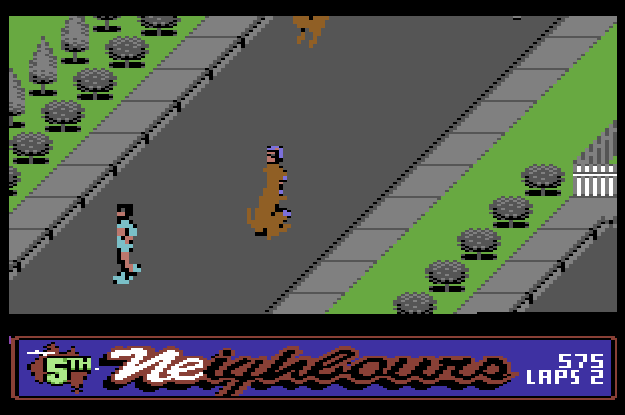
After you've chosen your opposition, a skateboard and decided what to do about your kangaroo, it's time to hit the road. It seems that in a long-forgotten episode, the Ramsey Street youngsters have been out and turned said street into a race track. They also appear to have rearranged the street, making it appear more like a maze than the cul-de-sac familiar to viewers of the TV show. Yourself as Scott Robinson and your competitors line up and begin racing. Rather bizarrely, each competitor has a different mode of transport. You use the skateboard that you picked earlier, and another of the racers also uses a skateboard, but the other competitors use a go-kart, bicycle and what looks like a lawnmower. Not that it really makes any difference to the race itself. Movement around the course is quite fluid although a bit fiddly at first, especially when taking corners. The idea of the game is simply to come first in the race, but making life more difficult are obstacles and the fact that you have to ride through pairs of markers. If you miss the markers, you need to go back on yourself to go through them. Depending on what you did in Scott's garage with your sheet, the obstacles include Mrs Mangle's dog Bouncer, Mrs Mangle herself, open manholes and manhole covers, and kangaroos. Oh yes, not only does every Australian keep a kangaroo in their garage, they also roam suburban streets. Here's a quick fact. In Neighbours, Bouncer, the dog, was paid more than the human actors! He was actually called Bouncer in real life too. That's two things I've learned today.
The best way to describe the gameplay is that it's a cross between Micro Machines, Paperboy and Horace Goes Skiing (or any skiing sim for that matter). Colliding too often results in you losing energy, with your energy bar represented by the Neighbours logo which loses colour as it depletes. If you win the race, you go onto another race where you face more obstacles and hazards, a redesigned street, and pairs of markers that are harder to get through.
I believe this was Lassiter's and Daphne's coffee shop. And that's Australia either side of it in case you need reminded where Neighbours was set.
The race itself is quite fun, but also frustrating. Collisions happen regularly, forcing you back a bit, and break up the flow of the game. If I was any good at the game, this probably wouldn't be a problem. The main problem though is that the street race feels more like a mini game than a full game. Although the game uses Ramsey Street as its setting, and includes the soap's characters, it feels that the game's link to Neighbours is tenuous to the extreme. Translating a soap opera to a computer game is never going to be easy, which is why there are very few other (if any) soap tie-ins, but more could have been made of the licence than just making a racing game with it. I'm not sure how, but a series of mini-games may have worked better. Maybe some sort of pool game in Madge's swimming pool, or trying to smash the windows of the houses by playing cricket in the street as featured in the opening titles (should I really admit that I remember that part from the show's opening?). Or trying to find out how many times you can play truant from Erinsborough High before Fisher expels you? Mr Fisher was Home & Away, wasn't he? Oh well. Anyway, yes, the game just feels like it's missing something and doesn't really capture the feel of the TV show that well. No matter how many kangaroos they insert into it.
The graphics do their job but aren't really that attractive and appear quite blocky even for a Commodore 64 game. Apart from a rendition of the theme tune, there's no other sound to speak of. Maybe the SID chip was exhausted after producing such a musical masterpiece. All in all, Neighbours isn't a terrible game but it's by no means a great game. It plays alright for a short period of time, but doesn't really maintain your interest and can feel a bit of a chore to play. It's quite simply a lazy tie-in, which doesn't represent the show it's based on at all well.
RATINGS Presentation: 60% A rather plain title screen, and not really anything going on in between action. Graphics: 65%
Dull and blocky and don't really represent Ramsey Street that well. Sound: 55%
The rendition of the Neighbours theme tune isn't too bad, but there isn't any other sound to speak of. Playability: 65% Quite fun at first and gets a bit better when you've got used to the controls, but it doesn't maintain your interest and doesn't draw you in for repeat plays. Overall: 65% A lazy attempt to cash in on the popularity of the television show.
Neighbours in other neighbourhoods
Aussies on the Speccy! Strewth!
As you'd expect, Neighbours wasn't a Commodore 64 exclusive. Instead, the residents of Ramsey Street found their way onto other computers too. Namely, the ZX Spectrum, Commodore Amiga and Atari ST. The Spectrum version was absolutely awful. With even more fiddly controls than the Commodore 64 version, a horrible version of the theme tune and barely recognisable sprites, you'd be throwing the overpriced cassette onto the barbie within minutes. On the Atari ST and Commodore Amiga, things were a little better. The graphics are much improved, which probably goes without saying due to them being on technically superior machines, and there is a greater variety of enemies and obstacles which make better use of their source material, but the controls are still too fiddly and it just isn't easy, or that fun, to play at all.
The opening screen on the Amiga version. Looks just like the TV show.
Traffic cones, cars in the middle of the road, some kid playing with his remote control car. Give me Summer Bay any day.
It's now summer and unbelievably the Sun is shining and the temperature is high! However, you can be certain that the current good weather won't last long and we'll be forced back indoors soon enough. But here are a few games that might help to extend the season a little longer.
California Games
Enjoy some totally rad West Coast activities in this collection of cool Californian sports. On offer is surfing, BMXing, roller skating, Frisbee throwing, skateboarding and, um, bag kicking. Released for just about every available computer and console in the late 80s and early 90s, the game was an instant hit. Played today, it reflects its era and the trends of the time very well. Gnarly dude.
NES: Just about to pull off an awesome turn on the half pike. Failed miserably though.
Punchy
The British seaside wouldn't be the same without Punch & Judy, and the violent politically incorrect puppet show is the basis of Punchy, a computer game released for the Spectrum, Amstrad and a few Commodore computers by Mr Micro. In it, wifebeater Mr Punch has kidnapped Judy's baby and it is down to you, as Bobby the policeman, to rescue it. The game is basically a clone of Hunchback (it was nearly called Hunchy) and wasn't a bad version at all, although time hasn't been good to it.
Spectrum: That's the way to do it! This game even features speech. Or something claiming to be speech.
Cool Spot
A platform game featuring 7-Up's mascot Cool Spot, who was based on the red dot in the logo of the fizzy drink. Well, its American mascot. We had shitty Fido Dido over here. And a game that made no reference to 7-Up at all. Although not technically a summer game, it had a summery feel to it, starting and ending on a beach, and Cool Spot wore sunglasses throughout his adventure. Cool Spot was released on the Super Nintendo, Sega Master System, Nintendo Gameboy, Commodore Amiga and Sega Mega Drive. A review of the SNES version is available here.
SNES: It's those lobsters in pants again.
Theme Park
If queuing for hours for a ride at Alton Towers just doesn't appeal to you but you wouldn't mind having the chance to run the place, then Theme Park might just be the game for you. Released in the mid-90s for a heap of computers and consoles, this management sim saw you setting up and managing your very own fairgrounds. The game was great fun and even had a few sequels which are also worth a look at too.
PC: Roll up! Roll up! Get yourself a Mr Whippy here, and then throw up all over my park!
Greendog: The Beached Surfer Dude
Released for the Sega Mega Drive and Game Gear only, Greendog was a platform game featuring a cool surfer dude on a treasure hunt to release a curse. It was an average platformer, released at a time when Sonic the Hedgehog was dominating the scene, but featured a groovy little Calypso soundtrack. Something to fill a bit of time on a Sunday afternoon perhaps.
Mega Drive: Greendog doesn't even have a steak bake to waft around, but the birds are after him anyway.
Dead or Alive XTreme Beach Volleyball
A volleyball game for the original Xbox featuring ladies in skimpy bikinis with breasts which appear to bounce of their own accord. Probably not a great game to put on when you've got the in-laws over, but a surprisingly good volleyball sim. Its sequel for the Xbox 360 features a bundle of mini games. It's basically California Games for pervs.
Xbox: Fun in the Sun with some beach babes.
Out Run
Nothing beats driving along the coast with the roof down, and in Out Run you get the chance to do just that. Out Run is the ultimate sun-soaked racer, featuring colourful visuals and a timeless summer soundtrack. The arcade version from 1986 was ported to the Spectrum, C64, Amstrad, Atari ST, Amiga, PC Engine, Xbox, PS2 and Gameboy Advance. It is also one of the few games to have been released on the Sega Master System, Mega Drive, Game Gear, Saturn and Dreamcast!