Don't come the raw prawn with me, ya flamin' gallah!
Game:Neighbours Format:Commodore 64 Developer:Impulze Year Released:1991 Also released on:ZX Spectrum, Atari ST, Commodore Amiga Now available on:Nothing
Neighbours, everybody needs good Neighbours. With a little understanding, you can find the perfect blend. And so on. Back in the late 1980s and early 1990s, everybody watched Neighbours. They might not admit it but, every evening at 5.35pm, after Children's BBC had finished, millions of people tuned their television sets to BBC One to find out what the residents of Ramsey Street had been up to. This was the era of Madge and Harold, Mrs Mangle and Bouncer, Jim, Paul and Lucy Robinson, Helen Daniels, Jane and Mike (played by Guy Pearce) and of course, Scott and Charlene, played by a young Jason Donovan and Kylie Minogue. The show was so popular that in one year the entire cast were invited to star in the Royal Variety Performance, and a range of merchandise was produced to cash in on its success. There were annuals, board games, jigsaws and computer games. As this website is dedicated to old video games, we'll focus on the computer game version of Neighbours, specifically the Commodore 64 version. Maybe I should start Classic Annuals UK where I could look at old annuals. Before we continue, let's remember the Neighbours theme tune and opening credits.
Ah! Memories! So, how do you transfer a soap opera into a computer game? Easy! Turn it into a racing game! And to ensure it accurately reflects the fact that it's based on a soap from the land down under, include kangaroos and emus as some of the obstacles. Strewth, there's no stereotyping in this game!
Scott appears to be getting over-friendly with a kangaroo.
G'day! Welcome to my garage.
The game opens with a SID rendition of the show's theme tune and a rather plain intro screen. I guarantee you that you'll sit and listen to the full theme tune while trying to remember the words to it. Or maybe that's just me. Afterwards, you pay a visit to Scott Robinson's garage. This is where you can pick from up to four other Ramsey Street residents to be your competitors and either a slow, medium or fast skateboard. There is also a small car and a kangaroo on the floor of the garage, partially covered by a sheet. As we know, every Australian keeps a kangaroo in their garage. Usually next to their barbecue, a crate of Fosters, a boomerang, and a hat with corks dangling from it. You can choose to cover the car or kangaroo with the sheet if you wish. Concealing them will prevent them from appearing in the game.
The characters you can pick as competitors are Lenny (who?), Henry, Matt (not sure who he is either) and Mike. Apparently Lenny could be Charlene. I don't ever recall her being called that but according to a Neighbours website, it was her nickname. You learn something new everyday, don't you? As the game was released in 1991, I don't think Mike, Henry, Scott or Charlene were still in the programme then. I even think their pop careers had taken a nose-dive too by then.
Rack off you dag. Bouncer appears to be in this screenshot. The filthy mongrel!
Scott meets an emu in Ramsey Street. Crikey!
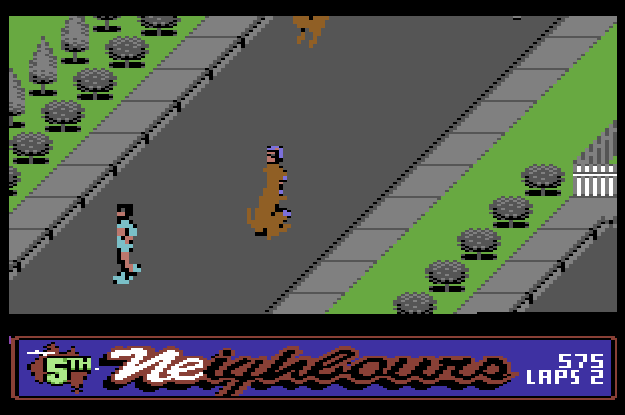
After you've chosen your opposition, a skateboard and decided what to do about your kangaroo, it's time to hit the road. It seems that in a long-forgotten episode, the Ramsey Street youngsters have been out and turned said street into a race track. They also appear to have rearranged the street, making it appear more like a maze than the cul-de-sac familiar to viewers of the TV show. Yourself as Scott Robinson and your competitors line up and begin racing. Rather bizarrely, each competitor has a different mode of transport. You use the skateboard that you picked earlier, and another of the racers also uses a skateboard, but the other competitors use a go-kart, bicycle and what looks like a lawnmower. Not that it really makes any difference to the race itself. Movement around the course is quite fluid although a bit fiddly at first, especially when taking corners. The idea of the game is simply to come first in the race, but making life more difficult are obstacles and the fact that you have to ride through pairs of markers. If you miss the markers, you need to go back on yourself to go through them. Depending on what you did in Scott's garage with your sheet, the obstacles include Mrs Mangle's dog Bouncer, Mrs Mangle herself, open manholes and manhole covers, and kangaroos. Oh yes, not only does every Australian keep a kangaroo in their garage, they also roam suburban streets. Here's a quick fact. In Neighbours, Bouncer, the dog, was paid more than the human actors! He was actually called Bouncer in real life too. That's two things I've learned today.
The best way to describe the gameplay is that it's a cross between Micro Machines, Paperboy and Horace Goes Skiing (or any skiing sim for that matter). Colliding too often results in you losing energy, with your energy bar represented by the Neighbours logo which loses colour as it depletes. If you win the race, you go onto another race where you face more obstacles and hazards, a redesigned street, and pairs of markers that are harder to get through.
I believe this was Lassiter's and Daphne's coffee shop. And that's Australia either side of it in case you need reminded where Neighbours was set.
The race itself is quite fun, but also frustrating. Collisions happen regularly, forcing you back a bit, and break up the flow of the game. If I was any good at the game, this probably wouldn't be a problem. The main problem though is that the street race feels more like a mini game than a full game. Although the game uses Ramsey Street as its setting, and includes the soap's characters, it feels that the game's link to Neighbours is tenuous to the extreme. Translating a soap opera to a computer game is never going to be easy, which is why there are very few other (if any) soap tie-ins, but more could have been made of the licence than just making a racing game with it. I'm not sure how, but a series of mini-games may have worked better. Maybe some sort of pool game in Madge's swimming pool, or trying to smash the windows of the houses by playing cricket in the street as featured in the opening titles (should I really admit that I remember that part from the show's opening?). Or trying to find out how many times you can play truant from Erinsborough High before Fisher expels you? Mr Fisher was Home & Away, wasn't he? Oh well. Anyway, yes, the game just feels like it's missing something and doesn't really capture the feel of the TV show that well. No matter how many kangaroos they insert into it.
The graphics do their job but aren't really that attractive and appear quite blocky even for a Commodore 64 game. Apart from a rendition of the theme tune, there's no other sound to speak of. Maybe the SID chip was exhausted after producing such a musical masterpiece. All in all, Neighbours isn't a terrible game but it's by no means a great game. It plays alright for a short period of time, but doesn't really maintain your interest and can feel a bit of a chore to play. It's quite simply a lazy tie-in, which doesn't represent the show it's based on at all well.
RATINGS Presentation: 60% A rather plain title screen, and not really anything going on in between action. Graphics: 65%
Dull and blocky and don't really represent Ramsey Street that well. Sound: 55%
The rendition of the Neighbours theme tune isn't too bad, but there isn't any other sound to speak of. Playability: 65% Quite fun at first and gets a bit better when you've got used to the controls, but it doesn't maintain your interest and doesn't draw you in for repeat plays. Overall: 65% A lazy attempt to cash in on the popularity of the television show.
Neighbours in other neighbourhoods
Aussies on the Speccy! Strewth!
As you'd expect, Neighbours wasn't a Commodore 64 exclusive. Instead, the residents of Ramsey Street found their way onto other computers too. Namely, the ZX Spectrum, Commodore Amiga and Atari ST. The Spectrum version was absolutely awful. With even more fiddly controls than the Commodore 64 version, a horrible version of the theme tune and barely recognisable sprites, you'd be throwing the overpriced cassette onto the barbie within minutes. On the Atari ST and Commodore Amiga, things were a little better. The graphics are much improved, which probably goes without saying due to them being on technically superior machines, and there is a greater variety of enemies and obstacles which make better use of their source material, but the controls are still too fiddly and it just isn't easy, or that fun, to play at all.
The opening screen on the Amiga version. Looks just like the TV show.
Traffic cones, cars in the middle of the road, some kid playing with his remote control car. Give me Summer Bay any day.
It's now summer and unbelievably the Sun is shining and the temperature is high! However, you can be certain that the current good weather won't last long and we'll be forced back indoors soon enough. But here are a few games that might help to extend the season a little longer.
California Games
Enjoy some totally rad West Coast activities in this collection of cool Californian sports. On offer is surfing, BMXing, roller skating, Frisbee throwing, skateboarding and, um, bag kicking. Released for just about every available computer and console in the late 80s and early 90s, the game was an instant hit. Played today, it reflects its era and the trends of the time very well. Gnarly dude.
NES: Just about to pull off an awesome turn on the half pike. Failed miserably though.
Punchy
The British seaside wouldn't be the same without Punch & Judy, and the violent politically incorrect puppet show is the basis of Punchy, a computer game released for the Spectrum, Amstrad and a few Commodore computers by Mr Micro. In it, wifebeater Mr Punch has kidnapped Judy's baby and it is down to you, as Bobby the policeman, to rescue it. The game is basically a clone of Hunchback (it was nearly called Hunchy) and wasn't a bad version at all, although time hasn't been good to it.
Spectrum: That's the way to do it! This game even features speech. Or something claiming to be speech.
Cool Spot
A platform game featuring 7-Up's mascot Cool Spot, who was based on the red dot in the logo of the fizzy drink. Well, its American mascot. We had shitty Fido Dido over here. And a game that made no reference to 7-Up at all. Although not technically a summer game, it had a summery feel to it, starting and ending on a beach, and Cool Spot wore sunglasses throughout his adventure. Cool Spot was released on the Super Nintendo, Sega Master System, Nintendo Gameboy, Commodore Amiga and Sega Mega Drive. A review of the SNES version is available here.
SNES: It's those lobsters in pants again.
Theme Park
If queuing for hours for a ride at Alton Towers just doesn't appeal to you but you wouldn't mind having the chance to run the place, then Theme Park might just be the game for you. Released in the mid-90s for a heap of computers and consoles, this management sim saw you setting up and managing your very own fairgrounds. The game was great fun and even had a few sequels which are also worth a look at too.
PC: Roll up! Roll up! Get yourself a Mr Whippy here, and then throw up all over my park!
Greendog: The Beached Surfer Dude
Released for the Sega Mega Drive and Game Gear only, Greendog was a platform game featuring a cool surfer dude on a treasure hunt to release a curse. It was an average platformer, released at a time when Sonic the Hedgehog was dominating the scene, but featured a groovy little Calypso soundtrack. Something to fill a bit of time on a Sunday afternoon perhaps.
Mega Drive: Greendog doesn't even have a steak bake to waft around, but the birds are after him anyway.
Dead or Alive XTreme Beach Volleyball
A volleyball game for the original Xbox featuring ladies in skimpy bikinis with breasts which appear to bounce of their own accord. Probably not a great game to put on when you've got the in-laws over, but a surprisingly good volleyball sim. Its sequel for the Xbox 360 features a bundle of mini games. It's basically California Games for pervs.
Xbox: Fun in the Sun with some beach babes.
Out Run
Nothing beats driving along the coast with the roof down, and in Out Run you get the chance to do just that. Out Run is the ultimate sun-soaked racer, featuring colourful visuals and a timeless summer soundtrack. The arcade version from 1986 was ported to the Spectrum, C64, Amstrad, Atari ST, Amiga, PC Engine, Xbox, PS2 and Gameboy Advance. It is also one of the few games to have been released on the Sega Master System, Mega Drive, Game Gear, Saturn and Dreamcast!
Game:CarVup Format reviewed:Commodore Amiga Developed by:Core Design Year of original release:1990 Also available on:Atari ST Available now on:Nothing
Core Design are perhaps most well known for creating the Tomb Raider games. By combining 3D action adventuring with puzzle solving and introducing a young lady with a massive pair of bazookas as its main character, Tomb Raider was an instant hit. Undoubtedly, the presence of Miss Croft alone probably helped shift a few copies. The success of the Tomb Raider games means it's all too easy to forget what Core Design did before Lara Croft blasted her way into the bedrooms of teenage boys across the world. So, this seems like as good an opportunity as ever to refresh our memories.
Before Tomb Raider's appearance and Core Design's resultant 32-Bit world domination, the Derby-based outfit were perfecting their art on the home computers of the 16-Bit era. They produced games aplenty for the Commodore Amiga and Atari ST, and even dabbled a bit in games for consoles too. Products included Chuck Rock, Rick Dangerous, Thunderhawk, Jaguar XJ220, Corporation and Asterix amongst others. Today's game of choice is CarVup, a title released in Europe only (apparently) for the Commodore Amiga and Atari ST in 1990.
He flies like a bird in the sky. That's a song, isn't it?
Instructions! Instructions! Get yer instructions here!
CarVup is a side-scrolling game featuring a car called Arnie. The idea of the game appears to be to free animals from traps. Not sure who's set the traps or why, but it's probably some weirdo without whom the world would be a better place. Animals are freed simply by completing each stage. Stages are split into six levels and to complete a level, Arnie must travel across each platform in them. Once he has driven over each section of the platform, it changes appearance in some way to indicate that Arnie has already been there. Once all the ground on the platforms has been covered, it's onto the next level. Each level wraps around, meaning that if Arnie continues to move in the same direction, he'll arrive back where he began. Controlling Arnie is simple. You can move him left or right, and press fire to make him jump. Hold up to do a high jump, down to perform a small jump, or left or right to perform a long jump in the respective direction. All manoeuvres are simple to pull off but essential to master to get to each part of the level to clear them. Arnie can't fall off platforms, and just turns and travels in the opposite direction when he reaches the end of one unless you direct him otherwise.
Towards the bottom of this screen is Turbo. Turbo is evil.
Getting in Arnie's way are a number of enemies which he must either avoid or defeat with collectable weapons. These enemies vary depending on the theme of the stage although they all do pretty much the same thing. The first level, set in a building site, features things like wheelbarrows, barrels, and diggers. Level two has a horror theme and features zombies, bats, mummies and ghosts. Other level themes are garden, country and western, musical, toys and prehistoric with characters that mostly suit each level, although there are some slightly surreal exceptions. Space Invaders in the prehistoric stage for example.
Defeating the enemies can be done by collecting weapons which drop from the sky on each level. There is quite a variety of weapons which mostly appear to resemble car parts. Most of the weapons are deployed automatically when an enemy comes into position. For example, if you have the gun and are driving towards an enemy, the gun will fire. Another weapon will destroy an enemy above you, so if you drive under it, it will release and fire at them. Weapons can also be deployed by pressing space.
Those ghosts look awfully familiar.
It's not just weapons that drop from the sky. There are also fruits, letters and other power ups. Fruits simply give you points, letters spell out words - either BONUS which gives you extra points or EXTRA which gives you an extra life - and power ups do things like freeze all the enemies in the level, turn them into Pac Man-like ghosts, or transform them all into carrots. Also on most levels is what appears to be a monkey man pulling a face at you, who doesn't do any harm but bounces around the level when hit. And then there is Turbo. Turbo is a demon-like thing who appears if you take too long clearing a level. He is indestructible and fatal to the touch but serves as a way of speeding you up.
There are no end of stage bosses. The sixth level in each stage is just an opportunity to collect points. The only boss is on the final level and takes the form of a head bouncing around it, and can be defeated using weapons that appear during the battle.
Somebody isn't happy.
Brrrr,,,, the Ice Age was a cold time. I'm sure some of the
graphics in this level also appear in Chuck Rock.
CarVup looks and sounds fantastic. Each level captures its theme very well and features a large variety of well-drawn and animated sprites, including Arnie himself. Levels are very colourful and the changing types of themes and their associated backgrounds and platforms means that a game which is actually quite samey throughout, doesn't really feel it. A special mention must go to the music which is amazing. Jolly upbeat tunes maintain the frantic nature of the game. If you don't want music, you can listen to sound effects instead which complement the game well and feature clear samples, including voice samples.
CarVup is a great computer game. It is incredibly easy to pick up and there is something satisfying about having to cover all ground to clear each level. It's a completionist's dream, although the never-ending appearance of fruits might send you crazy if you have particularly obsessive completionist tendencies! As each level is quite short, it really is just a case of covering all the ground as quickly as possible, taking out enemies en route and so on. As it is basically the same thing throughout, the game risks become dull, but the short levels and changing themes prevent this from happening. It starts off easy but gets quite challenging with you having to keep your eyes peeled to make sure you don't accidentally jump into an enemy when finding parts of the levels to clear. It really is a game which represents its era very well. So, if you're looking for a Core Design game that doesn't feature a lady with a pair of excessively large boobs as its main selling point, then it might be worth taking CarVup for a spin.
Hilarious joke ahoy!
RATINGS Presentation: 85% A static title screen, a list of instructions and controls and a high score table are all the game has intro-wise, with short animated intermissions between levels. They're all neat and polished and do the job well. Graphics: 90%
Colourful, crisp and bright. Varied sprites and attractive levels make the game look great. Sound: 90%
Three fantastic in game tracks and some intro music, or great sound effects with sampled speech are all a treat to the ears. Playability: 85%
Fun to play, simple to get into to with good responsive controls. Overall: 87%
Pure 90s style fun
VIDEO FROM CLASSIC GAMING UK'S YOUTUBE CHANNEL View CarVup in action here:
Game:Diamond Mine II Format reviewed:Acorn Electron Developed by:Blue Ribbon Year of original release:1985 Also available on:BBC Micro, Amstrad CPC, Commodore 16, Commodore Plus/4, MSX Available now on:Nothing
Mining and diamonds seem to be a common theme in computer games of old. Games like Boulder Dash for example and, er, um, Manic Miner. Not too sure we saw Miner Willy doing any actual mining in it though. I suppose you could count Jet Set Willy too as it featured the same character. Oh well, maybe mines and diamonds aren't that common a theme. Perhaps the black backgrounds that were a feature of many 1980s computer games made me think they were all set in mines, and I suppose diamonds were fairly easy to draw so they also seemed to pop up quite a bit in old games.
When this screen is moving, the box of colours changes and
moved inwards from the outer edge. Psychedelic!
Anyway, a game that was a fusion of the less-common-than-I-thought themes of mining and diamonds was Diamond Mine, a game released in 1984 for the Acorn Electron by MRM and again the following year by Blue Ribbon. Oh wait! There was also Mineshaft, also released on the Acorn Electron. Another mining game! We're not looking at that today though. We're also not looking at Diamond Mine either as it is pretty much impossible to play. Instead, we're heading straight for its far superior sequel, Diamond Mine II which Blue Ribbon also released on the Acorn Electron in 1985, as well as a few other machines which I may come onto later if I remember.
As its title suggests, the idea of Diamond Mine II is to mine diamonds. And like many games in the 1980s, the mines takes the form of maze-like levels. You simply have to clear the diamonds from the paths in the mazes. You do this by guiding a pipe through the level. If you touch your own pipe or attempt to go backwards on yourself, you lose a life. You can however retract your pipe, a necessity to get through the game. The pipe retracts for however long you hold down the relevant key, which is Return in the Electron version.
I was mining in a mine one day. In the very merry month of May
Making life tougher are nasties which take the form of mutant eyes. These eyes move horizontally through each level and are also able to travel through walls. You can suck them up your pipe but if they come into contact with any other part of it, it's another life lost. Sucking them up is only temporary as a few seconds later they're back! If this happens when you're clearing a completely different part of the level, you need to retract and suck them up again. Part of the beauty of the game is seeing how much you can clear before retracting, whether to be daring or over-cautious? As moving your pipe through the levels and retracting it uses energy, you need to be careful that you don't retract too often or waste too much time making a decision, so playing too safe isn't always a good idea. So you need to keep an eye on your energy levels as well as the wandering eyes. I once went out with somebody with a wandering eye. Had to end it though as I thought she was seeing somebody else.
Remaining energy becomes points at the end of each level.
There are diamonds on this level. They just happened to be
blue when I took the screenshot.
Controls for the game are simple. You just have up, down, left and right and the aforementioned retract key. At first, movement feels a bit sluggish but as you get into the game, the speed is just right. Clearing objects from mazes is a concept lifted straight from Pac-Man, but there are enough extra elements to make this a different kind of game. Levels quickly get tough and really do test your skills. It's sometimes frustrating to lose a life by accidentally going back into your own pipe, but this often happens when you're under pressure. Like a lot of 80s games, you need to combine skill with strategy and this game balances the two well.
Eye eye.
Graphics do a good job too. Levels are colourful and clear. Your pipe makes a chomping noise as it collects diamonds and there are suitable sound effects for deaths, bonus points and the like. The only music is a little tune which plays when you start a new game. Fortunately it doesn't play throughout as it would quickly get annoying. Like the graphics, the sounds suit the game. In fact, everything about this game just feels right. Although the game isn't up there with the all-time greats, and doesn't feel as frantic and as fluid as other arcade style games, Diamond Mine II is a good game if you're feeling like a quick challenge. It's also quite addictive too and leaves you knowing that you could easily do better if you just have one more go.
RATINGS Presentation: 65% Nothing too exciting but they do the job. The Blue Ribbon corporate loading screen is followed by the game's name, writer and copyright info on background of changing colours. Graphics: 83%
The game is colourful and it's clear to see what's going on. The diamonds are just dots of changing colours, while the game's only sprites, somebody bouncing at the top of the screen and the mutant eyes, are well-drawn. Sound: 70% Suitable sound effects with a short melody when you start the game. Playability: 82%
Easy to pick up, hard to put down. Fun to play without being overly frustrating. Overall: 81%
A great little Acorn Electron arcade style game, something to return to again and again.
Mining for Diamonds elsewhere
Diamond Mine II wasn't an Electron exclusive. Oh no, not at all. It also made appearances on some other home computers too, although for some reason didn't make it to the Spectrum or C64.
Level one Amstrad CPC-style
The BBC Micro version is almost identical to the Electron version, save for better sound and a different loading screen. It plays a bit smoother too. The game is also fairly similar on the Amstrad CPC, although features a different opening theme tune. Movement on this version is fluid like the BBC version although the eyes seem to regenerate quicker meaning there is more retracting of your pipe needed, so doesn't feel as fun.
While over on the Commodore 16, we have this.
The game was also released for the Commodore 16 and Commodore Plus/4. The Commodore 16 version, although it features the same concept of gathering diamonds with a retractable pipe, uses a different level layout and isn't quite as enjoyable to play. There are a larger number of enemy eyes which, like on the CPC, cause you to have to retract more often. This just makes the game feel frustrating. On the Plus/4, the level structure of the Acorn machines and the Amstrad are the same. However, although the pipe flows smoothly, you need to be in exactly the right place above or below a vertical path to be able to move you pipe along it. This again breaks up the flow of the game. An MSX version was released too, but I haven't taken a look at that one.
Wishy washy colours on the Commodore Plus/4
The BBC Micro version is the best of the bunch with the trusty Electron version a close second.
Cloning Diamonds
Diamond Mine II wasn't an original game. Instead it was based on a little known arcade game called Anteater from Tago Electronics whose only other release appears to be a game called Calipso. I have to say I have never heard of either. Instead of piping your way through a maze to collect diamonds, Anteater features an aardvark with an extendable snout which sniffs its way around similar mazes, collecting ants and worms. It is quite infuriating to play and it's little wonder that it isn't a well known game now. An unreleased port was apparently created for the Atari 2600, while the only other versions for other devices are clones. Aardvark was a very close remake, released for some of the Atari and Commodore machines of the early 80s, while Oil's Well from Sierra On-line and Diamond Mine II were clearly influenced by the gameplay of the Anteater arcade game.
Diamond Mine II video
Want to see Diamond Mine II on the Acorn Electron in action? Of course you do. Head on over to our YouTube channel to see it! Or view it here in super-tiny vision.
Game:Circus Maximus: Chariot Wars Format reviewed:Sony PlayStation 2 Developed
by:Kodiak Year
of original release:2002 Also available on:Xbox Available now
on:Nothing!
Looking back through some of my past gaming purchases, I often find myself thinking one thing - what the hell was going through my head when I bought that? Yes, there are some games that I appear to have actually gone to the trouble of purchasing that simply baffle me. They aren't necessarily bad games, or really that obscure, but they are most certainly a little odd. For some reason, a lot of these games seem to be on the PlayStation 2 but I believe that was more down to my buying habits at the time and not the PlayStation 2 hosting a disproportionate number of questionable games.
One of these such games was Circus Maximus: Chariot Wars, a chariot racing game released for the PlayStation 2 (and also the Xbox) back in 2001/2002. Yes, chariot racing, that most famous of gaming genres. The game was basically what you get when you cross Gran Turismo with Road Rash with Ancient Rome. But, before I get onto looking at the game, I feel that I need to try to figure out exactly what it was that inspired me to pick it up from a shelf, take it to a cashier and hand over money in exchange for it.
When I was younger, I was probably a bit too sensible when deciding what games to own, especially when it came to console games which were even more expensive back then than they are now. This may be because I would only really get games for birthdays and Christmas, and they were being bought for me rather than by me. So, instead of making up my own mind about what games to go for, I was nearly always influenced by reviews in gaming magazines and would usually only choose games that got a rating of over 90%. Sometimes this was combined with a positive portrayal of the game on video games shows such as Gamesmaster, Bad Influence and Games World, or even Movies, Games and Videos. In theory, this would mean that I would never own a dud game. For this reason, most of the games I owned during the 1990s were popular, mainstream games. They're also worth crap all now due to them being so common.
As I got older, something changed. At the beginning of the century, I was in my early twenties. I had a job, my own money, no major financial outgoings, and, more importantly, my own mind - which wasn't necessarily a good thing. I no longer read magazines and took the advice of journalists to tell me what I should play. I think, in a way, some of the "mega games" I played as a youngster actually disappointed me, and I found that some of the lower rated games that I sometimes rented were actually more fun. They probably had some irritating flaws which prevented them from becoming all-time classics, but they still had their own charm and appeal. And so, the older me would buy games and sometimes consoles spontaneously. I would go off my gut instinct rather than off the instruction of the apparent greater knowledge of a gaming journalist. And my gaming collection became a lot more varied and interesting. I will get to my review of Circus Maximus in a bit, but I'll reminisce about something vaguely related to demonstrate what I'm going on about for a bit first.
Back in the summer of 2000, I purchased a Dreamcast after seeing it demonstrated on a shopping channel late at night, not really knowing much about how well regarded it was by the gaming press at the time. The TV channel sold it to me so well that I wanted one straight away. So the following day, I went to Comet and picked one up. I suppose I should have bought it off the TV as a way of repaying their impressive efforts to persuade me to get one, but that would have meant waiting for it to be delivered. It came with Chu Chu Rocket, which I've played once - I never really understood what was going on in that game - and I picked up Crazy Taxi (the game demonstrated by the shopping channel that convinced me that I needed it) and Worms Armageddon to start off my Dreamcast collection. Later games that found a home in my collection were Fur Fighters, Resident Evil: Code Veronica, Virtua Tennis, Jet Set Radio, Rayman 2, Metropolis Street Racer, Who Wants to be a Millionaire? and Chicken Run. All were games which I enjoyed immensely, but they were games which I bought by just picking them off the shelves in shops rather than knowing much about them in advance. Some are nowadays quite rightly regarded as classics, others not quite so (Chicken Run??). Still, I quite like my small but varied Dreamcast collection. And it was my first gaming collection that was put together without much influence from so-called experts; I suppose I picked some games based on their chart positions, explaining why there were some highly acclaimed games in my collection, but that was probably the only factor other than instinct which influenced my purchasing decisions.
A few years later, I saw a bit of Grand Theft Auto: Vice City on TV, and decided there and then that I wanted it. Problem was, I didn't have anything to play it on. The day after a works Christmas party in January 2003 (our Christmas parties was always held after Christmas), a little worse for wear and probably still a bit drunk, I ventured up to Game and bought myself a PlayStation 2 and GTA: Vice City. Once again, this was a spontaneous decision that I made just because I felt like it. Over the years that followed, my PS2 collection gradually grew. But, like my Dreamcast collection, it grew with games that I bought with no prior influence or plan. Quite often, I would just look out for games on offer when I happened to be in a shop selling them. Shopping in Tesco late at night was great. By now it was open 24 hours. I worked in a pub and restaurant, and would stop off at Tesco on my way home looking for something for tea. And to prevent myself from going to bed on a full stomach, I would sometimes pick up a new game to play. Some weren't great, but there were some hidden gems amongst my collection. Giants: Citizens Kabuto was one. They also had a great choice of retro game compilations which is one of the PlayStation 2's strengths (that's one of the downsides of online game stores - retro games have gone up in price! That's another topic for another day though). But, the strangest purchase I made was Circus Maximus: Chariot Wars. See! I knew I'd get back to that game eventually! Rather than buying this in the middle of the night at Tesco, I bought the game from HMV one afternoon where they had an offer of two games for £20 or something like it. The other game I bought was Dynasty Warriors 2, which was another refreshingly good game, but not particularly well known. Neither game initially jumped out at me, nor were they promoted in any special way. I just felt like buying something different to what I would usually play. I don't even think I spent much time making a decision. I suppose I just thought, it's only £20, what have I got to lose? So, I picked up the two games, went to the counter and bought them. And later that day, I experienced my very first virtual chariot race.
So, after that over-long introduction to Circus Maximus: Chariot Wars, my review of the game had better be good.
Rule Britannia!
As you'd expect in any self-respecting chariot racing game, the aim of the game in Circus Maximus: Chariot Wars is to race chariots. Races take place on courses spread across the Roman Empire, from the green and pleasant lands of Britannia, to the dry sandy deserts of Alexandria. The Romans are meant to have built long straight roads, but I don't suppose that would make much of an exciting game, so the roads in this game are more varied with bumps, turns, adverse cambers and changing terrains. Even water. Wow!
Options! Options! Get your options here!
There are a couple of modes available in this game: arcade mode and tournament mode. Arcade mode allows you to have a quick(ish) race on whichever course you choose, whereas in tournament mode, you play them all in order, providing you win your races. Not all courses are initially available in arcade mode, with these needing to be unlocked through tournament play. Whichever mode you choose, you next have to pick your chariot, a rider and a fighter. Who needs Gran Turismo when this level of customisation is available to you? Chariots, riders and fighters are representative of geographical regions, such as Rome, Greece or Africa.
Choosing a vehicle, rider and fighter. It's a bit like picking out an outfit for work.
Smack!
Once you've chosen your game mode, your vehicle, rider, fighter and somewhere to race, the fun begins. The handling of the chariots is done quite impressively in this game with them controlling quite realistically. Turn too fast or take a bump at an awkward angle, and your chariot topples over. But, it's possible to attempt to prevent a topple by some skilful manoeuvring. Chariots are pulled by horses, so a bit a whipping will get your nag to speed up if you need a boost. Adding more variety is the fact the you sometimes need to duck to avoid low level obstacles - gates, bridges, and so on. There are also short cuts to be found, which can save quite a bit of time on your journey. The game isn't just about racing chariots though. Oh no, you also get to beat up your opposition. Holding on for dear life at the back of your chariot is your fighter. He or she will attack the fighter in competing chariots. This isn't automatic though. You have to do the fighting. Defeat your competitor and this will force their chariot off the road for a moment or two. But the same will happen to you if you get defeated. Scattered around the levels are power ups which offer extra speed, energy replenishments, extra strength and so on.
Beautiful! Absolutely beautiful! A quaint British road of old.
Phwoar! Boobies!
The graphics on offer are fairly good. The detail of the chariots and characters is good, although the scenery isn't fantastic. As each course differs though, there is quite a bit of variety on offer. Sound is not bad either. The clip-clop of hooves and wheels on the gravelly roads dominates, while there is Roman sounding music tinkling away in the background which doesn't always sound too suited to a racing game but obviously suits its historical theme. A nice touch is the ability to taunt other racers. This basically makes your fighter shout abuse at opponents or say something about his or her greatness.
Whoops! This isn't going to end well.
As already pointed out, the game controls well and the novel vehicle choice means it feels substantially different to other arcade-style racers. It is fun to ride the chariots through the various courses, and having to control fighters too doesn't distract too much, although you do have to keep your eyes peeled on the road ahead. Unlike games like Road Rash, where fighting was a selling point of the game, but wasn't actually necessary to do well, you have no choice but to get involved in fights in this game as opponents are eager to attack you. Like many racing games, fall behind and it's fairly easy to catch up, but you don't often get the chance to get too far ahead as your competitors also seem to find it easy to catch up. It's all about rubber band AI or something, but it doesn't feel that well done in this game. It's also all too easy to fall off tracks or collide into walls or obstacles so it sometimes feels a bit stop-start, but that will largely be down to the fact I haven't played the game for years. I'm sure with practice, it's easy to get around the tracks without too many restarts.
A good old Roman age snarl up.
This isn't the sort of game that will keep you enthralled for a while, but it is one that you'll come back to for a fun and unique race numerous times. At least, that's what I found myself doing several years ago. It is one of those games that gets forgotten about though over time, but is a pleasant find to rediscover in your collection. If you're looking for a fun non-pretentious racing game that doesn't take itself too seriously, then look out for this. It's very odd, quite unique, but nowhere near as bad as its poor reception over ten years ago probably suggests it was.
RATINGS Presentation: 60% Functional menu screens with pre-game intros but not a lot else. Graphics: 80%
Good detail on characters and chariots, but bland scenery in places and sometimes a bit dull Sound:
75% Music is drowned out by horse and chariot noises, taunts are quite funny but not always audible. Playability: 80%
Fun to pick up and play but unlikely to hold your attention for long. A good game to come to for a quick time filler. Overall: 77%
Unique but surprisingly fun
YOUTUBE
Footage of me playing the game available on our YouTube channel, or below!
EXTRA IMAGES
Once again, I took too many screenshots. Here are some left overs.
There's more to Classic Gaming UK than just a sporadically updated blog that gets about two visitors a month - that's this blog in case you're wondering. We also have our very own YouTube channel. Oh yes, not only can you read about games of yore here, you can also see them in action over on Google's video sharing site of plenty.
The Classic Gaming UK YouTube channel has footage of games that have been written about already on this very blog, such as Cool Spot, Phoenix, Moon Patrol, Kickle Cubicle, Crazy Taxi and Edd the Duck! There are also videos of the Conversion Comparisons of Marble Madness and Pac-Land. And, our most popular video, a playthrough of Fantasia on the Mega Drive. It's had over 7000 views in 11 months. Not sure how much of an achievement that really is, but I'm quite pleased. Going forward, to use a phrase overused in offices and other corporate environments, we aim to deliver more fantastic examples of games from decades past.
But that's not all! Oh no, not only does Classic Gaming UK's YouTube channel feature my attempts at capturing footage of video games in whatever convoluted way possible, it also features other game-related videos, and videos that aren't related to games in any way but might be of interest to people into nostalgia. In a half-assed attempt to declutter, I've been transferring VHS tapes to my PC before sending them to videotape heaven. So far, I have transferred and uploaded the free preview videos that came with issues one and three of Mean Machines Sega. There is also an extract from an episode of Movies, Games and Videos. I would have including the whole episode but as it includes bits from films, I'm not sure how this fits in with copyright rules. And there are also the commercial breaks from a Tommy concert performed by The Who that was shown on Sky One early in 1990, providing a fairly rare glimpse of the early days of satellite TV in the UK.
You can find Classic Gaming UK's YouTube channel either by searching for "classicgaminguk" (all one word) on YouTube, or by following this link: http://www.youtube.com/user/classicgaminguk
Game:Castlevania Format:Nintendo Entertainment System Developer:Konami Year
Released:1986 (Japan), 1987 (USA), 1988 (Europe) Also released on:Famicom Disk System, Commodore 64, Commodore Amiga, DOS, Microsoft Windows, Gameboy Advance Now available on:Virtual Console (500 Wii points)
Once upon a time, vampires were the hardmen of horror. They would go around and commit all kinds of socially unacceptable atrocities to satisfy their bloodthirsty desires. If there was any character in fiction that would typify evil, that character would be Count Dracula, the most infamous of vampires. Although Dracula and his cronies seemed to have an unhealthy obsession for young virgins, anything containing blood was fair game to them. Vampires were feared, and quite rightly too. Nowadays though, the reputation of vampires as being Transylvanian terrorists has been tainted somewhat by the popularity of teenage trash such as Twilight and The Vampire Diaries (lots of 't's in that sentence, wasn't actually intentional). In these, the vampires have morals and an awareness of good and bad. They hold upstanding roles in society and prefer to sip from the blood of animals rather than humans. They do well at school, appear to be rather cultured and knowledgable. The Cullen clan in Twilight seem to be a bunch of do-gooding vampire foster kids, all partnering off with each other, in a wimpy vampire version of Home & Away. If only Shannon from Home & Away was in it, it might be more interesting. Or Sophie. Or Angel. Or, er, ahem, where was I? Oh yes, vampires are now pansies. Fortunately, saving us from this current soft image that vampires now appear to possess is Castlevania, a video game featuring vampires in their more traditional guise - as the evil undead.
Entering Castlevania for the first time. The first time of many. Mwahahahahahah!
A cat (or is it a dog) waits to pounce.
Castlevania is a franchise of vampire-themed video games in which the protagonist, usually a descendent of the Belmont family, has to battle with Count Dracula and his assorted pals. Like many long-running game series, the storyline today is as convoluted as can be, with a multitude of story arcs, canons, tangents and diversions that only interest the most die-hard fans. For everyone else, Castlevania is an opportunity to defeat Count Dracula. Or at least, harm him enough so that he doesn't come back for quite a length of time, but hopefully by the time a follow-up is ready. The series began back in the mid-1980s on Nintendo's Famicom Disk System and the MSX 2 as Akumajō Dracula. Although the game on the two systems had the same title and shared a number of similarities, they were also slightly different to each other. The Famicom disk version was slapped onto a cartridge for us westerners and renamed Castlevania, and it is that version that is examined today.
Throwing an axe at a bat.
The 50 Shades of Grey book features a "Red Room of
Pain" (apparently). It was based on this.
Castlevania was a simple platform game - although kind of unique in style - in which you took on the role of Simon Belmont. Simon's quest is simple. Count Dracula has awaken and he needs to be put back to sleep. To get to Dracula, Simon must defeat a number of other enemies, including characters that wouldn't be out of place in Hammer Horror films, such as Frankenstein's monster and The Mummy. The Grim Reaper also makes an appearance. Simon possesses a whip and the ability to carry a second weapon. Initially, the whip is fairly weak and short, but can quickly be upgraded by collecting whip-upgrading power-ups. These power-ups are found by whipping animated ornaments, most often candles. As it doesn't take much effort to actually get the whip upgraded, regardless of where you are in the game, it does seem a little pointless that it needs upgrading in the first place. Although as you progress through the game, losing a life and therefore losing your power-ups, can make battling some of the tougher bosses much more difficult.
An annoying monkey thing is about to bounce around you. Whip the little shit as soon as you can.
Secondary weapons can be collected throughout the game which can be unleashed by pushing up and fire. These include boomarangs, swords, clocks that stop time and axes. You can also collect upgrades that allow you these secondary weapons quicker. Using the weapons is a case of pushing up and fire, so it is sometimes easy for Simon to shoot one off accidentally. That's what she said. Throughout the game you also collect hearts. The number of heart pieces you have collected represents the number of times you can fire the secondary weapons, so it's best saving them up for end of level baddies.
Simon meets his mummy, and his other mummy. He has lesbian parents.
At the top of the screen are two energy bars. One represents your energy, the other represents the energy of the end of level boss, so it doesn't do anything for most of the level. You can replenish your energy by collecting food, which is usually hidden in a platform block or some of the scenery somewhere in a level. In this game, hearts don't increase your health, which is something that takes a small amount of getting used to. Enemy collisions deduct your health.
Medusa's head is on its way. Get the bitch!
There are really only two types of enemies: walking ones and flying and jumpy ones. The walking ones are fairly easy to defeat, although take multiple hits as you get further through the game. The flying and jumpy ones are a pain in the ass though. Medusa's head oscillates its way through the screen, and there are jumpy monkeys and some other weird things that just hop around you and move unpredictably. The controls are ok, but they aren't amazing, feeling a bit stiff and make it a little awkward to time your movements well to avoid collision. A major issue with the game is how colliding with enemies affects you. Simply coming into contact with an enemy is enough to cause Simon Belmont to leap backwards. This becomes frustrating on some levels where if you fall off a platform, you fall to your death. As jumping over some of the enemies isn't always easy, you will find yourself losing lives, somewhat unfairly, all too often.
Duck! Duck now. Oh no, it's a bat.
As the game progresses, it gets extremely tough. This is down to the fact that enemy collisions deduct more and more points from your health. Early levels only see your health deducted by one bar, later levels by four. Added to the additional harm that enemies inflict on you, there are also a lot more enemies to defeat. It's challenging, but also frustrating and doesn't always feel entirely fair. Simalarly, end of level bosses begin by being quite easy to defeat, before getting rediculously tough towards the end.
A big white bird craps out a bald monkey.
The game's appearance is ok. Levels are mostly dark and dingy, although most NES games looked dark and dingy to me. They capture the horror theme quite well, although one level in the middle of the game seems to take place in daylight, which just seems a little out of place. Enemies are fairly well drawn, and Simon's animation is not too bad. The graphics are nothing amazing but do their job and are well suited to the game. Overall presentation is quite good too. The title screen is a fairly standard NES style one, displaying the game's title and little else. The game then shows Simon entering Castlevania before the action begins, and there are little map screens in between each level detaling his progress.
Looks happy, but scary at the same time. Bit like Ronald
McDonald.
As for the sound, the music is quite upbeat, featuring jolly, catchy tunes. Some of these are now classics in the world of video game music, and have gone on to feature in several of Castlevania's sequels and on albums. The music gives the game an arcadey feel, and somehow prevents the game from being seen as overly moody and sombre. Subsequent games retain this kind of soundtrack.
As a franchise that still exists today, it is good to see how many of the ideas the exist in current games began in the very first one. As a platformer in its own right, Castlevania is fun and challenging, if a little frustrating. A lot of 1980s platformers just haven't stood the test of time and are just a chore to play today, but Castlevania is still an enjoyable test of your gaming skills, looking and sounding good too.
It's Skeletor!
RATINGS Presentation: 75% Functional presentation which allows you to get into the game easily and suits its purpose well. Graphics: 72%
Mostly dark and moody and suit the games theme. Sound:
80% The birth of some famous video game tunes was in this game. They are typical NES tunes, but not as forgettable as most. Playability: 83%
The main character controls well, but is hampered by his reaction when coming into collision with enemies which results in some frustrating and unfair deaths. Gets a bit tough later on, but it's not impossible to complete due to unlimited continues. Overall: 80%
A high-quality, enjoyable platform game which captures its theme well.
This is a level from the demo seeing as I never got this far into the game when getting these shots.


.png)